


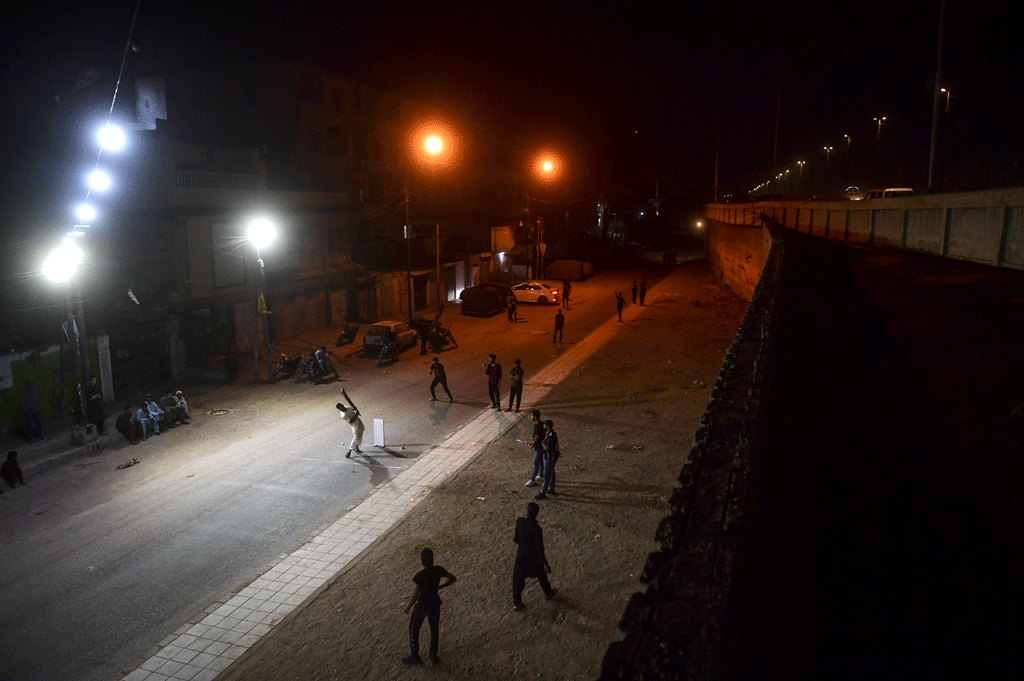

You are driving along merrily on a busy road when suddenly something pops up on your dashboard and you are jolted to the reality of a main road cricket match in which some ambitious batter has forgotten that they are close to the main road and insists on being the Shahid Afridi of the day.
This by far is not an isolated incident but happens all over the city where young men unmindful of the dangers involved turn main roads into cricket stadiums and not only hit out brazenly in crowded traffic but in pursuit of shots and to earn fame as outstanding fielders run through fast traffic unmindful of the dangers involved. It is heart stopping to see these youngsters almost trying to halt the flow of traffic to retrieve what they are pursuing whether it is a cricket ball or as the season nowadays prompts a football. All this is not without serious dangers that threaten the life of young children in the city.
There is a long list of accidents claiming young lives while involved in various sports on the streets of Karachi. A recent study lists children playing on streets and service roads as one of the four major groups most affected by traffic-related injuries.
The reason given is that there are no safe playing grounds. This is another reason for dumpers and other heavy vehicles being frequently involved with traffic accidents involving children. In 2024, there were 715 people, who were victims of traffic accidents, including 73 children.
One reason being that in densely populated neighbourhoods’ roads double as play areas due to the absence of safe spaces for children to play. You cannot, on the other hand, also keep children indoors all the time. Some major accidents happened as a result of this trend.
Here are some examples such as an accident involving 7-year-old Abdullah and 6-year-old Ali who were playing cricket in a service lane outside their apartment. Abdullah ran out to the road to retrieve the ball and was hit by a car being driven by a learner.
Abdullah died on the spot. Another story from Orangi Town details another accident in which four children had left their Madressa and were playing cricket when a speeding water tanker ran over them, killing two on the spot with skull fractures.
There are also examples from other parts of Karachi, mostly from the underprivileged areas, where children have no choice but to play on the roads amongst fast-moving traffic and no safety.
The underprivileged lot does not have access to parks like the Bin Qasim Park, Aunty Park and several others that are largely found in affluent parts of Karachi, though there are attempts to provide some parks and playgrounds in the previously neglected parts of Karachi.
According to estimates, 5 million children in Karachi do not have a proper playground or park within easy accessibility. With this paucity of play grounds the situation is compounded with the conversion of existing playgrounds and parks into commercial and residential projects.
As it stands today, according to some rough estimates, there are 40 to 50 major parks and playgrounds while as announced by the authorities 30 more major parks are being built; these to cater, according to estimates, to 8.5 million children and teens.
So how is the world providing playgrounds to their children in the more developed countries? The best in England is Norwich with 236 children per playground, and the worst is Liverpool with 1104 children per playground. A lot of planning goes into making these playgrounds.
Most of these playgrounds have 4 to 7 square meters of playground space per child to prevent over-crowding. What about Karachi? How do we stand in terms of space? It is rather a sad reflection on our services for children.
Play areas in Karachi presently cater to 40,000 children per play ground. Not a very healthy figure, but it seems steps are being taken to improve the situation and though we might not be able to compete with Europe we will at least improve the present availability of parks for children and save them from playing with fire on the streets of Karachi.
Copyright Business Recorder, 2026
The writer is a well-known columnist
























Comments