


China launches three-crew space flight as part of Moon ambitions
China launched its Shenzhou-23 mission, aiming for a year-long astronaut stay in orbit, a crucial step towards its 2030 Moon landing goal and building long-term space operational experience.
- First Hong Kong astronaut on the Shenzhou-23 mission.
- Scientific experiments and challenges of year-long space stays.
- China's ambitious goal of landing astronauts on the Moon by 2030.
- Development of new spacecraft for future lunar missions.
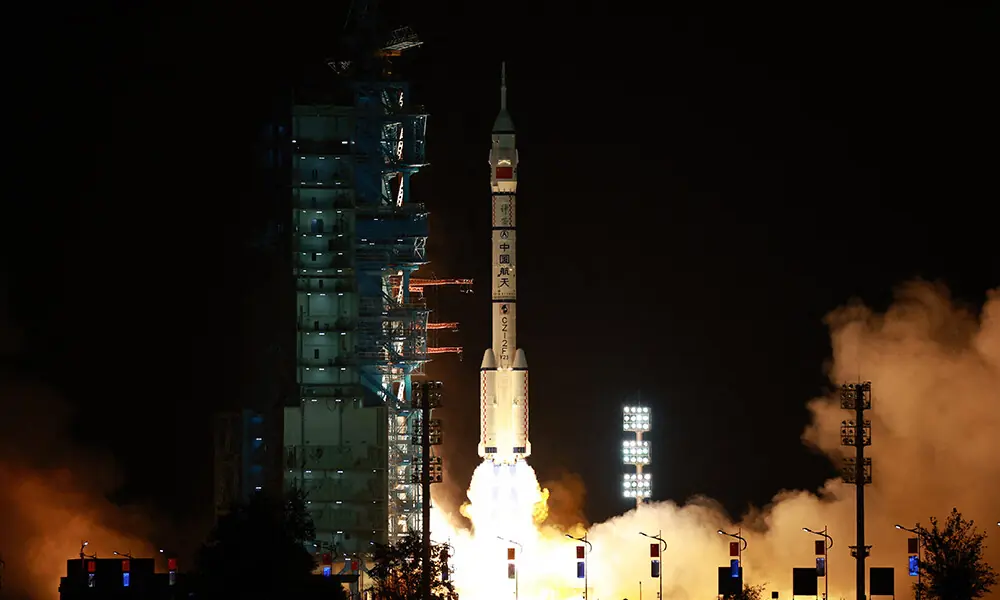

BEIJING: China launched its Shenzhou-23 mission on Sunday, which will see a Chinese astronaut spend a full year in orbit for the first time, a crucial step in Beijing’s ambition to send humans to the Moon by 2030.
The Long March 2-F rocket blasted off in a cloud of flames and smoke on time at 11:08 pm (1508 GMT) from the Jiuquan launch centre in China’s northwestern Gobi Desert, video from state broadcaster CCTV showed.
The spacecraft separated from the rocket around 10 minutes later and entered orbit, the Chinese space agency (CMSA) said on social media.
“The astronauts are in good condition, and the launch has been a complete success,” it added.
The mission marks the first spaceflight ever undertaken by an astronaut from Hong Kong: 43-year-old Li Jiaying (Lai Ka-ying in Cantonese), who previously worked for the Hong Kong police.
Other crew members include 39-year-old space engineer Zhu Yangzhu and 39-year-old Zhang Zhiyuan, a former air force pilot, who is travelling into space for the first time.
Cheering crowds waved Chinese flags at a farewell ceremony ahead of the launch, while a band played and the three astronauts saluted on stage.
The crew is set to carry out numerous scientific projects in life sciences, materials science, fluid physics and medicine.
A key experiment of Shenzhou-23 will be the full-year stay in orbit by one of the crew in order to study the effects of a long stay in microgravity.
Year-long experiment
The experiment is part of China’s preparations for future lunar missions, as well as missions to Mars.
The astronaut selected for this one-year mission will be named at a later date, depending on the progress of the Shenzhou-23 mission, a spokesperson for the CMSA said on Saturday.
The main challenges will be long-term effects on humans, including bone density loss, muscle wasting, radiation exposure, sleep disturbances, behavioural and psychological fatigue, said Richard de Grijs, an astrophysicist and professor at Macquarie University in Australia.
He also underlined the importance of reliable water and air recycling systems, as well as the ability to manage potential medical emergencies far from Earth.
China is “steadily” building operational experience for “sustained occupation” of its Tiangong space station, and year-long missions are an important step towards future lunar and potentially deep-space ambitions, de Grijs told AFP.
“A year in orbit pushes both hardware and humans into a different operational regime compared with the shorter Shenzhou missions of the programme’s earlier phases,” he said.
Crews aboard Tiangong have until now largely remained in orbit for six months before being replaced.
The Shenzhou-23 mission is part of China’s goal to land astronauts on the Moon before 2030, a race in which the United States is also competing with its Artemis programme.
Pakistani crew members
China is testing the equipment required for its goal, with an orbital test flight of its new Mengzhou spacecraft set for 2026.
The Mengzhou craft will replace the ageing Shenzhou line, and will carry China’s astronauts to the Moon.
Beijing hopes to have built the first phase of a manned scientific base by 2035, known as the International Lunar Research Station (ILRS).
China also plans to welcome its first foreign astronaut, from Pakistan, aboard the Tiangong station by the end of this year.
The Asian giant has significantly expanded its space programmes over the last 30 years, injecting billions of dollars into the sector in order to catch up with the United States, Russia and Europe.
In 2019, China landed a spacecraft the Chang’e-4 probe on the far side of the Moon – a world first.
Then in 2021, it landed a small rover on Mars.
China has been formally excluded from the International Space Station (ISS) since 2011, when the United States banned NASA from collaborating with Beijing, prompting the Asian giant to develop its own space station project.


















Comments