


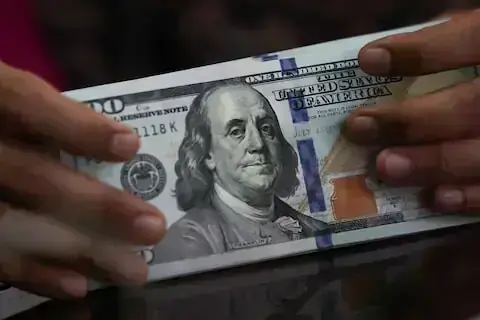
NEW YORK: The dollar edged up from three-week lows against the euro and the Swiss franc on Wednesday as investors digested US President Donald Trump’s speech at Davos, after his tariff threats triggered a broad selloff in US assets.
The dollar ticked slightly higher against major pairs following Trump’s speech, where he ruled out military action in Greenland, but said he was seeking immediate negotiations to discuss a deal to acquire the northern island.
The euro was down 0.17 percent at USD1.17, having risen more than 1 percent in the last two sessions. It hit USD1.1770 on Tuesday, its highest level since December 30.
The safe-haven Swiss franc was down 0.47 percent to 0.7934 per dollar, after gaining about 1.5 percent between Monday and Tuesday.
“We’re clearly not at the end of this saga, but any use of force would cause an irreparable schism between the US and Europe,” said Adam Button, chief currency analyst at investingLive.
“It doesn’t sound like is in Davos to make any real ultimatums.” French President Emmanuel Macron has pushed for the EU to consider the first use of its Anti-Coercion Instrument, informally known as the “trade bazooka”, which could limit US access to public tenders or restrict trade in services such as tech platforms.
Macron said on Tuesday it was “crazy” it had gone that far.
An announcement by Danish pension fund AkademikerPension on Tuesday that it would sell its roughly USD100 million holding of US Treasuries by the end of the month added to speculation about further foreign investor selling.
NATO Secretary General Mark Rutte said on Wednesday he was working “behind the scenes” to address tensions between the US and its European allies.
The Swedish krona hit a fresh 4-year high versus the dollar at 10.099 as investors favored countries with low debt levels.
The dollar was steady against the Japanese currency, which faced its own selloff after Prime Minister Sanae Takaichi on Monday called snap elections for February 8 and pledged measures to loosen fiscal policy.
The yen was slightly lower against the dollar at 158.255.
Investors closely watched Japanese government bonds (JGBs) which were hit hard early this week, but rebounded on Wednesday.
“The absence of strategic buyers in this segment has made price action more sensitive and amplified volatility.
I expect this environment of elevated volatility to persist through 2026,” said Vincent Chung, co-portfolio manager at T. Rowe Price.
“A further sell-off in JGBs would seem to drag the dollar/yen towards intervention territory at 159/160,” said Chris Turner, global head of markets at ING.
“However, if the yen sell-off is a self-inflicted wound from the Japanese government policy, the effectiveness of intervention will become increasingly questionable.”






















Comments
Comments are closed for this article.