


Dollar falls, investors look for safe havens as Trump ups tariff ante
- Dollar index eased slightly to 99.18
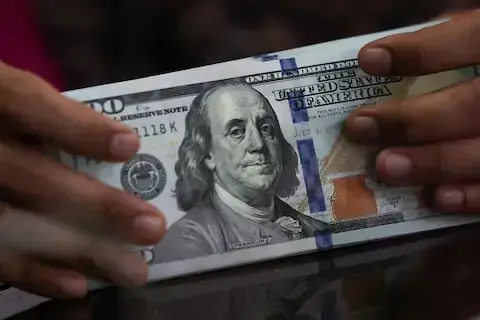
SINGAPORE: The dollar fell on Monday as investors unnerved by U.S. President Donald Trump’s latest tariff threats against Europe over Greenland piled into the safe-haven yen and Swiss franc, in a broad risk-averse move across markets.
Trump said over the weekend he would impose an additional 10% import tariff from February 1 on goods from Denmark, Norway, Sweden, France, Germany, the Netherlands, Finland and Britain, until the United States is allowed to buy Greenland.
Major European Union states decried the tariff threats over Greenland as blackmail on Sunday, with France proposing to respond with a range of previously untested economic countermeasures.
In the foreign exchange market, the initial knee-jerk reaction in early Asia trade was to sell the euro and sterling, in a move that pushed them to a seven-week low and one-month trough of $1.1572 and $1.3321, respectively.
Canadian dollar hits six-week low
However, the two currencies bounced from their lows and it was the dollar that came under pressure as the trading day got underway, as investors assessed the longer-term implications of Trump’s latest move on the greenback’s standing.
That helped the euro reverse its losses as it gained 0.21% to trade at $1.1623, while the British pound similarly recovered 0.11% to $1.3390.
“Typically you would think tariffs being threatened would lead to a weaker euro, but as we’ve seen last year as well, when the Liberation Day tariffs were getting put in place, the impact in FX markets actually has been more towards dollar weakness every time there is heightened policy uncertainty emanating from the U.S.,” said Khoon Goh, head of Asia research at ANZ.
Investors had dumped the dollar in the wake of last April’s “Liberation Day” announcement when Trump unveiled sweeping tariffs on the world, triggering a crisis of confidence in U.S. assets.
A similar trend played out on Monday, as the greenback slid 0.36% against the safe-haven Swiss franc to 0.7993, and was down 0.24% to 157.74 yen.
The dollar index eased slightly to 99.18.
“While you would argue that the tariffs threaten Europe, in fact, it’s actually the dollar that is bearing the brunt of it, because I think markets are pricing in increased political risk premia on the U.S. dollar,” said Goh.
Cryptocurrencies, which are often used as a gauge of risk sentiment, were also sold off heavily.
Bitcoin was down more than 3% to $92,477.54, while ether sank roughly 4% to $3,203.13.
In Asia, data on Monday showed China’s economy grew 4.5% in the fourth quarter from a year earlier, a touch above analysts’ expectations and bang in line with the government’s annual growth target.
The onshore yuan was little changed at 6.9647 per dollar following the release, while its offshore counterpart was a touch stronger at 6.9608 per dollar.
The Australian dollar, which is often used as a liquid proxy for the yuan, similarly did not budge on the data. It was last down 0.09% at $0.6685, as it remained under pressure from the broad risk-off move.
The New Zealand dollar was up 0.25% at $0.5766.






















Comments
Comments are closed for this article.