


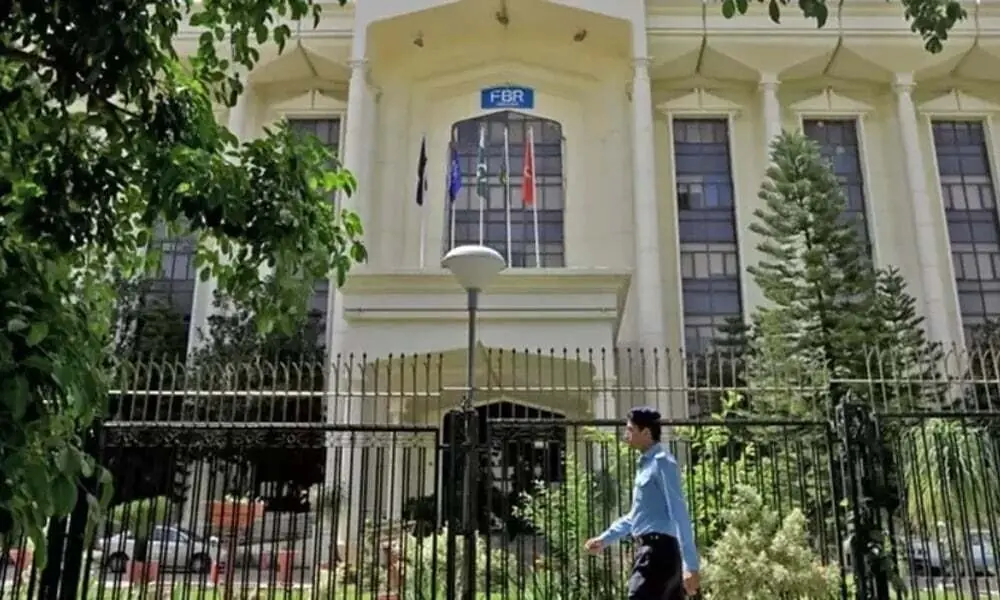

ISLAMABAD: Federal Board of Revenue’s strategy to strengthen revenue collection, counter illicit trade, and improve industrial transparency is increasingly centered on the deployment of Track & Trace System (TTS) on high-risk sectors backed by Unique Identification Marks (UIMs).
According to experts involved in regulatory reforms, the FBR is planning to expand the TTS to many high risk sectors.
The TTS has evolved into a nationwide electronic monitoring framework that enables near real-time oversight of production volumes through the affixation of secure, serialised, and tamper-resistant UIMs at the production stage. These identifiers allow enforcement authorities to track goods across the entire supply chain, from factory floor to retail outlet, significantly improving compliance, documentation, and auditability.
READ MORE: TTS: FBR now eyes tiles, spinning, GLT sectors
Industry experts emphasised that it is the security features of UIMs that have been central to the success of TTS implementation. By providing deterministic, unit-level data, UIMs enable authorities to independently verify declared production and sales, rather than relying solely on self-reported figures.
The presence or absence of a valid UIM serves as a clear compliance indicator, allowing enforcement agencies to quickly identify illicit, unstamped, or diverted products.
“When products are traceable, taxes are collectible, markets become fair, and revenue leakage is systematically eliminated,” experts highlighted.
Official outcomes cited in sector reviews indicated that Pakistan’s implementation of TTS has already delivered measurable results.
Targeted enforcement operations have led to the detection of undeclared production machinery, seizures of smuggled cigarettes, and recovery of unstamped sugar and fertiliser stocks, underscoring the shift from reactive raids to intelligence-led enforcement driven by UIM-based data.
Beyond enforcement and revenue protection, experts highlight the consumer-level benefits of UIM-enabled systems.
By allowing products to be verified through visible security features or digital authentication tools, TTS empowers consumers to differentiate between genuine and counterfeit or non-tax-paid products, thereby enhancing consumer confidence, protecting public health, and strengthening brand integrity.
In contrast, experts cautioned against over-reliance on video analytics as a standalone solution for production monitoring.
While cameras may provide operational visibility, policy analysts point out that video-based systems rely on visual inference rather than exact measurement, making them vulnerable to environmental factors such as dust, poor lighting, power disruptions, and camera obstruction. “Video analytics may show activity, but it cannot reliably quantify production, verify unique product identities, or ensure end-to-end traceability,” a regulatory source explained.
In sectors such as fuel, beverages, pharmaceuticals, and cement, video systems are unable to detect adulteration, scan serialised products on high-speed production lines, or establish legal product origin, capabilities that are critical for effective taxation and compliance.
Analysts further noted that large-scale video deployments are infrastructure-intensive, requiring continuous maintenance, high bandwidth, and specialised hardware, while also raising privacy and legal concerns if used beyond limited operational contexts.
Global experience suggests that the most effective approach is not an “either-or” choice. International implementations in the European Union, China, Brazil, Kenya, and Tanzania demonstrate that track-and-trace frameworks anchored in unique identifiers deliver the strongest outcomes in revenue protection, curbing illicit trade, counterfeiting, and market regulation, with video analytics serving only as a supporting tool.
The experts argued that the policy direction for Pakistan is clear, UIM-driven Track & Trace System should remain the backbone of production monitoring, while video analytics may be used only as a complementary mechanism or subsidiary to TTS.
Copyright Business Recorder, 2026




















Comments
Comments are closed for this article.