


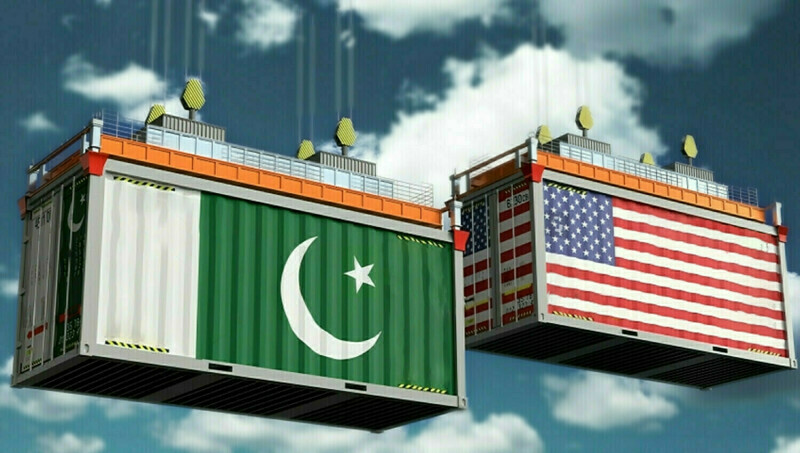

The United States collected approximately $611 million in annual tariffs on goods exported by Pakistan, while Pakistan collected about $157 million in duties on US products in 2024, an analysis of trade and tariff data reveals, says Economic Policy Business Development (EPBD) Think Tank.
EPBD further stated that Pakistan’s exports to the US were valued at $5.71 billion in 2024, with the US applying a weighted average tariff of 10.7% on these goods. Only 14.8% of Pakistani exports to the United States enter duty-free, while approximately 52.9% face some form of tariff.
In contrast, Pakistan imposes a simple average MFN duty of 10.3% on imports (13.0% for agricultural products and 9.9% for non-agricultural goods), with a trade-weighted average of 7.6%. Textiles dominate Pakistan’s exports to the US, accounting for 77% of total export volume, making this sector particularly vulnerable to any changes in US tariff policies.
The data indicates a significant tariff burden on Pakistani exports to the US market compared to other major trading partners like the European Union, where Pakistan benefits from preferential trade arrangements.
The impending increase in US tariffs to 29% under the reciprocal tariff policy presents both challenges and opportunities for Pakistan.
A research of the Think Tank further noted that while the overall tariff burden will increase significantly, Pakistan’s position relative to competitors like China (facing 245% tariffs), Vietnam (facing 46% tariffs) and Bangladesh (facing 37% tariffs) may create strategic advantages in certain sectors.
Pakistan’s upcoming challenges include addressing the US’s recent announcement of a reciprocal tariff policy that could raise duties on Pakistani goods to 29% in 2025, potentially affecting its trade surplus which stood at $3.65 billion in 2024, the Think Tank added. The impending increase in US tariffs to 29% under the reciprocal tariff policy presents both challenges and opportunities for Pakistan.
Trump tariffs: Pakistan to send high-level delegation to US
While the overall tariff burden will increase significantly, Pakistan’s position relative to competitors like China (facing 245% tariffs), Vietnam (facing 46% tariffs) and Bangladesh (facing 37% tariffs) may create strategic advantages in certain sectors.
Pakistan could leverage its competitive advantage in wearing apparel, woven fabrics, and food products where tariff increases are lower compared to regional competitors. In sectors like sports goods, Pakistan is projected to see improved market access relative to competitors, with 17 percentage points advantage over Vietnam, 8 percentage points over Bangladesh, and 216 percentage points over China.
However, India’s slightly better positioning with a 26% reciprocal tariff rate poses a competitive threat, particularly in textile, where Pakistan faces a 17.73 percentage point increase compared to India’s 7.962.
To navigate this shifting trade landscape, Pakistan should consider diversifying its export markets beyond the US, enhancing competitiveness in sectors with favorable tariff differentials, and engaging in diplomatic efforts to negotiate better terms. The heavy concentration of exports in textiles (77%) makes diversification particularly urgent as a risk mitigation strategy, it added.




















Comments
Comments are closed for this article.