


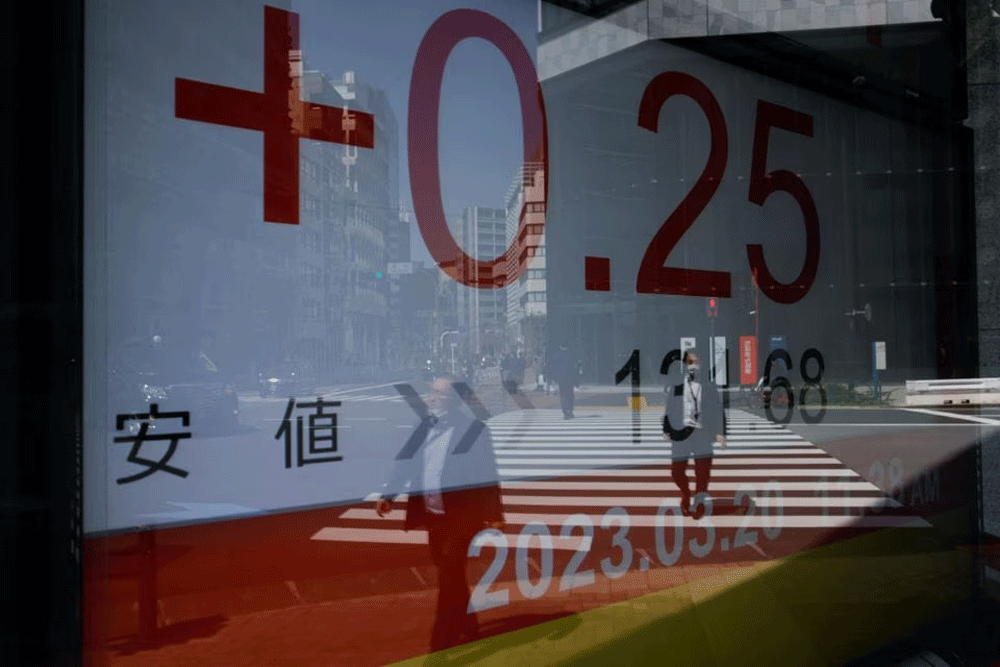

SINGAPORE: China led Asia’s stock markets higher on Wednesday as investors cheered the approval of a trillion-yuan sovereign bond issue as a harbinger of stimulus, while the Aussie dollar hit a two-week high as hotter-than-expected inflation lifted rate forecasts.
MSCI’s broadest index of Asia-Pacific shares outside Japan rose 0.9% and the Hang Seng 2%. Japan’s Nikkei rose 1.1%.
Bonds have held onto a bounce-back after the 10-year Treasury yield breached 5% on Monday, with the benchmark yield firm at 4.82% in Tokyo trade.
Overnight solid earnings and US economic data lifted Wall Street indexes, while oil and the euro had dropped on weaker-than-forecast purchasing managers surveys on the continent.
US and European stock futures were steady in early Asia trade. China’s top parliament approved a 1 trillion yuan ($137 billion) bond issue, state media reported adding the funds would be spent rebuilding disaster zones and improving infrastructure.
Also helping the mood was state-owned investment company Central Huijin announcing it was buying exchange-traded funds, a move which has sparked strong rallies in the past.
“Government expenditure will help the economy to stabilise further and strengthen growth in the fourth quarter,” said Steven Leung, executive director of institutional sales at broker UOB Kay Hian in Hong Kong.
Central Huijin promising ETF purchases drove rallies of more than 20% in 2013 and 2015, according to UOB, and Leung said the signal had given a strong boost to sentiment.
Asia shares slip on Middle East woes, higher yields
China’s blue-chip CSI300 index, which had been pinned near four-year lows, bounced 1%.
Hike looms down under
In currency markets, the euro made its steepest drop for two weeks overnight, falling 0.7% after the euro zone composite PMI fell deeper into contractionary territory to its lowest in three years.
Investors pulled forward European rate cut expectations a little and the euro was nursing losses at $1.0594.
The yen was pinned at 149.85 and the Australian dollar was the standout gainer, rising 0.6% to a two-week high of $0.64. The annual pace of inflation in Australia slowed in the third quarter, but at 5.4% was above forecasts of 5.3%.
Pricing for the odds on a rate hike next month shot to 60% from 35% before the data.
“Given the hawkish rhetoric from the RBA over the past two weeks and an uncomfortably high Q3 CPI outcome, we now expect the RBA to increase the cash rate by 25bp in November to 4.35%,” ANZ analysts said in a note.
Oil fell in commodity trade on Tuesday, thanks to the weak economic data from Europe, and was nursing losses on Wednesday.
Brent crude futures were steady at $88.13 a barrel, unwinding gains made in the wake of conflict in the Middle East.
“I think commodity markets are recalibrating the geopolitical implications in the Middle East more decisive drivers are needed for a clear direction,” said Glenn Yin, head of research at AETOS Capital Group in Melbourne.
The United States and Russia were among several nations pushing for a pause in fighting between Israel and Hamas to allow aid into the besieged Gaza Strip.
After touching $1,997 an ounce last week, spot gold traded at $1,973.
Bitcoin, meanwhile, seems to have awoken from long hibernation during the so-called “winter” that followed numerous scandals including the collapse of exchange FTX.
It’s up 15% this week mostly thanks to speculation that exchange-traded fund applications from BlackRock and others will succeed and drive capital into the asset class.
Bitcoin last bought $34,340.
The US Securities and Exchange Commission has declined to comment on the speculation.


















Comments
Comments are closed for this article.