




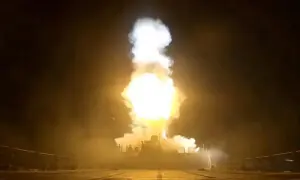
SEOUL/TOKYO: North Korea fired an intercontinental ballistic missile (ICBM) off its east coast on Wednesday, prompting condemnations from leaders of South Korea and Japan who met on the sidelines of a NATO summit.
The launch came after heated complaints from North Korea in recent days, accusing American spy planes of violating airspace in its economic zones, condemning a recent visit to South Korea by an American nuclear-powered cruise missile submarine, and promising to take steps in reaction.
The ICBM flew for 74 minutes to an altitude of 6,000 km (3,728 miles) and range of 1,000 km, Japan’s chief cabinet secretary Hirokazu Matsuno said, in what would be the longest ever flight time for a North Korean missile.
Japan’s Coast Guard had predicted the missile would fall about 550 km (340 miles) east of the Korean peninsula.
In April, North Korea test fired its first ever solid-fuel ICBM, one of around a dozen missile tests this year. Analysts believe the North’s ICBMs can fly far enough to strike targets anywhere in the United States, and the country likely has developed nuclear warheads that can fit on rockets.
“It could be a second test of the solid-fuel Hwasong-18 ICBM, building on the results of its first launch,” said Kim Dong-yup, a professor at the University of North Korean Studies in Seoul.
Yang Uk, a fellow at the Asan Institute for Policy Studies, said the latest test could be part of the North’s efforts to save face and retake the initiative after a failed launch of its first-ever spy satellite in May.
Pyongyang’s accusations of U.S. airspace breaches this week, which Washington and Seoul dismissed as groundless, were likely to build justification for the launch, Yang said.
Diplomacy at NATO
South Korean President Yoon Suk Yeol, in Lithuania for the NATO summit, convened an emergency national security council meeting to discuss the launch and vowed to use the summit to call for strong international solidarity to confront such threats.
Yoon and Japanese Prime Minister Fumio Kishida held separate talks and strongly condemned the launch as a grave violation of multiple U.N. resolutions and a serious provocation that escalates tension.
Kishida, describing the missile as an ICBM, said it threatened peace and stability in the region and beyond, and required closer cooperation between the two neighbours and with the United States.
Yoon, at an earlier meeting with Japan, Australia and New Zealand, said: “We cannot condone these provocations, and we must respond to North Korea’s reckless actions through strong responses and solidarity of the international community.”
Leif-Eric Easley, an international studies professor at Ewha Womans University in Seoul, said North Korea was following a pattern of staging weapons tests in time for diplomatic events such as the Yoon-Kishida summit.
With a wary eye on North Korea’s military moves and other rising challenges in the region, Yoon has moved to repair frayed ties with Japan and reduce historical disputes that have limited cooperation between the two U.S. allies.
Nuclear envoys of South Korea, the U.S. and Japan held a phone call on Wednesday to strongly condemn the North’s missile launch as a serious provocation that can “never be justified,” Seoul’s foreign ministry said. They also criticised Pyongyang’s recent threats against what they described as the allies’ normal flight activity in international waters.
The three countries’ top military generals gathered for a rare trilateral meeting in Hawaii just before the missile launch.



















Comments
Comments are closed for this article.