


EU buys up to 300 million more Moderna jabs
- The bloc's 27 members face a vaccine supply crunch in the near term because of a drastic shortfall in doses from AstraZeneca.
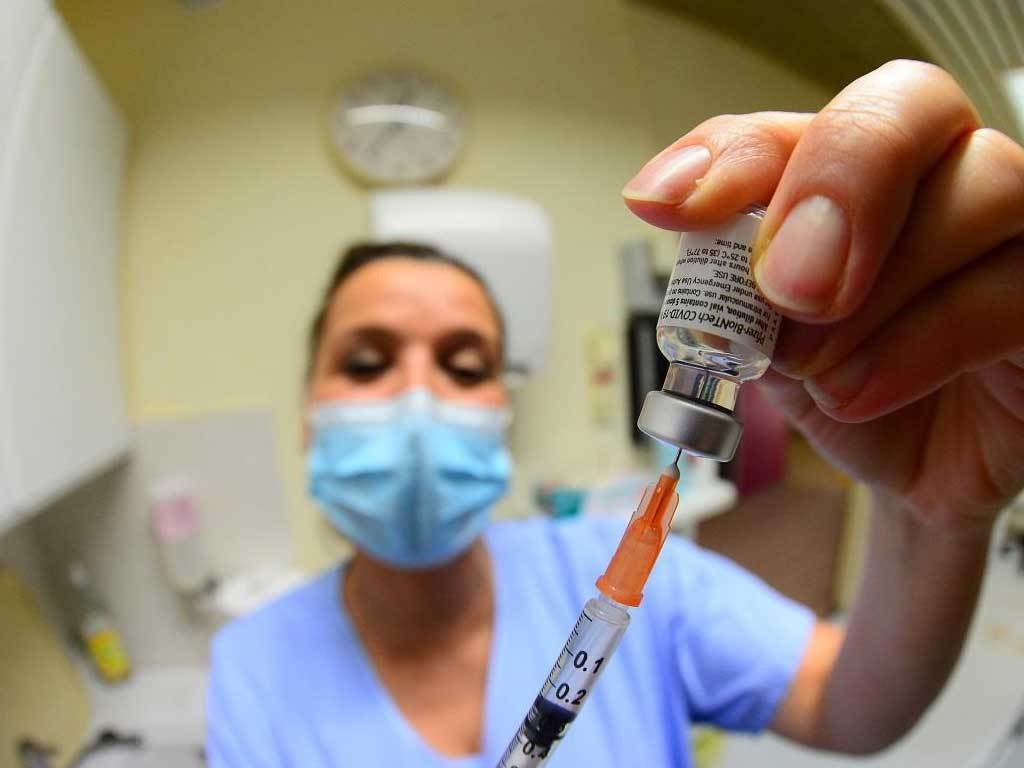
BRUSSELS: The European Union has bought up to 300 million extra Covid-19 vaccine doses from US firm Moderna, European Commission chief Ursula von der Leyen said on Wednesday.
The new deal, which she hailed as "good news", adds to the EU's vaccine stock as it strives to meet a target of fully vaccinating 70 percent of adults by mid-September.
The commission now has access to a "portfolio" of 2.6 billion doses of three EU-authorised vaccines and three more prospective ones, to be provided this year and next, von der Leyen told a media conference.
Numerically, that is more than enough for the EU's 450 million inhabitants, with the excess going to neighbouring countries, she said.
But another reason for such a big stock was to hedge against "the possibility for the virus to mutate", as is already being seen with variants, some of which appear to be at least partially resistant to some of the current vaccines.
"We will always have to be vigilant to be able, if there are escaped mutations, to fight them with improved vaccines," she said.
The terms of the new deal with Moderna, covering a firm order for 150 million doses late this year and an option for 150 million more next year, were kept secret under confidentiality clauses the commission has agreed with vaccine makers.
The bloc's 27 members face a vaccine supply crunch in the near term because of a drastic shortfall in doses from AstraZeneca.
The Anglo-Swedish company is providing only 25 to 40 percent of the more than 100 million doses it had originally promised for the first quarter of this year, which were meant to jumpstart the EU's vaccination programmes.
EU industry commissioner Thierry Breton, who is heading a commission task force to overcome supply bottlenecks, said of AstraZeneca: "I am confident they will be able to catch up."
He said the production yield in a Belgian factory used by AstraZeneca was "drastically increasing" with a 50-percent rise, and output in an Italian factory was also improving.
Von der Leyen has staked her reputation on the vaccine rollout across the European Union, after having her commission take over advance purchase agreements on behalf of the member states.
She has run into fierce criticism from some capitals over the stuttering start, largely due to the AstraZeneca supply problem, and has turned her attention to ensuring a stronger follow-up.
"We're still struggling to get started," she admitted, adding that a mechanism had been launched to allow member states to share doses between them once supplies permitted.
She also said a new commission project, called the HERA Incubator, has been created to boost research and detect virus variants.
So far, the European Union has authorised the AstraZeneca, BioNTech/Pfizer and Moderna vaccines for use, and is considering ones from Johnson & Johnson, CureVac and Novavax.
Its vaccination programme has lagged behind those of the US, Israel and Britain, but the bloc is looking to quickly scale up.
Von der Leyen said 33 million doses of the three authorised vaccines have so far been delivered to EU countries and 22 million people have received at least one dose, with seven million having received the two doses for full vaccination.














Comments
Comments are closed for this article.