


South Korea stocks hit 9-month low as US midterm results spark AI selloff
- The benchmark KOSPI index fell more than 8% in early trade to hit the lowest since February 6 at 4,911.28
South Korean shares plummeted to nine-month lows after US midterm election results sparked an AI stock selloff, leading to market volatility and policy interventions.
- Impact of US midterm elections on AI stock performance.
- South Korean KOSPI's sharp decline and circuit breaker activation.
- Government measures to stabilize market volatility.
- Investor sentiment on potential overreaction and future AI investment.

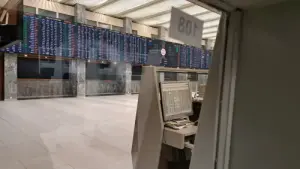
SEOUL: South Korean shares plunged to nine-month lows on Friday as Democrats’ win in the US midterm elections sparked a selloff in AI stocks, prompting policy measures to ease market volatility while investors cautiously assessed if market worries were excessive.
The benchmark KOSPI index fell more than 8% in early trade to hit the lowest since February 6 at 4,911.28 and triggered a 20-minute circuit breaker at 9:03 a.m. (0003 GMT), temporarily halting all stock and derivatives trading, before cutting losses to trade down 3.9% at 5,174.84 as of 0230 GMT.
“It is time for correction, but we feel that there may be some overreaction to the outcome of the midterm election,” said Jun Kwang-woo, chairman of the Institute for Global Economics, a financial think tank in Seoul.
“Hopefully we will stabilise very soon because after all, we understand that the speed of building AI infrastructure, especially data centres may slow down a bit because of the number of concerns in many states including Texas,” said Jun, who is a former chairman of South Korea’s National Pension Service.
US stock markets suffered their worst single-day session in more than a year on Thursday, led by a sharp unwind in high-flying technology and semiconductor shares.
Fresh uncertainty over policies on AI and data centres following the sweeping gains for the Democratic Party in the US midterm elections hit hardware and chip suppliers.
“Going forward, the focus of the market will be on whether aggressive foreign selling will calm down, how much of actual AI investment will be delayed and whether excessively-reflected worries will be resolved,” said Seo Sang-young, an analyst at Mirae Asset Securities.
A Seoul-based asset manager said the selloff was somewhat overdone due to a skewed reading of the midterm election results and unwinding by Wall Street hedge funds.
“Even people who were being cautious about the market didn’t expect a drop this big,” the manager said, speaking on condition of anonymity. Index cuts losses
South Korean retail investors, who were a driving force behind the KOSPI’s world-beating rally earlier this year, said they would take a wait-and-see stance as the market seemed to be overreacting to the US midterm election results.
“Isn’t the market overreacting? It’s not like Democrats will scrap all the data center constructions,” said Ahn Haesung, a 26-year-old retail investor. “I should have booked some profit from my ‘all-in tech’ investment.”
“I will keep going with index-tracking investment, but when it comes to Samsung, I think it is time to seriously consider (selling),” Ahn said, referring to his earnings of more than 100% from five-year-long investment in Samsung Electronics.
South Korean Finance Minister Lee Hyoung-il held an emergency meeting with the country’s top economic policymakers and decided to temporarily ease rules on retail investors’ leveraged investments to contain forced selling and limit market volatility.
The benchmark index cut losses as retail investors and institutional investors bought local shares worth 130 billion won and 780 billion won, respectively, countering foreign selloff of 1.1 trillion won ($812.79 million).
Shares of chipmaker Samsung Electronics traded down 3.23% and peer SK Hynix was down 5.30%, after dropping more than 10% and 13% each.
Friday’s drop brought the KOSPI down 43% from its June peak.
The index is still up 23% for the year.
“The future direction of AI investment has not changed yet.
Even if Democrats put the brakes on it, human greed will still win,“ said another South Korean retail investor in his 60s, who plans to watch market changes as he maintains his current investment portfolios.



















Comments