



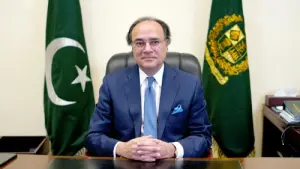
ISLAMABAD: Pakistan needs financial innovation that lowers the cost of doing business and brings more people into the formal economy as the country moves from economic stabilisation towards sustainable growth, Finance Minister Muhammad Aurangzeb said.
Virtually addressing the “Dialogue on Digital Assets and the Future of Banking,” organised by the Pakistan Banks’ Association (PBA) in collaboration with LUMS on Monday, Aurangzeb stressed that the integration of digital assets into the financial system should be guided by practical economic benefits and their ability to facilitate business operations.
Aurangzeb said Pakistan’s economic progress requires continued fiscal discipline, higher exports and greater private-sector investment.
READ ALSO: Pakistan explores tokenisation of existing Eurobond debt, says Aurangzeb
He highlighted the use of deposit tokens for institutional clients on blockchain networks as a practical example of digital financial innovation, explaining that such developments could help improve financial operations.
Senator Aurangzeb said the government is holding discussions on the proposed initiative and is seeking Cabinet approval before proceeding with the issuance of a request for proposals (RFP).
“We are reviewing at this point from the Ministry of Finance and Government of Pakistan, is tokenization of our existing Eurobond debt. We are in discussions at this point, and we are looking forward to the Cabinet approval on this, before we move ahead with issuing the RFP on this front,” he added.
The finance minister also referred to the Bank for International Settlements’ (BIS) Project Agora, which is examining tokenised bank deposits and exploring the potential for cross-border payments using central bank reserves.
The finance minister emphasised that banks remain central to protecting customers’ funds and reducing risks associated with digital technologies.
He said banks also have a fundamental role in delivering financial services to consumers, making their involvement important as digital assets become part of the financial system.
Aurangzeb noted that risks linked to stablecoins depend on their issuers and the mechanisms through which they are backed and redeemed. He added that the risks associated with unbacked crypto assets vary.
Aurangzeb said Pakistan has made progress towards developing a legal and supervisory regime for virtual assets, with the Virtual Assets Act 2026 providing the country’s legal framework.
Under the law, the relevant authority is responsible for licensing and supervising virtual asset service providers.
He stressed that regulations must distinguish between different categories of digital assets and the economic activities associated with them, rather than applying a single approach to the entire sector.
The finance minister identified the State Bank of Pakistan (SBP) and the Securities and Exchange Commission of Pakistan (SECP) as key institutions in shaping the regulatory framework for digital assets.
He said effective oversight is essential to ensure that innovation supports economic activity while addressing the different risks posed by stablecoins, other virtual assets and unbacked cryptocurrencies.
The finance minister urged banks to play an active role in developing practical proposals around digital financial technologies. “You bring the customer relationships, operational experience and risk management capabilities that this work requires. Invest in the expertise to assess these technologies and work with relevant regulators on the activities permitted within your mandates and, of course, with the support of your respective boards,” he added.
He stressed digital financial innovation must be accompanied by appropriate safeguards, regulatory oversight and cybersecurity measures. “We all need to acknowledge that we are under attack 24/7 by state and non-state actors, and therefore there is no room for complacency,” he added.
Aurangzeb said Pakistan has established a statutory framework through the Virtual Assets Act 2026. He said the next step is to ensure its effective implementation through capable supervision and stronger coordination among institutions.
Aurangzeb’s remarks underscored the government’s focus on linking digital financial innovation with Pakistan’s broader economic objectives, including sustainable growth, financial inclusion and a more efficient business environment.-NNI
A press release adds: Bilal Bin Saqib, Minister of State and Chairman, PVARA, said Pakistan should help build the new financial infrastructure now taking shape. “When the world’s correspondent banking arrangements and major payment networks were taking shape, Pakistan was largely a user of systems designed elsewhere, rather than an architect of those systems. Today, the rules of finance are evolving again. The question before Pakistan is simple: do we want to keep renting our future, or do we want to help build and own it?” He called on banks to become launchpads for innovators, to invest in AI capabilities and to strengthen collaboration with universities such as LUMS. He also identified supervised, bank-led payment arrangements involving major Gulf remittance corridors as an opportunity worthy of examination, subject to regulatory coordination and appropriate safeguards.
SaleemUllah, Deputy Governor, SBP, stressed the need to prioritise practical use cases over technology itself, identifying blockchain-enabled remittances and Roshan Digital Accounts as areas worth exploring in Sandbox. He underscored the importance of assessing and mitigating risks, including monetary and financial stability, cybersecurity, AML/KYC compliance and consumer trust, encouraging banks to test relevant solutions through SBP’s regulatory sandbox.
ImtiazHaider, Commissioner, SECP, emphasised the need for a clear, value-driven approach to tokenisation. He urged industry stakeholders and regulators to assess who stands to benefit, identify regulatory gaps and evaluate Pakistan’s readiness to adopt emerging technologies. He stressed that the fundamental question is not how assets can be tokenised, but which assets should be tokenised to deliver meaningful economic value.
ZafarMasud, Chairman, PBA, said, “Pakistan’s banks are not asking to be protected from this change. We are asking for clear regulatory standards that we can build towards. As the ultimate delivery channel, banks must be formally engaged from the outset, particularly while the regulatory framework is being developed. The industry brings the infrastructure, compliance capabilities and public trust needed to translate innovation into practical financial solutions. This Dialogue marks an important step towards developing a coordinated industry position for engagement with SBP, SECP and PVARA.”
Dr Ali Cheema, Vice Chancellor, LUMS, highlighted the importance of connecting research, policy and industry practice to assess emerging opportunities, address implementation challenges and build the capabilities required for the future of digital finance.
The Dialogue also featured a focused industry workshop led by Umar Farooq of J.P. Morgan, bringing together banking technology leaders, regulators and academia to identify priority use cases, potential pilots and implementation considerations.
The discussions will help shape a coordinated banking industry perspective and a potential roadmap for continued engagement with policymakers and regulators, supporting Pakistan’s transition towards a responsible, innovative and future-ready financial ecosystem.
Copyright Business Recorder, 2026



















Comments