



Pakistan’s economic debate is marked by a troubling contradiction. Macroeconomic stabilisation is presented as evidence of recovery, yet households continue to struggle with food, electricity, transport, and housing costs. The World Bank’s latest poverty assessment documents a reversal in earlier progress. The question is whether stabilisation is improving ordinary Pakistanis’ lives.
An economy may improve its external balances and contain financial risks without generating sufficient employment, protecting real incomes or restoring purchasing power. For households, recovery means being able to buy food, pay rent, educate children and meet unexpected expenses without falling into debt.
The poverty puzzle
Pakistan’s national poverty rate fell from 64.3 percent in 2001–02 to 21.9 percent in 2018–19. However, the World Bank estimates that it rose to approximately 29 percent in 2024–25, leaving around 70 million people below the national poverty line. Real wages declined by an average of 3.4 percent annually between 2018–19 and 2024–25.
These figures raise questions about the sustainability of poverty reduction and economic growth. Families just above the poverty line can be pushed below it by illness, job loss, rising rents or other increases in essential expenses. The challenge is to build an economy in which households can sustain their livelihoods despite economic shocks.
Inflation falls, but the burden remains
Lower inflation does not mean prices return to previous levels; it means they rise more slowly. After successive years of price increases, households can continue to struggle even when inflation moderates.
Pakistan’s consumer price inflation reached 10.26 percent year-on-year in September 2026, while the IMF’s October projections put average inflation at 9.9 percent for FY2026–27.
The pressure is especially visible in household food budgets. The cost of essential foods, including wheat, flour, vegetables and meat, can force families to make difficult choices. When meat becomes less affordable, families may buy it less frequently. Rising food costs can also force households to reduce quantities, compromise dietary diversity or postpone other expenses.
Inadequate nutrition, compounded by extreme heat, cold and other harsh weather conditions, can increase health risks, particularly for children, older people and those already vulnerable. The consequences extend beyond household budgets to health, education, and human development.
Daily-wage earners, pensioners and workers in the informal economy are particularly exposed when incomes fail to keep pace with prices. The relevant measure is not simply how much people earn in rupees, but what those rupees can buy—and what families must sacrifice to make ends meet.
The rupee and the erosion of purchasing power
The rupee’s long-term depreciation against the US dollar has added to economic pressures. A weaker currency raises the domestic cost of imports, including fuel, machinery and industrial inputs. These costs can pass through production and distribution chains to consumers.
Taxes, supply conditions and distribution costs also influence prices. Nevertheless, dependence on imported energy, machinery, and intermediate goods leaves Pakistan vulnerable to currency depreciation.
Exchange-rate stability is valuable, but it cannot reverse the accumulated effects of earlier depreciation or guarantee stronger household purchasing power. Purchasing power parity compares what currencies can buy in different countries; it is distinct from the market exchange rate. For households, the immediate concern is whether incomes keep pace with essential costs.
Sustained improvements in productivity and export competitiveness can strengthen foreign-exchange earnings, while greater domestic productive capacity can reduce exposure to selected import-cost shocks. Households ultimately need real incomes that keep pace with living costs.
Fuel prices: a cost that travels
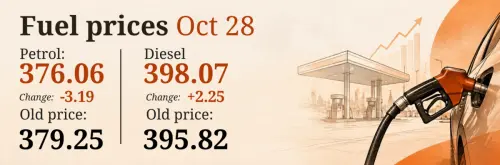
Fuel prices affect far more than motorists. Petrol raises commuting costs, while diesel is essential for freight, agricultural machinery and the movement of goods. Price increases can therefore spread throughout the economy.
Farmers face higher machinery and transport expenses. Traders pay more to move goods to markets, while workers spend a greater share of their earnings commuting. Businesses must absorb these costs, reduce margins or pass some on to consumers.
International oil prices, exchange rates, taxes and fiscal constraints shape domestic fuel prices. Pricing and energy taxation should therefore be assessed not only against revenue targets but also for their distributional effects. Without efficient energy use, reliable transport and a productive domestic economy, repeated cost increases can undermine the benefits of stabilisation.
Growth is not the whole story
The IMF projects Pakistan’s economic growth at 3.5 percent for FY2026–27. Growth is necessary, but the headline rate tells us little about the quality of jobs created, the distribution of benefits or changes in real incomes.
Agriculture illustrates this disconnect. Pakistan produces a wide range of food commodities, yet many households struggle to afford food while farmers face high input costs and uncertain returns. International prices, energy, storage, transport and intermediaries all influence the relationship between farm-gate and retail prices.
The real question is why consumers can face high prices even when farmers struggle to earn adequate returns. Storage losses, transport costs, seasonal supply and weaknesses in market access can widen the gap. Improving productivity, storage, market access and distribution is essential to addressing this disconnect.
Housing adds another burden. Rent competes directly with food, healthcare and education, while home ownership remains beyond the reach of many families. In September 2026, the Pakistan Bureau of Statistics reported a 12.39 percent annual increase in the broader category covering housing, water, electricity, gas and other fuels. This is not a rent or house-price index, but it reflects continuing pressure on essential household costs.
Economic growth must generate productive employment and rising real incomes. Without stronger agricultural and industrial productivity, investment and export capacity, expansion may not translate into meaningful relief.
Stabilisation must deliver relief
Macroeconomic discipline is necessary. Fiscal imbalances, external vulnerabilities and persistent inflation cannot be ignored. But stabilisation is a means to an end, not the final measure of economic success.
The next phase must connect economic discipline with productive investment, employment, stronger real incomes and sustained poverty reduction. Tax and energy adjustments should be assessed for their effects on different income groups, while agriculture, education, healthcare and essential public services need sustained attention.
Social protection can cushion immediate hardship, but it cannot substitute for secure livelihoods and productive jobs.
The real test of economic policy is whether families can afford nutritious food, maintain decent housing, educate their children and withstand financial shocks without slipping into poverty.
Pakistan’s challenge is to turn macroeconomic stability into a recovery that reaches households. Stabilisation without relief is an incomplete recovery. Closing that gap is not merely a social imperative; it is an economic necessity.
Copyright Business Recorder, 2026
The writer holds a PhD and is a former Add. Secretary-Executive Director General Board of Investment, Prime Minister’s Office, with extensive experience in investment policy, public governance, and corporate law. Email: [email protected])













Comments