


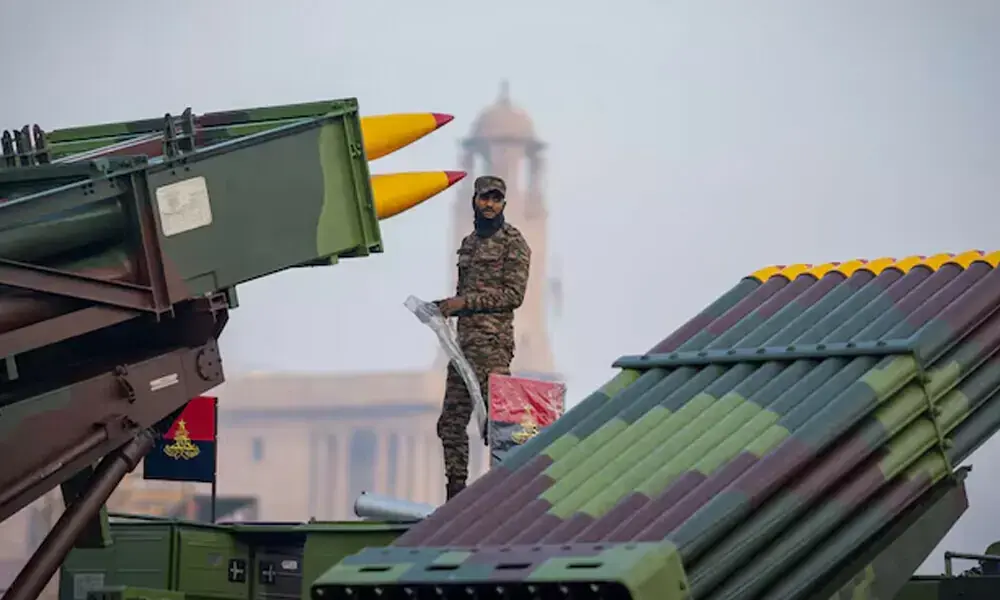
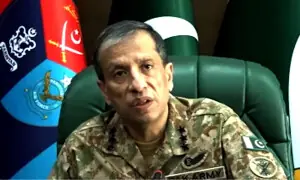
ISLAMABAD: Adviser to the National Command Authority (NCA), Lt Gen Khalid Kidwai (retd), on Tuesday asserted that Pakistan would not allow India to create a strategic imbalance in South Asia, warning that New Delhi was moving towards a more combat-ready nuclear force with a potential first-use capability to launch a strike with virtually no warning.
“Pakistan has never accepted, and will never accept, strategic imbalances being created in South Asia,” Kidwai said at the second edition of the Islamabad Non-Proliferation Conference, hosted by the Strategic Vision Institute, an Islamabad-based think tank specialising in strategic issues.
Gen. Kidwai said that India’s reported deployment of nuclear weapons aboard a submarine, combined with missile modernisation and recent military confrontations between the two countries, raised serious concerns about regional strategic stability.
READ ALSO: India’s defence exports hit ‘all-time high’ of USD4bn
Citing the Stockholm International Peace Research Institute (SIPRI) Yearbook 2026 and other publicly available information, Gen. Kidwai, along with former adviser to the NCA Lt. Gen. (Retd) Sarfraz Sattar, pointed to some reports that India had deployed about 12 nuclear warheads on a submarine for deterrence patrols. They also highlighted India’s moves toward missile canisterisation and broader nuclear and conventional modernisation, arguing that these developments cast doubt on the credibility of its declared “No First Use policy”.
Gen. Kidwai said the submarine deployment suggested India had mated some nuclear warheads with submarine launched ballistic missiles and conducted sea based deterrence patrols.
“I do not see any reason as to why a SIPRI report might be inaccurate or speculative,” he said.
“This irresponsible escalatory transition towards creating asymmetry in nuclear posture will have profound destabilising effects on South Asian strategic stability,” Gen. Kidwai added.
He argued that India’s ability to maintain a continuous at sea deterrent would further undermine the credibility of its declared No First Use policy and indicate a shift toward a more offensive nuclear posture.
“The operational reality that emerges is that India can undertake a first strike against Pakistan at zero notice,” Gen. Kidwai said. “Strategic balance and strategic stability in South Asia has apparently been dangerously disturbed by India once again.”
He also expressed concern over the absence of advance notification for Indian submarine launched ballistic missile tests.
Gen. Kidwai recalled the February 2019 confrontation, when Indian aircraft carried out airstrikes near Balakot in Pakistan, and said India was also reported to have deployed its Arihant nuclear submarine in the Indian Ocean, presumably with nuclear weapons aboard.
He described the latest reported submarine deployment as part of a broader pattern of operationalising nuclear capabilities rather than an isolated development.
While reiterating Pakistan’s commitment to peace, strategic stability and responsible nuclear stewardship, Gen. Kidwai said Islamabad could not ignore what he described as India’s escalatory steps.
“Pakistan reserves the right to undertake all appropriate measures to safeguard its national security and preserve strategic balance in the region under all circumstances,” he said.
“Pakistan will review and reconsider all options for appropriate deployments in order to restore the strategic balance and strategic stability while retaining the policy of strategic ambiguity,” Kidwai said.
He urged India to study Pakistan’s policy of Full Spectrum Deterrence and consider its implications for regional security.
“India in fact will be well advised to read and re-read Pakistan’s policy of Full Spectrum Deterrence and seriously absorb its wide ranging implications for strategic deterrence, strategic stability, and for India’s security,” he said.
Gen. Sarfraz Sattar said the May 2025 conflict between the nuclear armed neighbours demonstrated how quickly conventional hostilities could escalate when advanced weapons and strategic military assets were brought into play.
He said the ceasefire came only after the conflict had involved the limited use of cruise and ballistic missiles by both sides, alongside the deployment of strategic naval assets by India.
Drawing parallels with the 2019 confrontation, Gen. Sattar said Indian Prime Minister Narendra Modi had then referred to the deployment of Indian nuclear submarines for deterrence patrols and the positioning of Brah Mos missiles along Pakistan’s border.
The May 2025 fighting was more intense, involving kamikaze drones, supersonic Brah Mos missiles capable of carrying conventional or nuclear warheads, and cyber and electronic warfare capabilities, he said.
Gen. Sattar said India’s technological advances and doctrinal developments were adding to regional uncertainty. He cited the canisterisation of land and sea based missiles, development of multiple independently targetable re-entry vehicle (MIRV) capabilities, short range tactical missile systems, ballistic missile defences, hypersonic weapons and autonomous platforms.
Combined with what he described as India’s offensive Cold Start doctrine, broader military modernisation and the absence of a bilateral arms control mechanism, these developments, he noted, raised questions about the credibility of India’s No First Use declaration and its traditionally recessed deterrence posture.
The conference is taking place amid intensifying great power competition, the erosion of arms control arrangements and the emergence of technologies that could compress decision making timelines during military crises.
The two-day conference has brought together Pakistani and international nuclear experts to examine regional deterrence, lessons from the May 2025 conflict, the changing global nuclear order, the weakening of arms control frameworks and options for reducing nuclear risks.
Copyright Business Recorder, 2026
















Comments