


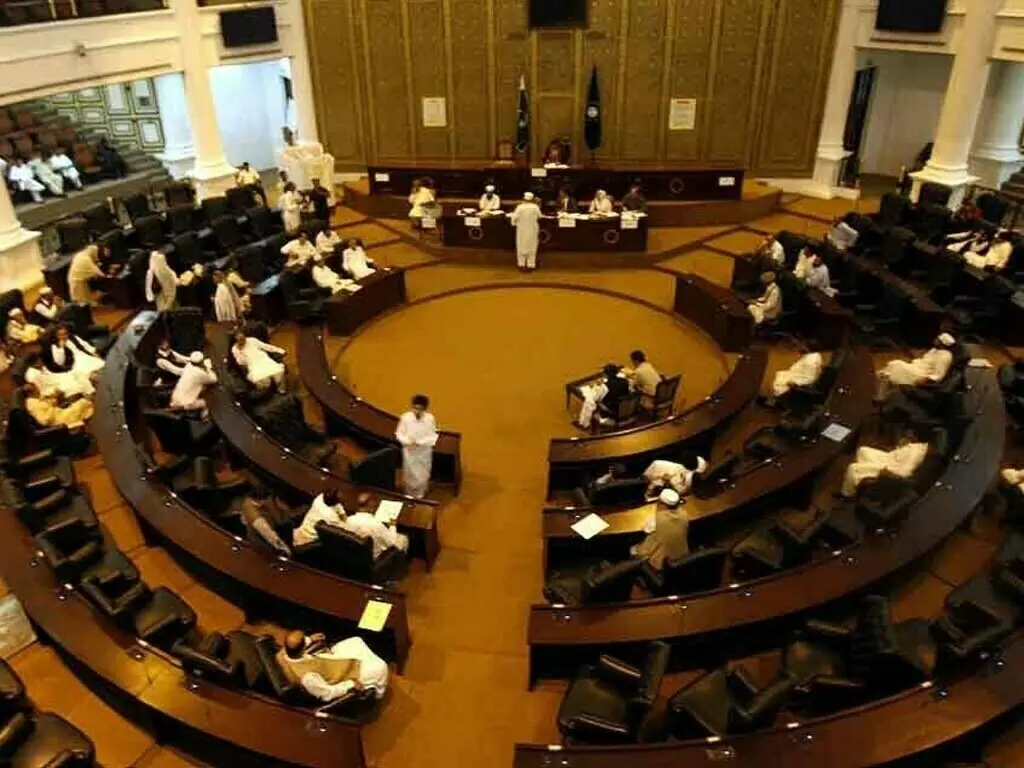
PESHAWAR: Provincial Cabinet has approved the Khyber Pakhtunkhwa Police Act 2026.
The proposed legislation would introduce a comprehensive institutional framework aimed at making the police more accountable to the public while strengthening investigation, improving career progression and establishing clearer distinctions between policy-making and operational functions.
Upon enactment by the Provincial Assembly, the new law would strengthen the investigation mechanism through the introduction of Regional Investigation Officers (RIOs) in the province, according to the provincial minister information Shafi Jan.
“The proposed Police Act is designed to strengthen the investigation system and enhance professional capacity within the police by introducing a dedicated regional investigation structure,” he added.
The minister said the legislation would also introduce greater institutional accountability in police postings and transfers, particularly with regard to the appointment and transfer of Regional Police Officers (RPOs) and District Police Officers (DPOs) under the Khyber Pakhtunkhwa Rules of Business, 1985.
Highlighting the provisions relating to career development, Shafi Jan said the proposed Act would address longstanding hurdles in the promotion of police officers by rationalizing the promotional, fast-track promotion and direct recruitment quotas.
“The legislation seeks to remove impediments to the long-awaited promotion of officers and provide a more structured mechanism for career progression by increasing promotion quota for the police force,” he said.
The minister further explained that the proposed law would introduce a clear separation between the policy and operational streams of policing through the establishment of two distinct institutional forums — the Police Policy Board, to be headed by the Chief Minister, and the Police Operations Board, to be headed by the Provincial Police Officer (PPO).
According to Shafi Jan, the proposed legislation would also introduce a performance-based accountability mechanism for the PPO.
The minister said that the Act would provide the provincial government with the authority to seek the repatriation of the PPO in case of unsatisfactory performance, thereby strengthening institutional oversight and ensuring greater responsibility at the highest level of police command.
He added that the PPO would also be required to prepare and present an annual policing plan before the Police Policy Board for consideration and approval.
“The annual policing plan will provide a structured framework for policing priorities, performance and institutional objectives, subject to approval by the Police Policy Board,” he said.
The minister said the Act would introduce a clear and comprehensive mechanism for the functioning of Dispute Resolution Councils (DRCs) across the province, addressing the existing gap in the legal framework.
To ensure greater transparency, accountability and uniformity, all existing DRCs would be dissolved and reconstituted afresh in accordance with the provisions of the new law.
According to him, the Cabinet also approved the Khyber Pakhtunkhwa Stamp (Amendment) Bill, 2026, the revised cost estimate for the intake structure and tunnel (up to daylight) under the Peshawar Water Supply Scheme, and the release of the balance allocation along with a supplementary grant for land acquisition in respect of the ADP scheme for the construction of sports complexes in District Chitral.
Cabinet members, the Chief Secretary, administrative secretaries, and the Inspector General of Khyber Pakhtunkhwa Police attended the Cabinet meeting, with Chief Minister Khyber Pakhtunkhwa Muhammad Sohail Afridi in the chair.
Copyright Business Recorder, 2026













Comments