


Include planning ministry in IMF negotiations
The Planning Minister seeks a role in IMF negotiations, highlighting a disconnect with the Finance Ministry over economic policy and development spending, amidst concerns about rising poverty and the impact of current strategies.
- Planning Ministry's push for inclusion in IMF policy talks.
- Finance Ministry's control over development spending and budget cuts.
- Economic policies contributing to Pakistan's high poverty levels.
- Call for a more people-centric approach to IMF program implementation.

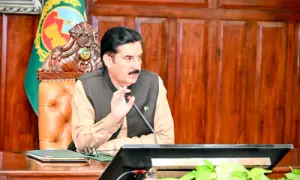
EDITORIAL: International Monetary Fund (IMF) programme is a whole of the government programme engaging federal and provincial institutions as well as the Planning Commission/Ministry of Planning, so maintained a press release issued a day after Ahsan Iqbal, Minister of Planning, Development and Special Initiatives, stated that he had written a letter to the Prime Minister requesting a seat at the table during negotiations with the IMF as the “broader discussions on the economy including growth, inflation, poverty and others are the domain of our ministry.”
During its quarterly programme reviews, the Fund routinely carries out technical and policy discussions. While technical discussions involve all sectors, provinces, and ministries, policy discussions only include representatives under the administrative control of the two signatories to the Letter of Intent: the Minister of Finance and the Governor of the State Bank of Pakistan.
Neither the press release nor Ahsan Iqbal’s statement clarifies whether the Planning Ministry is represented at the policy-level talks, where the time-bound conditions and structural adjustments debated during technical-level discussions are officially signed off by the two signatories.
In the event that Ahsan Iqbal was referring to a lack of representation during policy-level discussions, his letter may strongly reflect his increasing frustration with the limits imposed by the Ministry of Finance on the Public Sector Development Programme outlay prior to a budget (due to a very narrow fiscal space). It also highlights a widening gap between authorization by the Planning Ministry and actual allocation or disbursement by the Finance Ministry during the year — data that is uploaded to the Ministry of Planning website and updated monthly.
Development expenditure continues to be slashed as and when the budget deficit becomes a source of concern. Or, in other words, the Ministry of Planning is not empowered to challenge the Ministry of Finance’s reduced disbursement for specific development projects — a reduction that has implications on growth and employment.
In all fairness, the Minister for Finance, Muhammad Aurangzeb, has repeatedly stated that, given stabilisation has finally been achieved, the government is now focused on growth.
The budget for the current year has focused on pro-industrial policies — specifically export-oriented sectors — within the constraints imposed by the IMF.
However, there has been a rise in current expenditure on all items, be it procurement, salaries, or pensions — outlays that ought to have been frozen to ensure greater leverage with the Fund and for more inclusive growth.
The taxation measures particularly those relating to enforcement, are so far limited to sales tax collection on three items; notably, sugar, cement and now fertilizers, a tax whose incidence on the poor is greater than on the rich.
Such policies have contributed to extremely worrisome poverty levels (44.7 percent as per the World Bank) that are attributable to the acceptance of severely contractionary monetary and fiscal policies as well as administrative measures that raise utility tariffs and curtail imports in support of the balance of payment position.
To date, the IMF has focused almost entirely on mitigating the impact of these policies on the vulnerable by raising the budgeted allocation for the Benazir Income Support Programme (BISP) and increasing the quarterly cash disbursements for a rising number of beneficiaries.
Disturbingly, the total BISP allocation is no more than 4 to 5 percent of the total current expenditure, and the cash pay-outs cover no more than two weeks’ worth of groceries for a family of six within a three-month period.
Pakistan has been on an IMF programme since 2019. The focus of the finance ministry led by the four subsequent administrations (including the caretaker governments) has been a near-mute acceptance of Fund policies; no in-house, out-of-the-box policies were reportedly shared or debated with the Fund staff.
One would hope that the Ministry of Planning will be allowed to share its expertise with the Fund and convince its staff to accept a more phased and people-friendly approach, given the ministry’s three stated objectives: (i) lead national development planning: design and implement planning approaches that guide economic and social development programmes, strengthen national competitiveness, and provide clear directions for the economy; (ii) build effective partnerships: strengthen collaboration with public agencies, the private sector, and development stakeholders to align efforts, achieve shared objectives, and improve institutional performance; and (III) strengthen public institutions: develop the planning and implementation capacity of public entities so they can formulate sound strategies, manage programmes, and deliver development priorities effectively.
We urge the government to take advantage of the expertise available within the Ministry of Planning instead of disregarding its solid, research-based recommendations.
Copyright Business Recorder, 2026











Comments