


Betting the house on ‘transitory’
Despite rebuilding reserves to $21 billion, the SBP's decision to hold interest rates is a gamble, relying on temporary inflation shocks and stable exchange rates amidst growing economic pressures.
- The SBP's gamble on temporary inflation.
- Risks of persistent real exchange rate appreciation.
- How large reserves might encourage policy complacency.
- Multiple assumptions needed for current policy success.

SBP has spent the better part of last three years painstakingly rebuilding the war chest. From less than $3 billion in liquid reserves at the depths of the 2023 crisis, the central bank now sits on roughly $21 billion, having reduced its forward book, extended external maturities, restored access to international capital and rebuilt enough liquidity to make another balance-of-payments accident look considerably less imminent.
And having finally arrived at the table with chips to spare, the Monetary Policy Committee now appears willing to find out how long its luck can hold. Monday’s decision to leave the policy rate unchanged at 11.5 percent is not reckless in itself.
However, the comfortable assumption underneath it is becoming increasingly difficult to defend: that the latest inflation shock remains temporary, that the exchange rate can continue to sit still, and that a larger reserve buffer is sufficient protection if either assumption proves wrong.
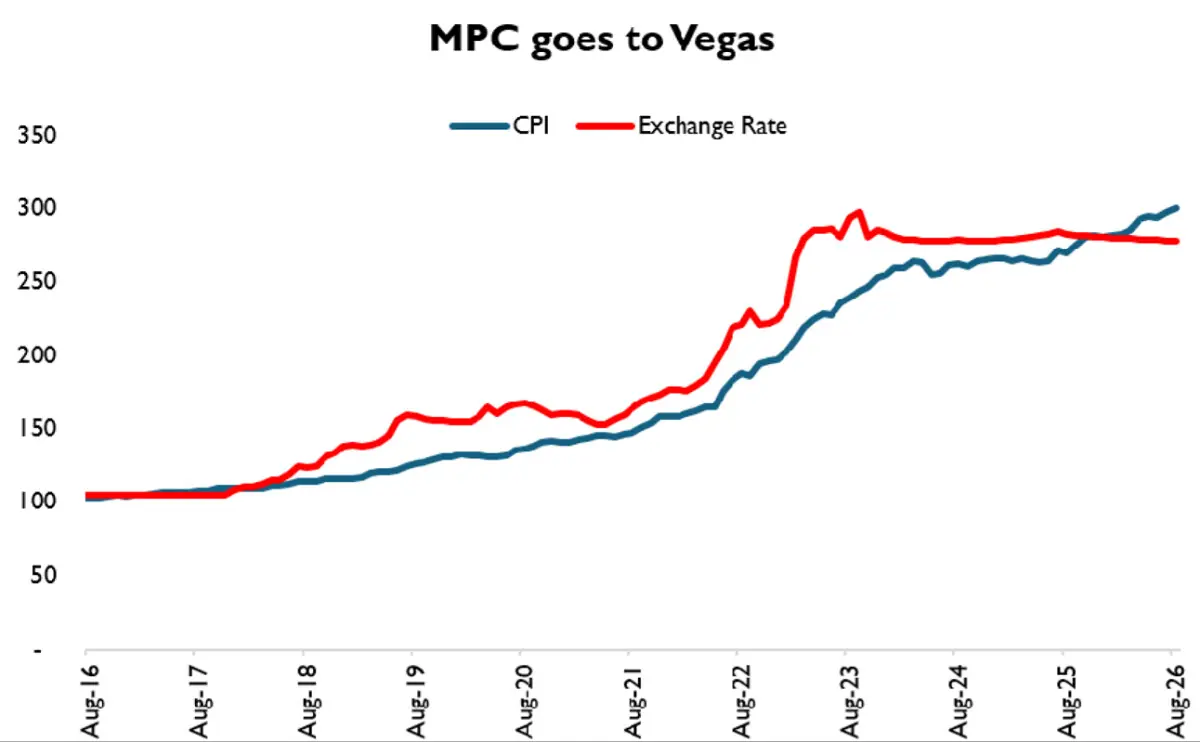
The vote itself hardly suggests an MPC staring at an uncomplicated outlook. The decision was hardly unanimous, with dissenting voices insisting on a quantum jump. The vocal minority hardly sounds paranoid given headline inflation climbing back into double digits, rising inflation expectations, and the central bank acknowledging that risks to the outlook have increased.
Waiting is not necessarily the wrong decision. Much of the latest acceleration in prices has indeed come through food and energy, while the economy hardly resembles the overheating episodes Pakistan has experienced in the past. Raising interest rates every time oil prices jump would be an expensive way of discovering that monetary policy cannot produce crude oil, fix shipping lanes or settle wars.The problem lies in how long the word “transitory” can reasonably survive.
A supply shock is defined by where it originates, not by how quickly it disappears. Oil, freight, insurance and food inflation can remain supply-side in origin for twelve months or longer, but once firms begin resetting contracts, governments revise administered prices, households adjust wage expectations and businesses change pricing behaviour, it becomes increasingly meaningless to dismiss the resulting inflation as temporary merely because excessive domestic demand did not cause the original disturbance.
That distinction is no longer academic. The Middle East conflict has already persisted long enough to influence energy markets, freight costs, insurance premia and expectations, and there is little reason to assume that it will conveniently resolve on a timeline consistent with the SBP’s inflation fan chart. If the war persists through the US midterm elections and potentially beyond, Pakistan is not dealing with a three-month spike followed by a clean reversal; it is dealing with a sustained deterioration in the cost environment.
The MPC is therefore making a wager. It is betting that the shock remains sufficiently short-lived to avoid feeding materially into second-round effects, that inflation expectations remain anchored, and that the broader economy does not accelerate fast enough to turn supply-side pressure into a more persistent nominal problem.
Demandis no longer dormant. Large-scale manufacturing grew 5 percent in FY26, the PMI remains above the expansion threshold, capacity utilisation sits close to its long-run average, private-sector credit is growing strongly, consumer financing has accelerated and the SBP expects economic growth to rise toward 3.5-4.5 percent in FY27. None of this constitutes overheating, but the economy is clearly moving away from the compressed-demand conditions that helped stabilise the external account in the first place.
That matters because the distinction between “supply-side inflation” and “demand-side inflation” can become too convenient when used as a policy excuse. Pakistan’s own recent experience should make policymakers especially cautious. Between August 2023 and August 2026, the domestic price level has increased at roughly 8 percent per annum, while the nominal exchange rate today remains broadly where it was three years ago.
That is the macroeconomic anomaly sitting quietly underneath the current stability. Pakistan has absorbed a substantial increase in domestic prices without anything resembling the nominal exchange-rate adjustment that would normally accompany a persistent inflation differential against trading partners.
The rupee does not have to depreciate mechanically in line with inflation, and purchasing-power parity is not a law of nature operating month to month. Remittances, capital flows, reserve accumulation, interest-rate differentials, import compression, administrative measures and expectations all matter, and those forces can keep the nominal exchange rate away from its long-run relative-price anchor for prolonged periods.
But they cannot make relative prices irrelevant. If domestic prices continue to compound materially faster than our trading partners while the nominal exchange rate remains broadly unchanged, the real exchange rate shall keep appreciating unless productivity, terms of trade or export performance improve sufficiently to justify it.
There is little evidence of a productivity miracle capable of explaining that adjustment. Manufacturing activity is recovering, not transforming; exports are recovering, not exploding; and economic growth is only now moving back toward rates that Pakistan has historically managed without anyone mistaking them for an East Asian productivity boom.
This is where the SBP’s enthusiasm over $21 billion in liquid reserves becomes more important than a celebration of successful reserve accumulation. The reserves are real, valuable and hard-won, and rebuilding them from the crisis levels of 2023 deserves credit. The danger begins when the stack of chips starts being mistaken for evidence that the odds themselves have changed.
The distinction is critical because reserve adequacy and exchange-rate equilibrium are not the same thing. A large reserve stock allows a central bank to absorb pressure, smooth adjustment and buy time, but the ability to postpone an adjustment does not prove that the underlying adjustment is unnecessary.
Pakistan has seen this picture before. External financing improves, reserves rise, the exchange rate stabilises, confidence returns and currency stability itself slowly begins to be treated as evidence that the macroeconomic regime has fundamentally changed.
The lesson has rarely been that the reserves were fictitious. The reserves were perfectly real; the problem was that they bought policymakers enough time to believe that an accumulating relative-price imbalance had somehow ceased to matter.
The irony is that a larger reserve buffer can make the eventual policy mistake easier to commit. With $3 billion in the bank, policymakers have little room for experimentation; with $21 billion, there is considerably greater temptation to sit through an unfavourable oil shock, tolerate a stronger real exchange rate and wait for the world to cooperate.
The stronger criticism is that the SBP appears too comfortable with how many things now have to go right simultaneously. The Middle East shock has to fade, food inflation has to normalise, second-round effects must remain contained, inflation expectations must stop rising, remittances must remain exceptionally strong, external financing must stay available, import demand must remain manageable as growth improves, and the rupee must somehow continue absorbing a widening inflation differential without requiring a meaningful nominal adjustment.
Any one of those assumptions is reasonable. Betting on all of them at once is where policy starts looking less like prudence and more like a visit to Nevada.





















Comments