


More profits out, less investment in
Pakistan's FY26 saw profit repatriation to foreign investors exceed new foreign direct investment, indicating a significant outflow of funds despite a growing base of profitable foreign companies.
- Pakistan's profit repatriation exceeding new foreign investment.
- Impact of foreign exchange stability on investor confidence.
- Concentration of profit outflows in power and financial sectors.
- Attracting new, diversified, and export-generating FDI.

Pakistan paid out more to existing foreign investors than it attracted in fresh net foreign investment during FY26.
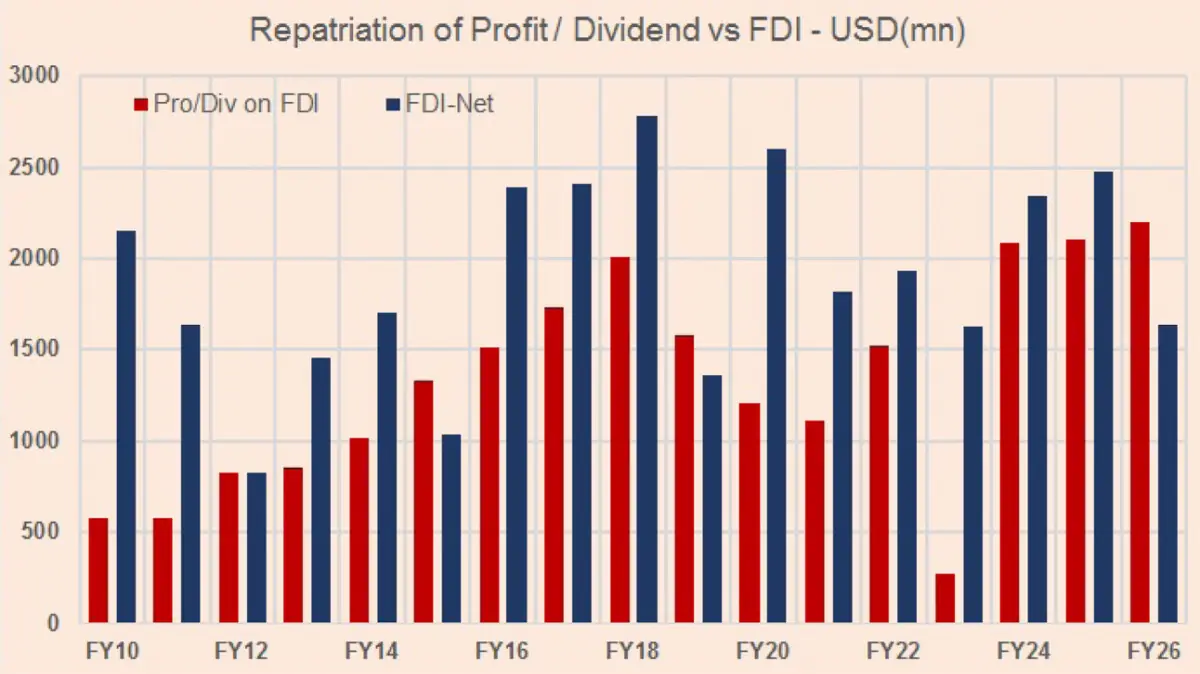
Profit and dividend repatriation on foreign direct investment reached around USD2.2 billion, while net FDI stood at only USD1.64 billion, indicating foreign companies sent home more in dividends and profits than Pakistan received in new net investment during the year.
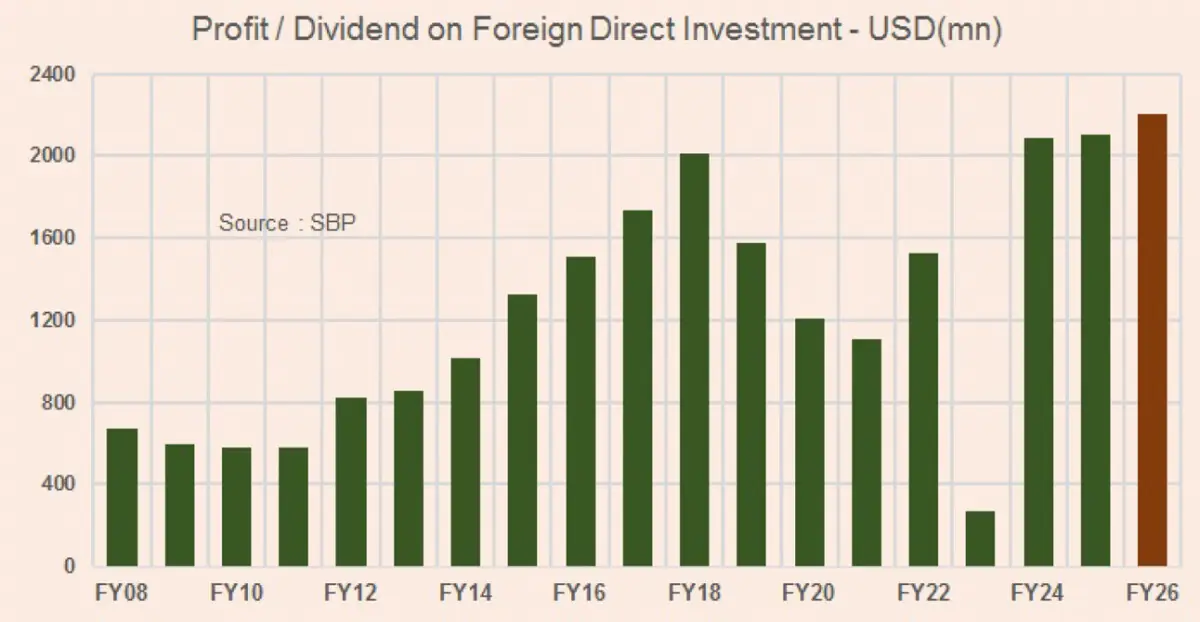
Rising profit repatriation is not necessarily a bad sign. It indicates that foreign companies are earning profits in Pakistan, while the long-term increase—from around USD680 million in FY08 to more than USD2 billion annually in recent years—reflects a larger and more profitable foreign investment base, which could particularly be in banking and power.
The ability to remit these earnings is equally important for investor confidence.
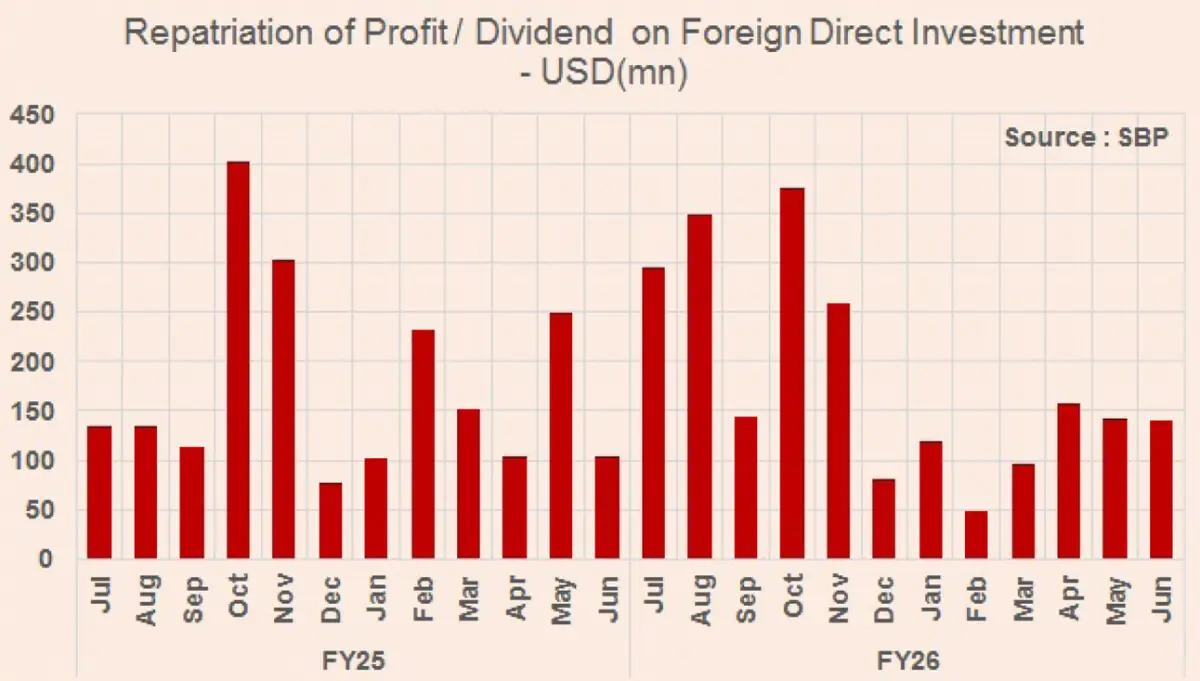
During the FY23 foreign-exchange crisis, restrictions and delays reduced repatriation to roughly USD260 million, leaving many multinational companies unable to transfer legitimate payments. Its recovery to above USD2 billion in FY24 and around USD2.2 billion in FY26 suggests that access to foreign currency has largely normalised and earlier backlogs have been cleared. This matters because investors are unlikely to commit capital where profits cannot be taken out; while restrictions may temporarily conserve reserves, they ultimately weaken credibility and discourage future investment.
The real concern, therefore, is not the repatriation figure on its own. It is the gap between profit payments and fresh FDI. In FY26, profit and dividend outflows were equal to around 134 percent of net FDI. Put simply, Pakistan sent out about USD1.34 in profits for every USD1 of new net foreign investment received.
The data show that outflows were also concentrated in established sectors. The power sector accounted for around USD508 million, while financial businesses repatriated approximately USD535 million, growing by 27 percent and 39 percent year-on-year, respectively.
Together, they made up more than 45 percent of FY26 repatriation. These payments largely represent returns from existing power projects and banking investments rather than profits from a new wave of export-oriented industries.
Beyond these two sectors, food was the next-largest contributor at USD200.5 million, although this was down from USD306.1 million in FY25. Communications remained broadly stable at USD159.9 million, while tobacco and transport accounted for USD117.5 million and USD109.1 million, respectively.
Pharmaceuticals stood out, with repatriation more than doubling to USD94.3 million, while oil and gas exploration declined sharply to USD54.1 million from USD146.4 million a year earlier.
For Pakistan, every dollar repatriated is a foreign-exchange outflow and adds to current-account pressure. But blocking these payments is not the solution. The challenge is to attract sufficient new, diversified and export-generating FDI to offset these outflows, while encouraging existing foreign companies to reinvest a larger share of their earnings locally—an area where Pakistan continues to fall short.






















Comments