


Iran-Pakistan pipeline needs a price reset
The Iran-Pakistan gas pipeline is commercially unviable due to high costs, lack of a functioning gas market in Pakistan, and significant supply and geopolitical risks, making it a potential taxpayer liability.
- High cost of Iranian pipeline gas versus existing alternatives.
- Pakistan's non-existent gas market and weak buyer base.
- Supply reliability, flexibility, and regional risks of the project.
- The pipeline's potential financial burden on Pakistani taxpayers.

Without a functioning gas market and a substantially lower price, the project risks becoming a taxpayer liability rather than an energy-security asset.
The Iran-Pakistan gas pipeline is again being presented as a strategic answer to Pakistan’s energy shortages. The case is not without political appeal, but the commercial case is weak. At the pricing formula currently being discussed, Iranian pipeline gas would not provide low-cost energy. It would add another high-cost imported fuel to a system that already struggles to absorb expensive gas.
The issue is not whether Pakistan should ever buy gas from Iran. The issue is whether the present formula, infrastructure requirement and domestic market structure make sense. They do not. A pipeline can improve energy security only when the gas is competitively priced, reliably deliverable and backed by a clear market. None of these conditions is evident at present.
The central problem is price. The circulated formula is IP gas price = 0.12 x JCC + USD1/MMBtu. At JCC crude of USD70/bbl, the border price is USD9.4/MMBtu. At USD100/bbl, it rises to USD13/MMBtu. At USD120/bbl, it reaches USD15.4/MMBtu. These are border prices, not delivered prices in Pakistan’s system.
Indicative IP gas cost under the circulated formula
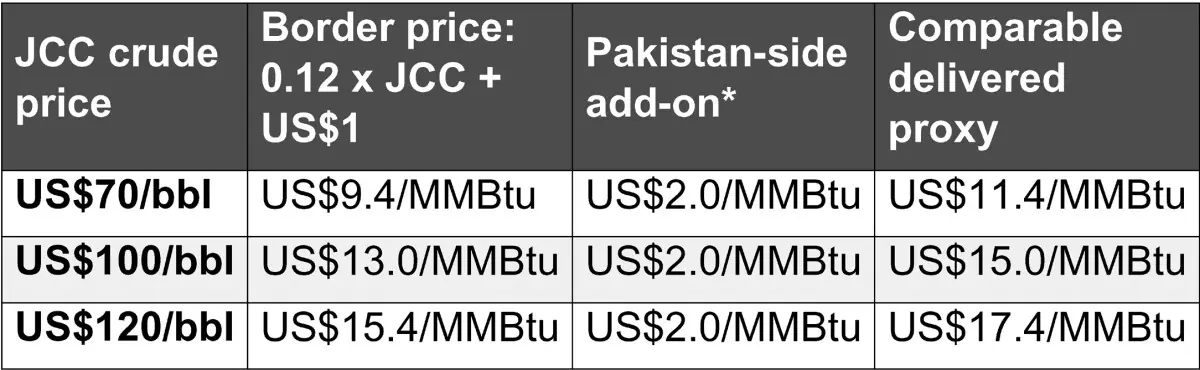
• Pakistan-side add-on is used only as a comparison proxy for approximate UFG/losses of around 10 percent plus SNGPL/SSGC administrative, handling and distribution costs.
On this basis, Iranian gas has no clear price advantage over RLNG. OGRA’s February 2026 RLNG notification shows distribution prices of USD11.3345/MMBtu for SNGPL and USD10.2704/MMBtu for SSGC, linked to an average DES LNG import price of USD7.4553/MMBtu. At moderate oil prices, IP gas is broadly comparable to these RLNG distribution prices; at higher oil prices, it becomes more expensive.
The second problem is that the pipeline is not being developed as a merchant gas project supported by bankable downstream off-take. It is a sovereign-driven infrastructure project. Once contracted, the burden is unlikely to remain within ordinary commercial contracts. If the gas cannot be absorbed, the liability will move to the gas utilities, the public sector and ultimately the taxpayer.
This is the missing element in Pakistan’s gas debate. Pakistan is not only short of gas. It is short of a functioning gas market. There is no deep, transparent and competitive market in which imported gas can be sold to buyers willing to pay its full delivered cost. Without such a market, another supply obligation will not solve the gas problem. It will create another administered liability.
The likely buyer base is weak. The power sector is no longer a dependable anchor buyer for expensive gas. Gas-fired generation is being displaced where cheaper sources are available, including solar and other lower-cost electricity. If gas costs USD15/MMBtu or more, it will struggle to compete in dispatch. The system will use cheaper electricity when available and leave costly gas underutilised.
Industry is not positioned to fill the gap. The captive power levy has changed the economics for export-oriented textiles and removed a major potential buyer from the imported gas market. General industry faces weak demand, high taxation and energy-cost pressure. Domestic consumers cannot pay import-parity gas prices. Fertiliser cannot absorb such gas without subsidy. The question is therefore practical rather than rhetorical: who will buy this gas at the delivered price?
The third issue is flexibility. LNG has its own contractual and market risks, but it provides options that pipeline gas does not. Depending on the contract, cargoes can be deferred, swapped, stored, diverted or resold. Pipeline gas is a fixed-route, single-supplier obligation. Once the system is connected and volumes are contracted, Pakistan must either absorb the gas, curtail other supply or convert the obligation into another financial burden.
This rigidity matters because Pakistan’s gas demand is already impaired by pricing distortions, weak industrial demand and competing fuels. Expensive gas cannot be forced into the system without generating losses somewhere else. Pakistan’s energy sector has shown this repeatedly: when prices are misaligned with demand, the cost reappears as circular debt, subsidy, delayed payments or public borrowing.
The fourth concern is supply reliability. Iran has large gas reserves, but reserves are not the same as exportable gas. South Pars supplies roughly 70-75 percent of Iran’s gas production, and most of that production is consumed domestically. Iran faces winter shortages, curtailment and fuel switching. During peak periods, it has also relied on imports and swaps to balance domestic supply. Pakistan cannot assume that dependable incremental gas is available at present simply because the field is large.
Additional exportable supply would require major investment in South Pars pressure maintenance, offshore compression, wells, platforms, pipelines and processing capacity. Iran has announced large pressure-boosting projects, but these are multi-year capital works. They do not create immediate export surplus. For Pakistan, the reasonable assumption is delay and delivery uncertainty, not near-term reliability.
The fifth issue is regional and physical risk. Renewed fighting would affect both supply and infrastructure risks. South Pars and associated processing facilities are strategic assets. Any disruption can reduce Iran’s ability or willingness to export gas, especially in winter when domestic demand takes priority. LNG also carries regional risk, but supply can be diversified across sellers, routes and timing. Pipeline gas does not provide the same cushion.
The sixth issue is infrastructure cost. Pakistan would not only pay for gas; it would also need to build, secure, operate and integrate additional pipeline infrastructure, compression, metering and system connections. The approved 80-kilometre first phase from the Iranian border to Gwadar has been estimated at about USD158 million. Full integration into demand centres would require further expenditure. These costs would eventually be recovered through tariffs, public finance or debt.
Taken together, the project has a weak commercial basis at current prices. The gas is not clearly cheaper than RLNG. It is less flexible than LNG. It requires new infrastructure. It faces supply delay and regional risk. Most importantly, Pakistan has not created a local gas market capable of absorbing this gas at its delivered cost.
The immediate priority should be market creation. Pakistan needs third-party access, transparent pricing, enforceable downstream contracts, credible buyers and direct contracting between producers, importers and consumers. Gas market reform is not an administrative detail; it is the condition that determines whether any imported or domestic gas can be used productively.
Without a major renegotiation and a substantial reduction in price, the Iran-Pakistan pipeline does not make economic sense. Physical connectivity is not the same as energy security. A pipeline carrying unaffordable gas into a market that has not been created is not a solution. It is a liability waiting to be passed on to the taxpayer.
Copyright Business Recorder, 2026

PUBLIC SECTOR EXPERIENCE: He has served as Member Energy of the Planning Commission of Pakistan & has also been an advisor at: Ministry of Finance Ministry of Petroleum Ministry of Water & Power
PRIVATE SECTOR EXPERIENCE: He has held senior management positions with various energy sector entities and has worked with the World Bank, USAID and DFID since 1988. He is former secretary general of APTMA. He has many international publications and has been regularly writing articles in Pakistani newspapers on the industry and economic issues which can be viewed in Articles & Blogs Section of this website.













Comments