


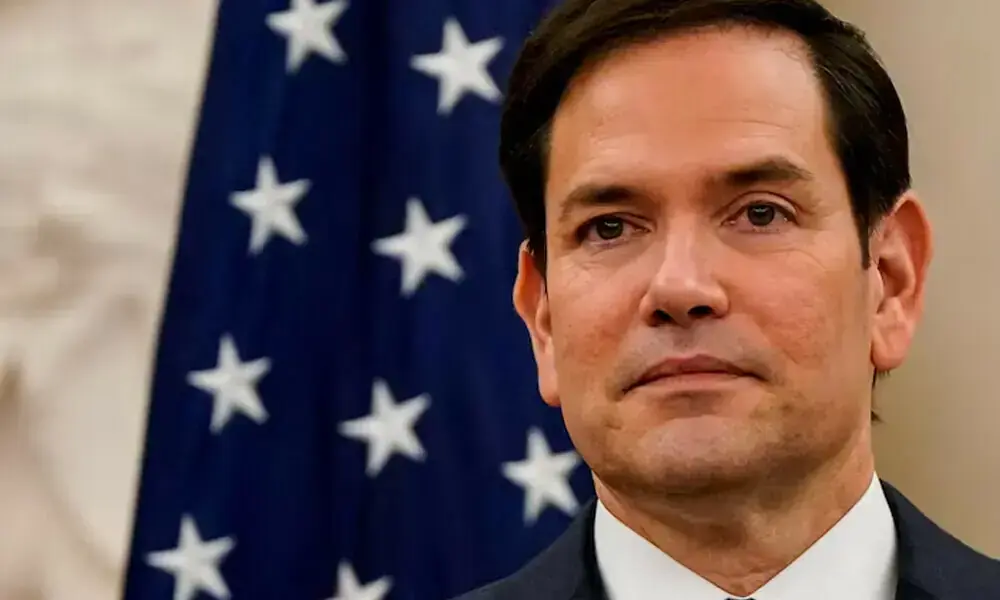

ABU DHABI: US Secretary of State Marco Rubio acknowledged he faces a delicate mission this week pitching Washington’s Iran peace deal to Gulf Arab leaders who fear excessive concessions will strengthen Tehran and reshape the region’s security balance and oil flows.
America’s top diplomat arrived in the United Arab Emirates late on Tuesday and was due to travel in coming days to Kuwait and Bahrain, where he will meet officials from the Gulf Cooperation Council, a grouping of monarchies that also includes Saudi Arabia, Qatar and Oman.
Asked if he was planning to address allies’ disquiet with the accord, Rubio told reporters: “That most certainly will come up in these discussions.” He said they would also discuss issues not covered by the memorandum of understanding.
At issue are elements of a draft agreement that includes no limits on Iran’s ballistic missiles, a proposed $300 billion reconstruction fund and provisions that could expand Tehran’s regional influence and control over critical oil shipping lanes.
He said he would not be asking regional allies to contribute to any reconstruction fund during the trip, even as the MoU suggests that countries in the region would at least be partially responsible for footing the bill. He said that was a discussion for the future, and Iran receiving any funds would depend on Tehran’s behavior going forward.
“That’s far down the road,” Rubio said.
All six GCC nations are strategic US allies that offered some degree of logistical support to Washington during the US-Israeli war with Iran that began four months ago, and all were buffeted by Iranian airstrikes as a result.
Some of those countries are feeling privately disappointed - and surprised - by an interim deal that could open the door to US normalisation with Iran, a predominantly Shi’ite country that most Sunni-led GCC states consider their main adversary.
The opinions of these nations matter to US policymakers.
The UAE, Saudi Arabia, Qatar, Kuwait and Bahrain all host US military bases that make up the backbone of America’s security architecture in the Middle East. Should any of those countries rethink their security relationship with the US, even in a subtle way, it could have a significant impact on US military strategy in the region.
For Rubio personally - who has maintained notable distance from the Iran talks in recent weeks, deferring almost entirely to Vice President JD Vance and other Trump aides - the trip requires a balancing act.
While America’s top diplomat needs to assuage regional allies, he must do so without appearing to criticize the US-Iran memorandum of understanding. President Donald Trump, who signed the accord last week, remains firmly behind it despite criticism from some of his fellow Republicans in Congress who have accused the administration of capitulating to Tehran.
Andrew Peek, a former deputy assistant secretary of state for Iraq and Iran who served on Trump’s National Security Council during both his terms, argued that Rubio could reassure any nervous allies by pointing out that Trump has a history of being tough on the Islamic Republic.


















Comments