


Improved regional stability post US-Iran deal to spur investment, trade: Aurangzeb tells UK minister
- Aurangzeb briefed on the government’s economic reform agenda and shared key priorities reflected in the Federal Budget 2026–27
Pakistan's Finance Minister discussed economic planning, budget, and geopolitical risks with a UK official, emphasizing that regional stability, like the US-Iran understanding, is crucial for investment and trade.
- Pakistan's economic planning and budget for FY2026-27.
- Impact of regional stability on investment and trade.
- Ongoing fiscal and structural reform efforts.
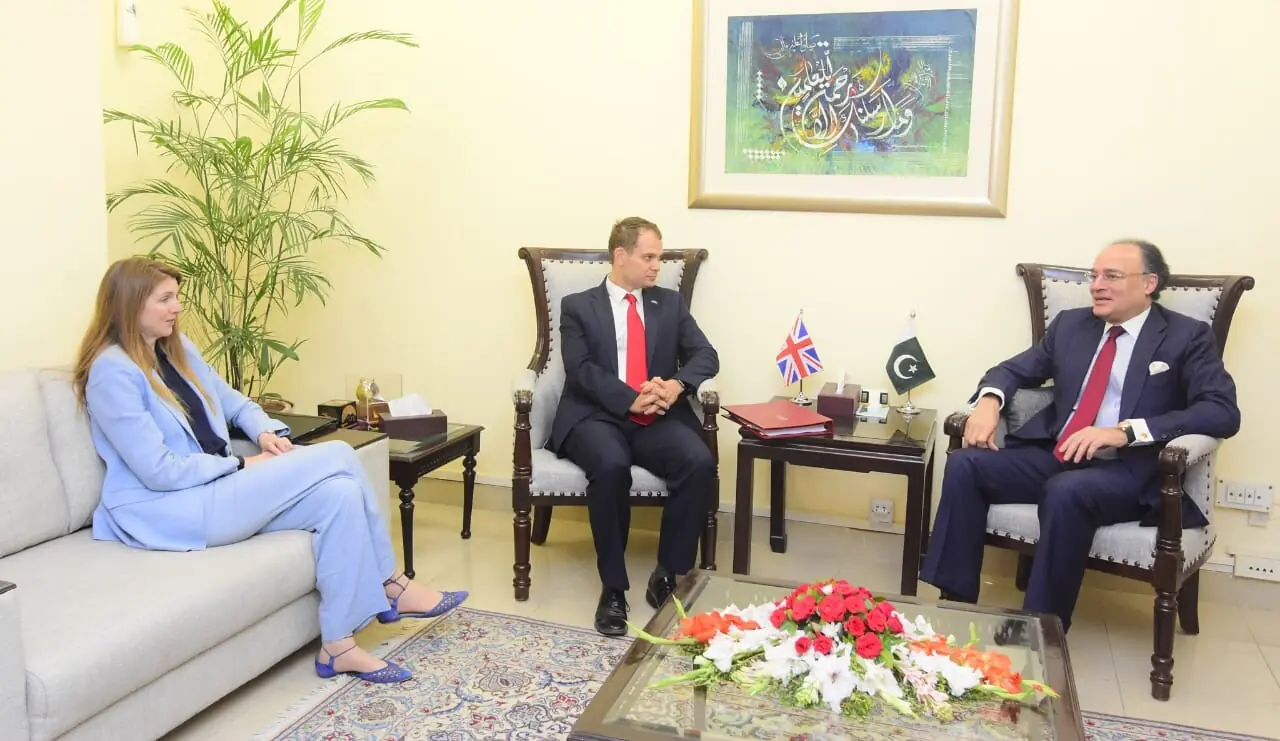

Pakistan has factored potential geopolitical and external risks into its economic planning and budgetary framework for fiscal year 2026-27, Finance Minister Muhammad Aurangzeb said on Tuesday, while stressing that improved regional stability following the recent understanding between the United States and Iran could create a more favourable environment for investment, trade and economic activity.
The finance minister shared the government’s assessment during a meeting with Hamish Falconer, MP, Parliamentary Under-Secretary of State for the Middle East, Afghanistan and Pakistan (MENAP) of the United Kingdom, who called on him at the Finance Division.
Falconer was accompanied by Jane Marriott, British High Commissioner to Pakistan. Also present during the meeting were Alice Duffy, Ministerial Private Secretary; Sarabjit Singh, Second Secretary (Economy), British High Commission; and senior officials of the Finance Division, stated an official statement.
The meeting involved a comprehensive exchange of views on regional developments, Pakistan’s macroeconomic outlook, ongoing structural reforms, fiscal priorities, institutional modernisation, and opportunities to further strengthen Pakistan–United Kingdom economic cooperation.
Aurangzeb briefed the visiting delegation on the government’s economic reform agenda and shared key priorities reflected in the Federal Budget 2026–27. He reaffirmed the government’s focus on preserving macroeconomic stability, sustaining the economic recovery, accelerating structural reforms, and creating conditions for inclusive and durable growth.
During the discussion, the finance minister also referred to recent regional developments, including the easing of tensions following the recently agreed understanding between the United States and Iran.
He underlined Pakistan’s consistent support for dialogue, de-escalation, and peaceful resolution of conflicts and noted that Pakistan had actively advocated for reducing regional tensions at an early stage.
He observed that prolonged instability in the region carries implications for economic confidence, energy markets, supply chains, and growth prospects across emerging economies.
The minister shared that the government’s economic planning and fiscal assumptions had remained mindful of possible external and geopolitical risks, including potential second-order impacts arising from prolonged regional uncertainty, while emphasising that improved regional stability creates more favourable conditions for investment, trade, and economic activity.
Aurangzeb also briefed the delegation on Pakistan’s ongoing fiscal and institutional reform efforts. He highlighted measures being undertaken to improve revenue mobilisation, strengthen compliance, reduce leakages, and modernise tax administration through greater use of technology, data integration, centralised processing, and digital invoicing.
The finance minister emphasised that the reform agenda seeks not only to improve revenue performance but also to strengthen transparency, reduce discretionary intervention, and rebuild trust between citizens, businesses, and public institutions.
The discussion further covered the government’s broader structural reform program, including privatisation, rightsizing of public sector entities, improving public expenditure efficiency, and expanding digital governance and targeted social protection mechanisms. He highlighted progress being made towards technology-enabled service delivery and more efficient allocation of public resources.
Hamish Falconer appreciated the government’s commitment to economic reform and acknowledged the seriousness and breadth of Pakistan’s ongoing transformation agenda.
He noted the importance of sustained reform implementation, institutional strengthening, and continued efforts to enhance economic competitiveness and governance. He also reaffirmed the United Kingdom’s interest in continued engagement and cooperation in areas of mutual economic interest.
Both sides reaffirmed their commitment to maintaining close engagement and strengthening Pakistan-United Kingdom cooperation in support of sustainable economic growth, institutional development, and regional stability.




















Comments