


FY27 budget on June 5: President summons NA, Senate sessions
- Before the budget, the Pakistan Economic Survey 2025-26 will be released on June 4
President Zardari has summoned Parliament for the 2026-27 federal budget presentation on June 5, amidst economic uncertainty and employee demands for significant salary and pension increases.
- Proposed federal budget figures and economic targets.
- Government employees' demands for salary and pension hikes.
- Economic challenges influencing the budget formulation.
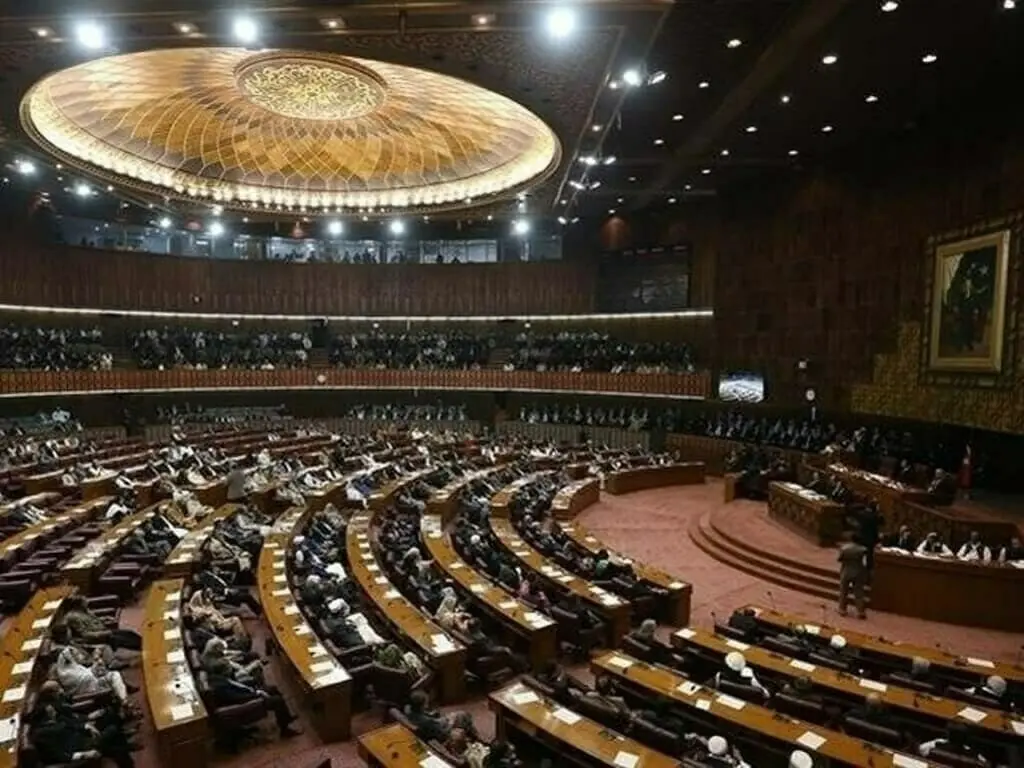

ISLAMABAD: President Asif Ali Zardari has summoned separate sessions of the National Assembly and Senate on Friday, June 5, for the presentation of the 2026-27 federal budget.
A statement issued by the President’s Office on Friday said that the President summoned the National Assembly’s budget session on Friday, June 5, at 5 pm and the Senate session on the same day at 6 pm.
Prime Minister Shehbaz Sharif has also called a special meeting of the federal cabinet on the morning of June 5 to approve the Budget 2026-27 ahead of its presentation in Parliament. Federal Minister for Finance and Revenue Senator Muhammad Aurangzeb will present the Budget in the National Assembly and lay it before the Senate for discussion.
READ MORE: Budget must focus on solutions beyond short-term fixes, NA panel tells MoF, FBR
According to parliamentary tradition, after the presentation of Budget 2026-27 in the National Assembly on Friday, the Speaker of the House will give a two-day break (Saturday and Sunday) and adjourn the House until Monday morning for the start of the budget debate. The Leader of the Opposition in the National Assembly will open the debate on the budget.
Before the budget, the Pakistan Economic Survey 2025-26 will be released on June 4, providing an overview of the country’s economic performance during the outgoing fiscal year. The Pakistan Economic Survey, an annual document reviewing the country’s economic performance over the outgoing fiscal year, is traditionally released a day before the budget speech and is usually followed by a detailed briefing by finance ministry officials and economic managers.
The government is preparing the country’s budget amid economic uncertainty stemming from the Iran-US conflict and pressure to meet International Monetary Fund (IMF) reform targets.
According to sources, the government had initially planned to convene the National Assembly and Senate sessions on June 1. However, the schedule was changed due to the absence of many lawmakers who travelled to Saudi Arabia to perform Hajj. More than 60 members of parliament are currently in the Kingdom and are expected to return during the first week of June.
Officials said work on budget proposals, tax measures, and fiscal recommendations for the new financial year is continuing. Sources within the finance ministry said the government is working on proposals related to taxation, energy prices, salaries, pensions, and development spending. Discussions are also underway regarding measures, which are aimed at controlling inflation and supporting business activity.
Finance Minister Muhammad Aurangzeb has already indicated that the government is trying to minimise the financial burden on ordinary citizens in the upcoming budget. He said efforts are being made to provide maximum possible relief to the public while maintaining economic discipline and improving revenue collection.
Sources said the total volume of the federal budget for 2026-27 is expected to exceed Rs17.8 trillion. The government is proposing an economic growth target of 4.1 percent, while average inflation for the next fiscal year is estimated at 8.4 percent.
Budget documents under consideration suggest a tax revenue target of Rs15.267 trillion. The petroleum levy target is proposed at Rs1.727 trillion. The federal Public Sector Development Programme (PSDP) is likely to receive an allocation of Rs1.1 trillion.
The government is proposing to allocate Rs7.824 trillion for interest payments on loans. A further Rs2,665 billion is expected to be earmarked for the defence sector.
Even before the budget announcement, differences have emerged between the government and government employees over salary and pension adjustments.
Government officials have indicated that relief for employees and pensioners may be provided in proportion to inflation. However, employee representatives say the proposed measures are insufficient given rising living costs.
The All Government Employees Grand Alliance (AGEGA) has demanded salary and pension increases of up to 100 percent. The alliance is also calling for the implementation of the agreement reached with the government on March 10, 2025.
The AGEGA has warned that failure to implement its charter of demands will result in a full-scale protest movement. Government employees have decided to stage a sit-in outside the Ministry of Finance and Parliament on budget day. The protest is scheduled to take place one day before the federal budget announcement.
Among their major demands, employees have called for the minimum wage to be set at Rs50,000 per month. They have also demanded that the minimum pension be increased to Rs50,000.
Copyright Business Recorder, 2026


























Comments