


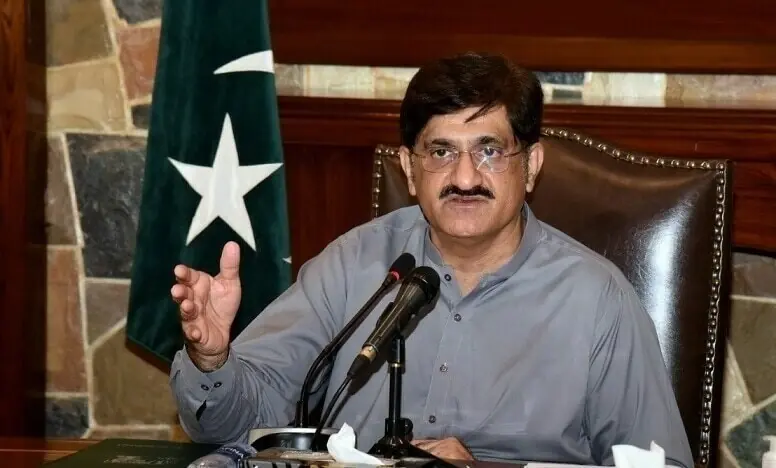

KARACHI: Sindh Chief Minister Syed Murad Ali Shah on Monday presided over a high-level joint meeting of the Planning & Development and Finance departments to review the provincial development strategy and investment plans for the current fiscal year.
The meeting, held at CM House, outlined a comprehensive vision for a resilient and inclusive Sindh, backed by a total development outlay of Rs 1,018 billion. The meeting was attended by Minister P&D Jam Khan Shoro, Minister Works Haji Ali Hassan Zardari, Chief Secretary Asif Hyder Shah, Chairman P&D Najam Shah, Secretary to CM Raheem Shaikh, Secretary Finance Fayaz Jatoi and Secretary Works Nawaz Sohoo and others.
Strategic vision and infrastructure resilience:
Sharing his vision, the chief minister said that the “Development Strategy 2025-26” focused on creating climate-resilient infrastructure for buildings, roads and housing.
He directed the Planning & Development Department to prioritise schemes that enhance climate resilience and ensure that all new projects are designed to withstand extreme weather events. He further instructed the departments concerned to integrate disaster-risk considerations into project planning and approvals.
“The main thrust of our development strategy is climate-resilient infrastructure, rapid flood recovery, and inclusive growth. I want every rupee of development spending to contribute to reducing poverty and achieving the Sustainable Development Goals (SDGs),” he said.
The CM said flood recovery would include rehabilitating damaged education and health facilities, while improved connectivity would link major cities and support mass transit systems in urban centres.
He emphasised that poverty reduction and inclusive development must remain cross-cutting priorities across all departments.
ADP 2025-26 Allocations
Murad Shah said his government has earmarked significant funds across key sectors under the Rs 520 billion Provincial Annual Development Programme (ADP) 2025-26.
Road infrastructure
The meeting was informed that a massive Rs 582 billion plan has been prepared for road infrastructure, including the construction and rehabilitation of 970 km of roads under flood recovery and other major projects such as the Sindh Coastal Highway.
Karachi-specific road projects account for Rs 194 billion, including the Shahrah-e-Bhutto corridor, Malir River bridge and various underpasses and flyovers aimed at easing congestion.
The CM directed the Works & Services Department to fast-track the execution of Karachi’s critical road projects and ensure strict adherence to quality standards and timelines. He warned that delays and substandard work would not be tolerated.
Chairman P&D Najam Shah briefed the CM that a monitoring mechanism was being strengthened to track physical and financial progress on all major road schemes, particularly those in Karachi and flood-affected districts.
Education
A Rs 340 billion investment plan has been approved to reconstruct 1,600 secondary schools damaged during the floods and to establish nine new cadet colleges and a Women’s University in Sukkur.
The CM directed the School Education & Literacy Department to ensure that reconstruction work in flood-hit areas is completed on a priority basis so that children do not remain out of school. He also instructed them to ensure that girls’ education receives special focus in the new schemes.
The CM was informed that tenders for a large number of school reconstruction projects had been floated and that work on priority districts would begin shortly. They assured him that the Women’s University Sukkur project was being fast-tracked.
Health
With an allocation of Rs 300 billion, the province will expand nine DHQ hospitals and establish medical colleges in Karachi, Hyderabad and other major cities. Notably, Rs 146.9 billion has been earmarked as grants-in-aid for institutions such as SIUT, NICVD and Indus Hospital to ensure operational efficiency.
The CM directed the Health Department and the Finance Department to ensure the timely release of funds so that these institutions can continue to provide free and quality healthcare to people across Sindh.
Secretary Finance Fayaz Jatoi informed the CM that, on his instructions, grants-in-aid were being disbursed on priority and that a schedule had been drawn up to avoid any disruption in services.
Water, Sanitation & Hygiene (WASH)
A combined investment of over Rs 930 billion is planned for the Water, Sanitation & Hygiene (WASH) sector, including the K-IV Water Supply Project (Rs 126.9 billion) and the Hub Canal project for Karachi.
The CM directed that all WASH schemes must be closely monitored, especially those related to drinking water supply in rural and urban areas. He asked for monthly progress reports on K-IV and Hub Canal improvements.
The CM was told that coordination with the federal government and international partners on K-IV had improved, and key milestones were being achieved as per plan.
Energy & Transport
The strategy also includes a Rs 69.97 billion energy package featuring the Sindh Solar Energy Project, and a Rs 155.34 billion transport plan covering the Red, Yellow and Orange Line BRTs. He said that he had personally visited the under-construction Red Line project last week, and work has sped up.
The CM directed the Energy Department to speed up solarisation initiatives in public buildings and off-grid areas, especially in health and education facilities. He also instructed the Transport Department to remove bottlenecks in land acquisition and approvals for BRT corridors.
The CM was told that the department was in close coordination with development partners to expedite procurement and implementation for these projects.
World’s Largest Housing Initiative:
The “Sindh People’s Housing for Flood Affectees” (SPHF) project remains a cornerstone of the provincial agenda. It aims to restore 2.1 million houses affected by the 2022 floods. To date, 2 million validations have been completed, and approximately 1.4 million disbursements have been made.
Copyright Business Recorder, 2025




















Comments
Comments are closed for this article.