


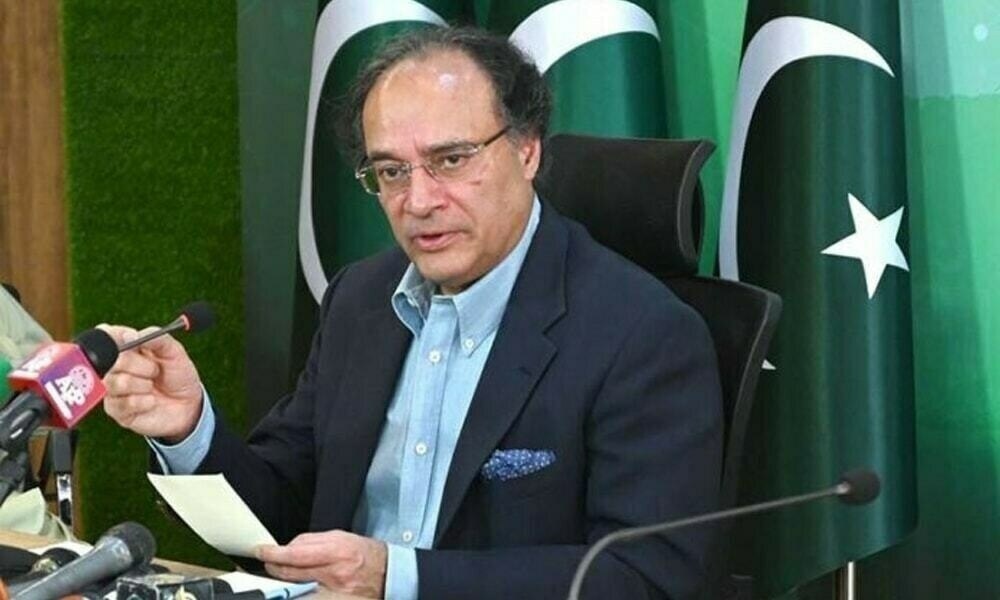
EDITORIAL: The eleventh National Finance Commission (NFC) meeting, under the chairmanship of the Federal Finance Minister Muhammad Aurangzeb, reportedly envisages a revenue-sharing plan that seeks to provide the federal government with greater revenue than was agreed in the 2010 seventh NFC award.
The consensus is that the federal government, with an ever-rising revenue shortfall, is focused on increasing Centre’s share of the divisible pool that would necessitate a constitutional amendment in view of Article 160 3 (A) that stipulates “the share of the provinces in each award of the NFC shall not be less than the share given to the provinces in the previous award.”
Chairman of Pakistan People’s Party Bilawal Bhutto-Zardari has publicly voiced his party’s opposition to amending 3 (A) of the constitution while Asad Qaiser, a key member of the opposition under the banner of the Tehrik Tahaffuz-e-Aain-e-Pakistan, expressed serious concerns about long-standing commitments to the newly merged districts in Khyber Pakhtunkhwa remaining unmet.
Federal planning minister Ahsan Iqbal, a long-term loyalist of the Pakistan Muslim League-Nawaz, has publicly stated that population should not be the major criteria for determining the share of the award — at present it is at 82 percent — because that is tantamount to incentivizing population growth, which is globally recognized as a major impediment to economic growth.
This was supported by Muhammad Aurangzeb while speaking at the World Population Day on 11 July this year. And, Balochistan remains an underdeveloped region in spite of its mineral wealth. Thus, there is a need to resolve multiple concerns – a challenging task, especially for the NFC Chairperson who does not have the political backing that is actually required to reach a consensus. It is relevant to note that such a backing has been hard to coalesce, even when the Finance Minister enjoyed overwhelming political backing of his own party members as well as those in other provinces.
The last NFC award, approved by all the participants, was in 2010 in spite of the fact that the constitution mandates an award every five years and NFC meetings called during the past 15 years ended without a consensus. Reports suggest that the 2010 NFC was agreed only after the then President, Asif Ali Zardari, offered the Punjab-led PML-N government a constitutional amendment allowing for a third-time prime minister — an amendment that became part of the eighteenth constitutional amendment in 2010.
A lack of consensus on changing revenue sharing between the centre and the federating units has been the norm and one would hope that the federal government approaches the problem in a manner that would be acceptable to all parties, including: (i) a 600 billion-rupee reduction in current expenditure with around 100 billion rupees on running of civilian government that would entail no rise in wages for a couple of years and another 100 billion rupees decline in subsidies which, in turn, would reduce reliance on borrowing internally as well as externally by another 300 billion rupees; (ii) a rise in tax-to-GDP ratio of one percent, estimated at around 100 billion rupees; and (iii) transferring at least two of the devolved subjects to provinces (saving of around 100 billion rupees) as envisaged in the 18th Constitutional Amendment.
In sum, the upcoming NFC award assumes more importance than that of its predecessors owing to the reasons stated earlier. Therefore, the federal government or the Centre in particular will be required to take every possible step aimed at defusing or easing concerns about the devolution of resources between the Centre and the provinces. This objective, in this newspaper’s view, can only be achieved by striking a delicate balance between vertical and horizontal distribution of revenues.
Copyright Business Recorder, 2025




















Comments
Comments are closed for this article.