


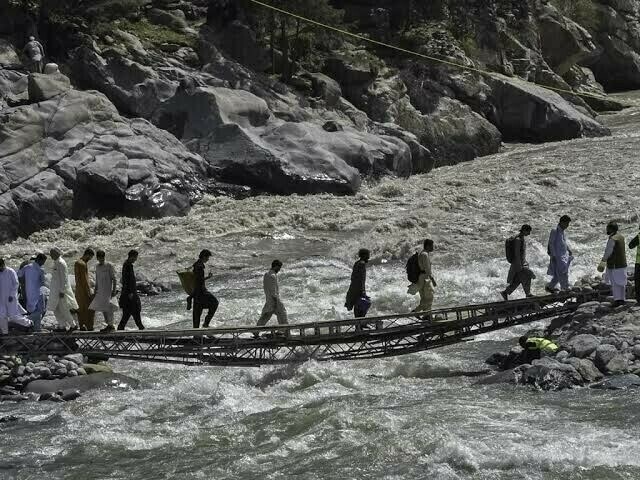

ISLAMABAD: The federal government and the National Disaster Management Authority (NDMA) came under sharp criticism in the National Assembly on Monday, as the opposition Pakistan Tehreek-e-Insaf (PTI) condemned what it described as an alarmingly inadequate response to last month’s devastating cloudburst and subsequent flooding in Buner district.
The House suspended its routine business through a motion to hold a debate on the recent flooding across the country. Taking the floor, Pakistan Tehreek-e-Insaf (PTI) leader Barrister Gohar Ali Khan accused both the federal government and the national Disaster Management Authority (NDMA) of failing to provide meaningful relief to the flood-hit people of Buner.
“We have long called for national unity in the face of natural disasters,” said Khan, lamenting that Buner had been “wiped off the map” by the August 15 cloudburst and subsequent flooding, which claimed at least 240 lives, left 14 injured, and over 120 persons still missing.
While thanking political parties, the PTI-led provincial government, religious organisations, NGOs, and the military – which deployed three battalions for rescue operations – the PTI leader strongly criticised the federal government and the NDMA’s response as inadequate.
“The NDMA’s entire contribution amounted to 200 blankets, 98 ration bags, five 7KV small generators, and five dewatering pumps and that’s it,” he claimed, adding that compensation of Rs2 million was paid to only 40 families, while others 200 affected families were ignored. “This is not just inadequate – it is unjust,” he lamented.
He continued that despite the scale of the tragedy, the federal government’s response had been largely “symbolic” rather than substantive. He called for a coordinated and institutional approach to effectively deal with such calamities in future.
Taking part in the debate, Defence Minister Khawaja Asif acknowledged the worsening pattern of flooding across the country and stressed the need for systemic reforms over short-term fixes.
He pointed to the absence of functioning local governments – dormant in most parts of the country for over 14 years – as a major factor undermining disaster preparedness and response.
“The devastation is not just natural – it is the direct result of human negligence,” he said, citing unchecked commercial construction on riverbanks, the sale of plots along natural waterways, and widespread encroachments that have made urban areas increasingly vulnerable.
“We narrowed rivers, sold plots inside streams, and now act surprised when nature pushes back,” the minister remarked in a rare moment of candour.
Asif advocated for the construction of small dams, saying such projects could be completed within two to three years, unlike mega-dams such as Diamer-Bhasha, which take decades.
“Authoritarian regimes built major dams. In democracy, we hesitate – always looking left and right to protect political capital instead of national interest,” he added, calling for an end to what he termed “shopkeeper politics.”
Lawmakers from across the aisle linked the recurring floods to structural weaknesses and environmental degradation.
Pakistan Peoples Party’s (PPP) Naveed Qamar warned that Pakistan could see a 22 per cent increase in flooding in the coming years due to rising temperatures and glacial melt.
“Deforestation, encroachments, and illegal construction have narrowed the paths rivers take, turning seasonal floods into national emergencies,” he said, urging the government to implement a comprehensive climate and disaster mitigation policy “in letter and spirit.”
He also called for an immediate halt to deforestation and full mobilisation of the relevant departments.
PTI’s Ali Muhammad Khan echoed the sentiment, emphasising the need to depoliticise disaster management and handle it through a unified national framework involving both federal and provincial authorities.
Federal Minister for Board of Investment Qaiser Ahmed Sheikh told the House that his entire village had been destroyed in the recent flooding. He proposed the construction of a major water reservoir in Chiniot to prevent such disasters in the future.
Touching on a separate issue, Sheikh drew an economic comparison between the United States and China, stating that although the US economy was once ten times larger, China had surpassed it within a decade.
He went on to endorse Chinese President Xi Jinping’s Global Governance Initiative (GGI), introduced at the recent Shanghai Cooperation Organisation Plus summit held in Tianjin.
At the outset of the session, lawmakers from both treasury and opposition benches called for a coordinated national effort to address the challenges posed by climate change. They emphasised the need for nature preservation, anti-encroachment measures, and large-scale tree plantation drives.
Following the heated debate, a majority of lawmakers – many from the treasury benches – rushed to the NDMA headquarters, where the top disaster management body had scheduled a closed-door briefing.
Notably, despite the gravity of the issue, the NDMA – headed by a serving Lieutenant General – chose to hold the session at its own headquarters instead of briefing lawmakers in Parliament.
Copyright Business Recorder, 2025























Comments
Comments are closed for this article.