


Electricity demand and generation profiles are not supposed to transform dramatically within the span of just twelve months.
Yet, Pakistan’s July 2025 versus July 2024 hourly electricity curves tell a strikingly different story — one that is increasingly being scripted not inside the control rooms of the NTDC or NPCC, but by the uncoordinated solar rush playing out on rooftops across the country.
Look closely at the two charts. The demand and generation profiles for July 2025 reveal steep midday dips, followed by sharp evening rebounds.
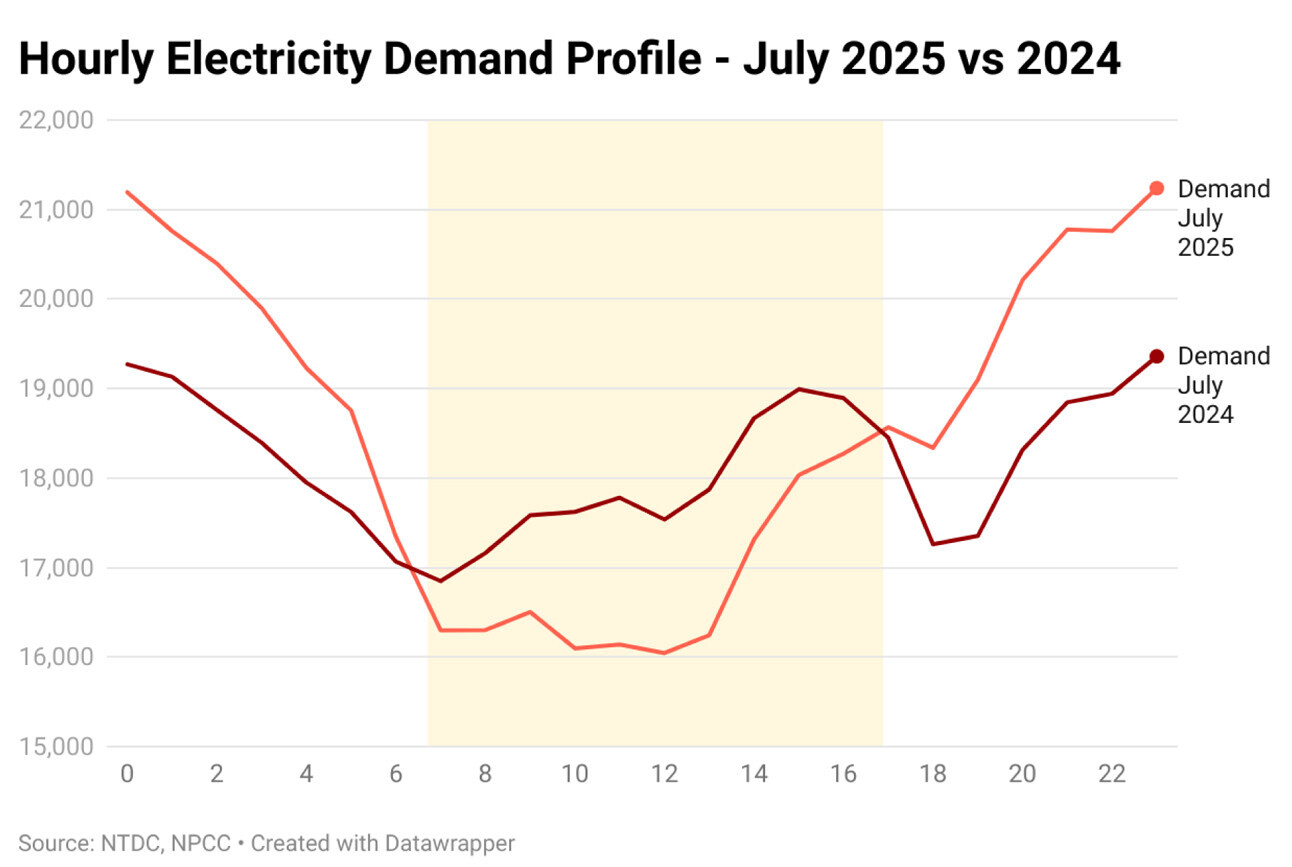
Compare this with 2024, where the curves were relatively smoother, and the contrast is glaring. These are not seasonal anomalies, nor random fluctuations. They are structural shifts in the way electricity is being consumed and produced.
And at the heart of it is solar energy — particularly the explosion of off-grid and net-metered rooftop installations.
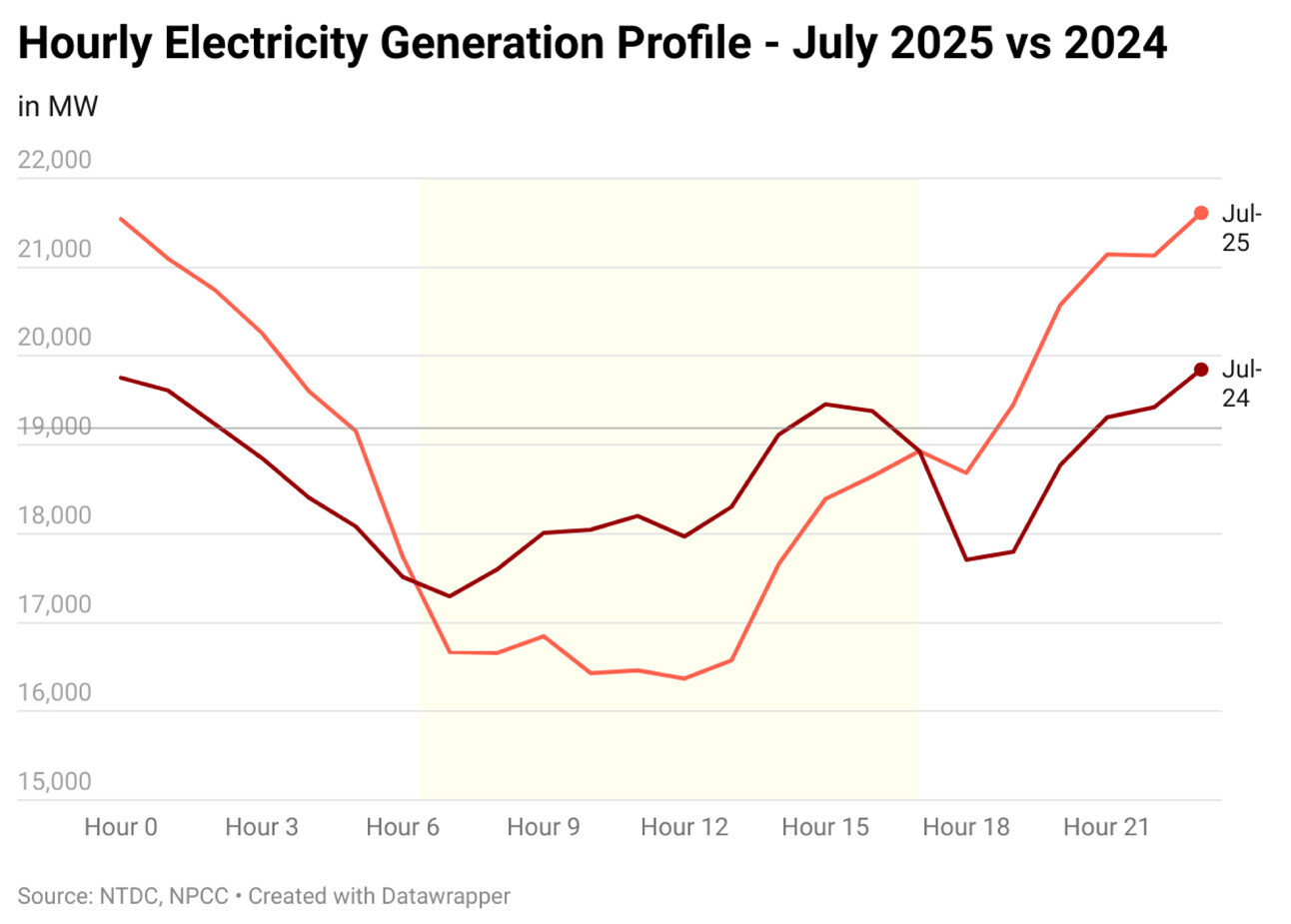
In July 2024, demand stayed broadly within the 18,000–20,000 MW range for much of the day, with the evening peak and morning troughs being manageable. Generation, too, followed the conventional rhythm. Fast forward to July 2025, however, and the midday collapse is unmistakable.
Demand during hours 9–14 has dropped nearly 2,000 MW below last year’s comparable levels. Simultaneously, system generation has also receded in those hours, only to swing upward in the evening as solar contribution fades and consumers rush back to the grid.
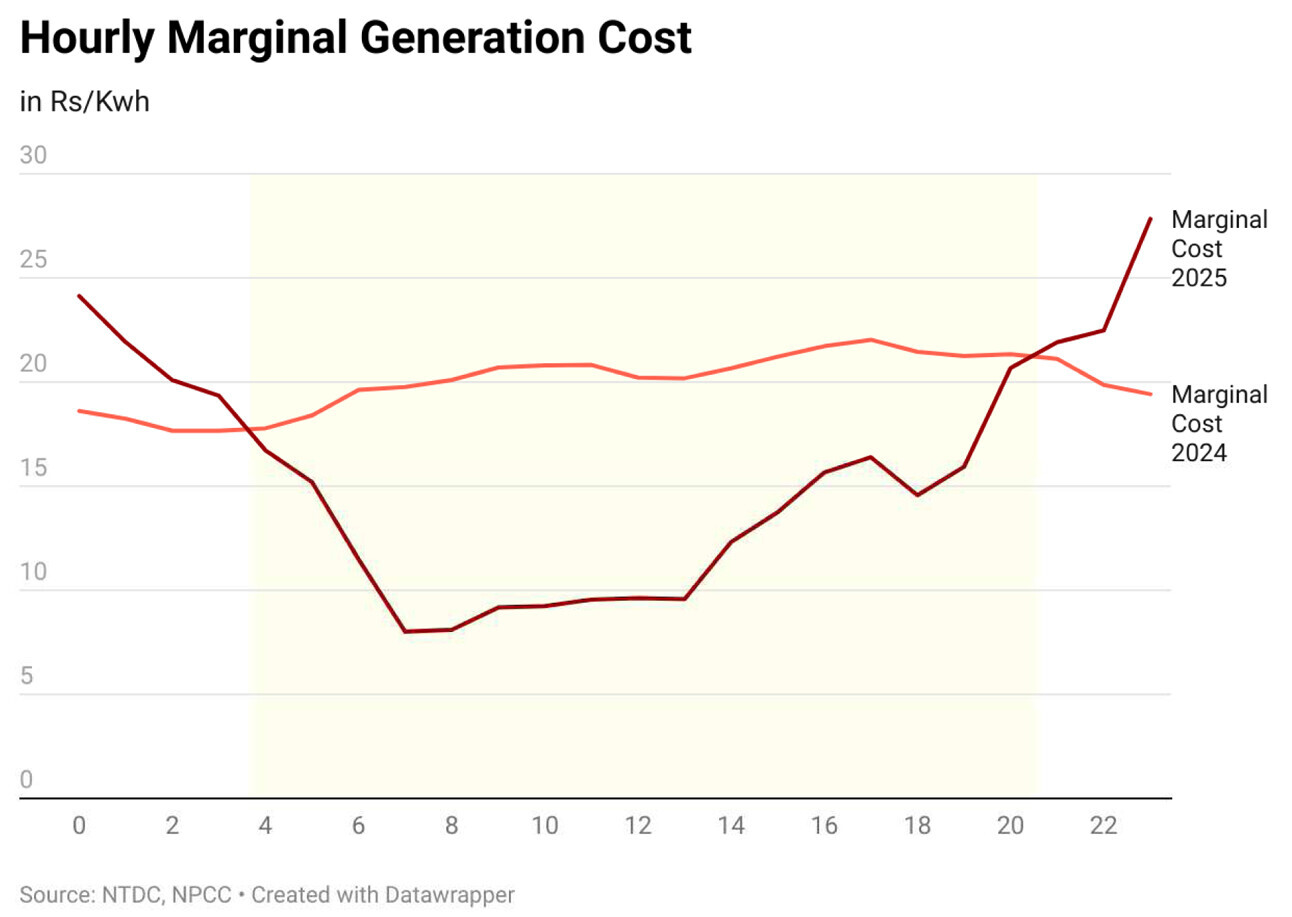
This is the classic “duck curve” — a pattern already familiar in markets like California, now emerging in Pakistan with startling speed.
Except here, it is not being managed through utility-scale renewables or carefully planned capacity additions. Instead, it is being driven bottom-up, with households and businesses rushing to insulate themselves from high tariffs and unreliable supply through solar panels, often with little coordination or system-level foresight.
The implications are profound. For one, traditional demand projections are becoming increasingly unreliable.
A flat 4–5 percent annual increase in demand no longer captures the hourly dynamics that now matter more than ever. Daytime demand is being shaved off by solar self-generation, while evening demand is intensifying, requiring expensive plants or imported fuel-based capacity to fire up at precisely the time when the system is most stressed.
Second, the current approach to capacity addition — long-term, baseload-heavy, and slow-moving — risks being fundamentally misaligned with this new reality. Adding coal or RLNG plants to a system where the midday demand troughs are deepening makes little economic sense. Instead, flexible, fast-ramping, and storage-backed options should become the core of planning.
Third, and perhaps most critically, the solar pricing regime itself needs urgent rationalization. Net metering was designed to incentivize adoption, but its unchecked expansion is creating distortions. If left unaddressed, the costs of balancing the system during evening peaks will fall disproportionately on non-solar consumers, deepening inequities and exacerbating circular debt.
Pakistan’s power sector has long suffered from planning that looks backward instead of forward. These hourly profiles are flashing a warning sign in real time: the energy transition is happening faster than official forecasts anticipate. Policies that continue to treat solar as a marginal side story will soon find themselves completely detached from reality.
What is needed now is a recalibration of the entire planning framework around the new demand-generation interplay. That means aligning capacity additions with hourly realities, integrating storage solutions, incentivizing demand-side management, and revisiting net metering tariffs to reflect actual system costs.
Twelve months apart, the graphs of July 2024 and July 2025 may appear as just another set of lines. But behind them is a revolution in motion — one that is already dictating terms. Whether policymakers catch up in time will determine if this revolution leads to stability and sustainability, or deeper imbalances in Pakistan’s power sector.





















Comments
Comments are closed for this article.