


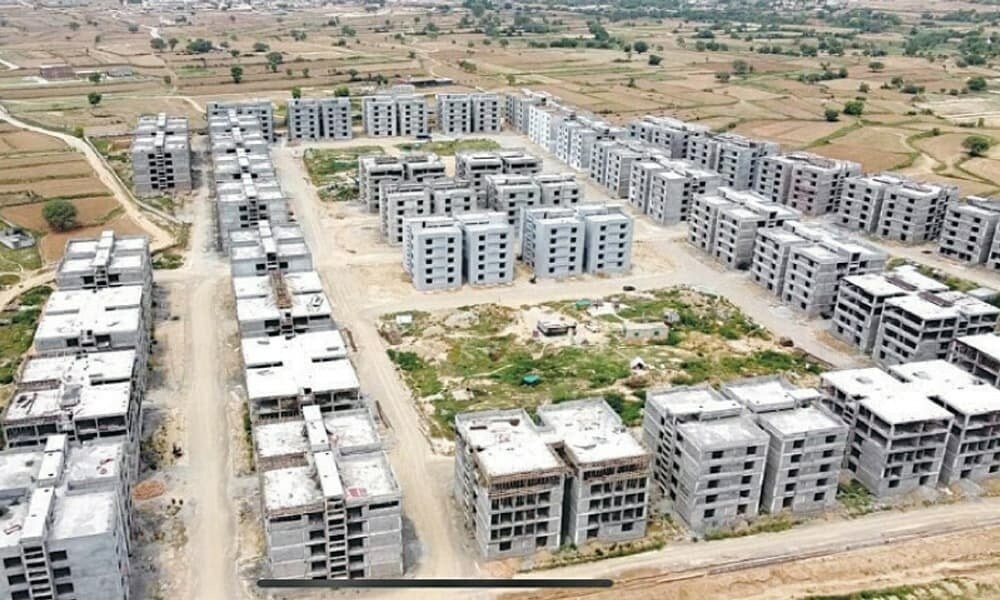
EDITORIAL: The grievous state of the country’s housing sector points to a crisis defined by deepening housing insecurity, unplanned urban sprawl, chronic institutional neglect, unaffordable options and substandard living conditions.
A recent report by the House Building Finance Corporation highlights some of the key drivers behind the alarming shortfall of affordable, quality housing across Pakistan. It has specifically noted how rising inflation, elevated interest rates and increased taxes on property transactions have choked activity in the housing market, leaving sales and bookings nearly frozen.
The study specifically paints a grim picture of housing finance accessibility for low-income groups. With current construction costs standing at Rs4,300 per square feet, even a modest 1,000-square-feet home is priced at a whopping Rs4.3 million.
At a 15 percent interest rate, this translates into a prohibitive monthly mortgage payment of Rs57,139, well beyond the reach of most low-income households, who, based on standard affordability metrics, can allocate only around Rs9,165 to housing. Even if they somehow manage to cobble together a 30 percent down payment of Rs1.3 million, the remaining Rs3 million loan would still require monthly payments of Rs39,997, well above their entire monthly income.
To make matters worse, the private sector offers few housing finance options for the low-income segment, and government efforts to introduce or expand cost-effective financing mechanisms have also been limited.
As a result, affordable housing remains largely inaccessible to those who need it most. Instead, mortgage market growth continues to disproportionately benefit higher-income groups, while the broader sector remains hampered by deep-rooted structural and procedural inefficiencies that hinder inclusive access to housing finance.
The crisis in the sector, however, goes well beyond the regulatory and financial hurdles to cost-effective housing. Our cities and towns are dotted with substandard, unsafe and poorly constructed dwellings that fail to meet basic standards of safety and livability. This deteriorating housing landscape both contributes to, and is worsened by, the twin existential challenges facing the nation: the galloping population growth rate and the increasingly unpredictable impacts of climate change.
Urban housing, especially, continues to deteriorate in quality as population growth outstrips planned development, pushing millions into poorly built homes, and fuelling the rapid proliferation of slums. Here, millions are trapped in a cycle of deprivation, lacking access to essentials like clean water, sanitation, electricity, healthcare, and education. As the social and physical structures of our cities fray, we face a dangerous convergence of poverty, disease, environmental decay, crime and widening inequality.
It isn’t only informal settlements that suffer from poor-quality housing. Formal housing, especially in low-income neighbourhoods, is also in disrepair, with building codes routinely flouted, often due to corruption and weak enforcement. This has had deadly consequences, as seen in the recent tragedy in Karachi’s Lyari neighbourhood.
While the incident prompted a flurry of inspections and statements from city and provincial authorities, the scale of the problem is vast and demands sustained, systemic action beyond reactive measures.
Adding to these structural failings is the growing intensity of extreme weather events, making it all the more urgent to shift towards more climate-resilient, environmentally sustainable housing. This must be paired with critical upgrades to related infrastructure, such as drainage systems, embankments, flood barriers, stormwater management, roads, and water supply networks.
Instead, what we see is a persistent disregard for an integrated, holistic approach to urban planning and resilient construction. Slums continue to emerge along stormwater drains, while in recent years, even upscale housing societies have encroached upon natural waterways, amplifying monsoon-related destruction.
Taken together, the challenges of affordability, poor quality, weak regulation, environmental vulnerability and systemic neglect have left Pakistan’s housing sector deeply fractured, demanding urgent, holistic and long-term reform at every level of policy and planning.
Copyright Business Recorder, 2025




















Comments
Comments are closed for this article.