


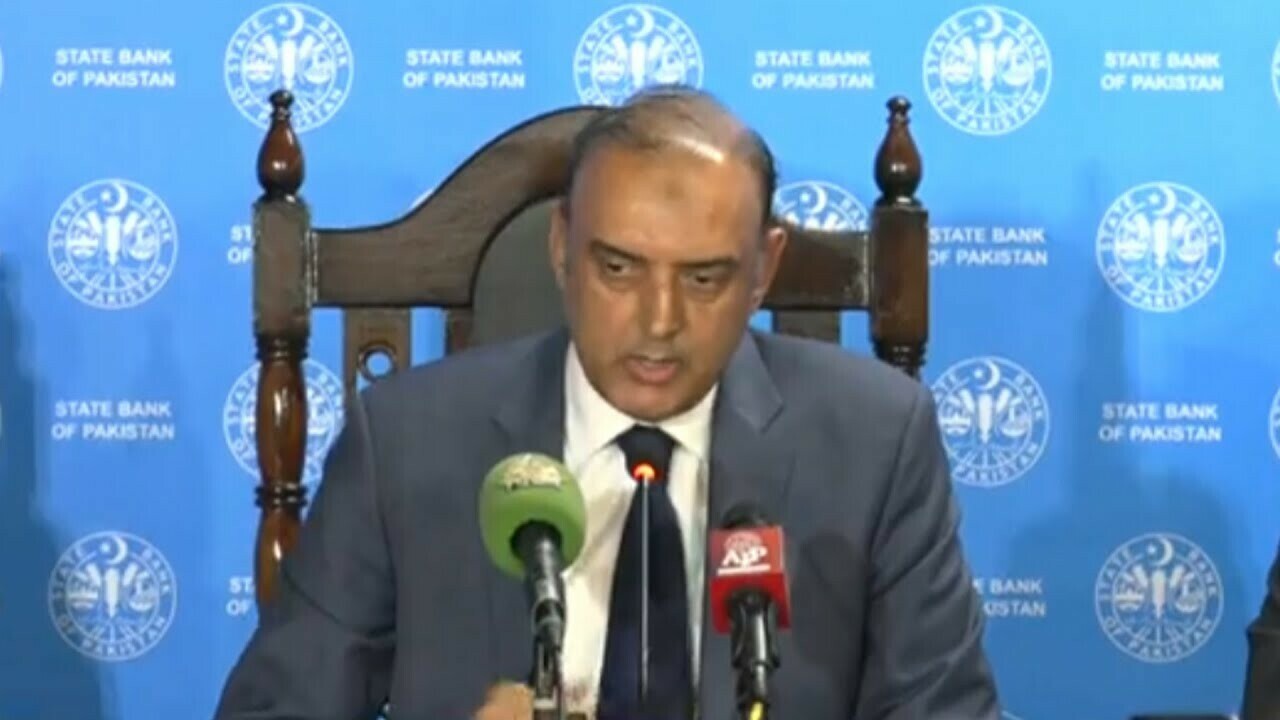
EDITORIAL: The Monetary Policy Committee (MPC) under the chairmanship of Governor State Bank of Pakistan Jameel Ahmed decided to keep the discount rate unchanged at 11 percent. This has surprised many, given the macroeconomic data routinely released by government entities in recent weeks and months.
Consumer price index (CPI), or headline inflation, reported to be the prime determinant of the discount rate, has been declining since November 2024 — from 4.9 percent, to 4.1 percent in December, 2.4 percent in January, 1.5 percent in February, 0.7 percent in March and 0.3 percent in April.
The MPC reduced the discount rate to 13 percent on 16 December, 12 percent on 12 January and 11 percent on 5 May even though the decline in CPI was much sharper during these months than previously.
True that CPI rose to 3.5 percent in May and declined to 3.2 percent in June this year; however, the rate has been kept unchanged since May, indicating that the CPI may not be the primary determinant of the discount rate. Core inflation has also been steadily declining since March this year — from 8.2 percent to a low of 6.9 percent in June.
The Monetary Policy Statement (MPS) noted that high frequency economic indicators were depicting a global economic recovery (and not just in Pakistan) — a stance that is clearly at odds with the International Monetary Fund (IMF). According to the IMF, “forecasts for global growth have been revised markedly down compared with the January 2025 World Economic Outlook (WEO) Update, reflecting effective tariff rates at levels not seen in a century and a highly unpredictable environment.” The MPS further claimed notable year-on-year growth in automobile sales, fertilizer off-take, credit to private sector, imports of intermediate goods and machinery — sales and purchases that are not indicative of higher output, but a decline in inventories while post-Trump’s inauguration the dollar lost value against all major currencies except the rupee, which accounts for lower import costs.
The MPS makes reference to purchasing manager’s index in recent months for the first time which begs the question as to how it is calculated. One may assume that it is part of the technical assistance (TA) extended by the IMF to Pakistan to deal with “important shortcomings that remain in the source data available for sectors accounting for around a third of GDP while there are issues with the granularity and reliability of the Government Finance Statistics (GFS).” The September IMF documents note that the TA will support government efforts to improve GFS and formulate a new Producer Price Index. It is relevant to note that Business Recorder was informed by the Pakistan Bureau of Statistics that the TA began in July 2025 and will not be completed till end June 2026.
The MPC appeared to be unaware of the fact that the large-scale manufacturing (LSM) growth was at negative 1.52 percent July-April 2025 (the most recent data released) against 0.26 percent in the comparable period of the year before; private sector credit rose from 323.5 billion rupees in 2023-24 to 676.6 billion rupees July-June 2024-25 with the rise associated with the stock market rather than the LSM. And maintained that barring flood-related risks agriculture sector is expected to recover in the current year — a risk that compromised the target last year and the recent ongoing floods may well belie this optimistic projection.
In relation to the discount rate decisions taken by the MPC it is appropriate to cite the observation by the IMF in its May 2025 documents uploaded on its website titled the first review under the extended arrangement: “while the reduction in headline inflation has been impressive, core inflation remains elevated, and the SBP should continue to calibrate monetary policy carefully, removing monetary constraint gradually and contingent on clear evidence that inflation is firmly anchored within SBP’s target range”.
In other words, the decision to remove monetary constraints on repatriation of profits under contractual obligations (in spite of reserves on 18 January cited at USD 14,456.6 million though the Governor SBP noted during his press conference that rollovers account for USD 16 billion) may be the primary reason for the Fund staff not to give the green light to the MPC to reduce the discount rate.
The Governor SBP held a press conference after the MPC meeting, which must be appreciated as it is in line with the Fund recommendation to undertake effective communication “as it will help the public better understand the MPC’s reaction function and build support for policy decisions.” Sadly, it is fairly obvious that he failed to convince the naysayers in the industrial community that the decision to keep the rate unchanged was an appropriate one.
The central bank seems to have taken a cautious approach with a view to ensuring price stability amid a surge in energy prices that has worsened the inflation outlook.
Copyright Business Recorder, 2025




















Comments
Comments are closed for this article.