


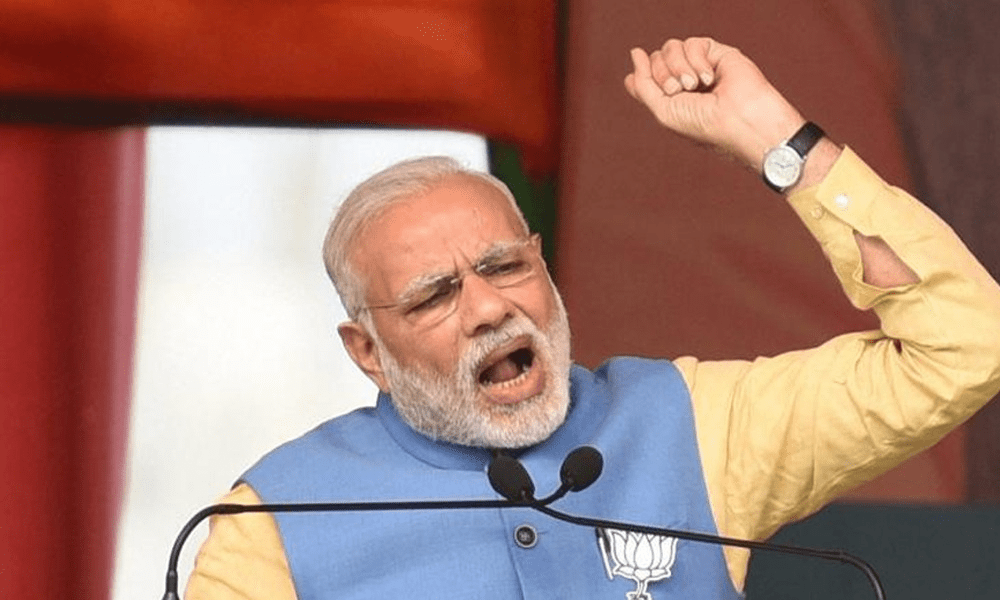
EDITORIAL: It is not the first time that an Indian election campaign has found itself tangled in jingoism. But Prime Minister Narendra Modi’s latest tirade, delivered from the Rajasthan stump, drops the pretence of statesmanship altogether. His reckless allegations against Pakistan are not just baseless – they are, in fact, incendiary. And as the Pakistani Foreign Office rightly noted, they are designed to stoke regional tensions for narrow political gains.
This is politics at its most dangerous. To posture for votes by peddling distortions about a neighbouring nuclear-armed state is not just irresponsible – it is profoundly destabilising. That Modi chooses to speak in the language of war while the subcontinent teeters on the edge of environmental, economic, and demographic stress says less about Pakistan and more about the disarray within India itself.
We are meant to believe, once again, that the source of India’s unrest lies across the border. But who, truly, has gained from the politics of terror in South Asia? Pakistan has spent the better part of two decades fighting the fallout of extremism – at great human and economic cost.
Thousands of lives have been lost, and billions drained from a struggling economy, precisely because the country made the difficult choice to take on militant groups. India, on the other hand, has found it politically convenient to weaponise the language of counterterrorism not against terrorists, but against Pakistan itself.
Indeed, it is India whose record of fomenting instability in the region is now the worst kept secret in intelligence circles. From the arrest of Indian spy Kulbhushan Jadhav to documented support for anti-Pakistan elements in Afghanistan, New Delhi’s hand in destabilising its neighbours has long been visible to those who care to look past the official denials and media fog. Even within its own borders, the Indian government has exploited “terror” to justify the brutal suppression of dissent in Kashmir, silence political opposition, and demonise its Muslim minority.
That Modi’s rhetoric comes as elections approach should surprise no one. The formula is tired but effective: portray Pakistan as the eternal enemy, conflate Muslims with terrorism, wrap it all in the tricolour, and let the news anchors do the rest. If that creates a diplomatic crisis or ignites military tensions, so be it – provided the next headline reads “Modi Strong on Security.”
But this time, Pakistan has not let the accusation go unchallenged. The Foreign Office’s sharp response has made it clear that any attempt to turn political theatre into military adventurism will be met in kind. Pakistan does not seek conflict. It has extended the hand of dialogue time and again, only to be met with silence or sabre-rattling. But this desire for peace should never be confused for weakness. As history has shown, when tested, Pakistan has responded with discipline, resolve, and precision.
There is a deeper danger here, however, that goes beyond India and Pakistan. When the largest democracy in the world uses the language of war to distract from its own failures – economic discontent, rural unrest, the crumbling promise of “Make in India,” and the brutalisation of minorities – it creates a model for others to follow. Authoritarian populism dressed up as nationalism does not stop at one border.
It is not just Pakistan that must stay vigilant. The region as a whole – already fragile – cannot afford another round of posturing from Delhi. Nor can the international community continue to indulge India’s double game: acting as a responsible global actor abroad while playing with fire at home.
Modi’s comments are not the mark of a confident state. They are the symptoms of political insecurity. And the more India tries to distract from the truth – of repression in Kashmir, of internal unrest, of economic underperformance – the louder its leaders shout across the border.
Pakistan’s position remains principled: peace, dialogue, and mutual respect. But if challenged, it will respond with strength. And in the end, it is those who toy with fire for the sake of applause who get burned.
Copyright Business Recorder, 2025



















Comments
Comments are closed for this article.