


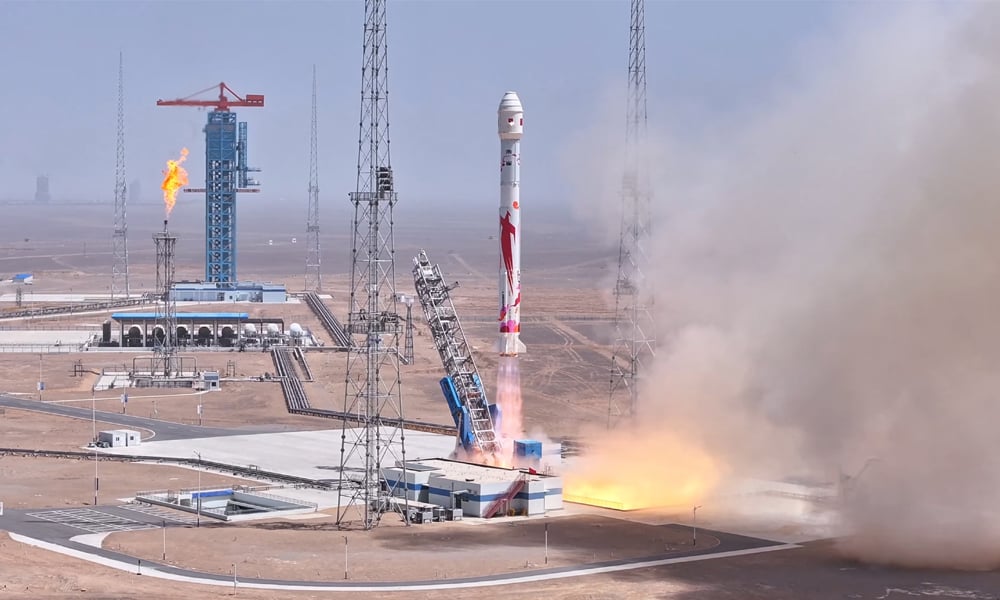
BEIJING: A new methane-powered rocket developed by China’s LandSpace Technology launched six satellites into orbit on Saturday, as the private startup doubles down on a cheap, cleaner fuel that it hopes will help it develop reusable rockets.
The Zhuque-2E Y2 carrier rocket blasted off at 12:12 p.m. (0412 GMT) from the Jiuquan Satellite Launch Center in northwest China, marking the fifth flight for the Zhuque-2 series, according to a company statement.
Beijing-based LandSpace became the world’s first company to launch a methane-liquid oxygen rocket in July 2023, ahead of US rivals including Elon Musk’s SpaceX and Jeff Bezos’ Blue Origin.
Interest has grown in recent years in launching carrier vehicles fuelled by methane, which is deemed less polluting, safer and cheaper than more commonly used hydrocarbon fuels, and a suitable propellant in a reusable rocket.
LandSpace has increased the rocket’s payload, reflecting increasing demand in China’s expanding commercial space industry amid growing competition to form a constellation of satellites as an alternative to Musk’s Starlink.
Its first successful methane-powered launch did not carry any real satellites, but the second launch in December 2023 successfully sent into orbit three satellites. Saturday’s launch put six satellites into orbit, mainly developed by Chinese firm Spacety, also known as Changsha Tianyi Space Science and Technology Research Institute.
Li Xiaoming, the institute’s vice-president, said in a livestream hosted by LandSpace before the launch that the payload comprised a radar satellite, two multispectral satellites and three satellites for scientific experiments, weighing between 20 kg and 300 kg (44-660 pounds).
The three research-focussed satellites will help with China’s deep-space exploration ambitions, while the pair of multispectral satellites will be dedicated to environmental monitoring and identifying mineral deposits, respectively, Li said.
The radar satellite is an all-weather Earth-observation satellite that produces images during the day and night, as well as see through clouds and rain, he added.
The radar satellite “can also pick up small, millimetre-level shifts in the surface, a capability that makes it extremely useful across urban development, transportation and energy infrastructure monitoring,” said Li.
Spacety was sanctioned by the US Treasury Department in January 2023 for allegedly supplying a Russian company with radar satellite imagery over Ukraine, which the US said was used to enable the Russian mercenary group Wagner’s combat operations in Ukraine.




















Comments
Comments are closed for this article.