


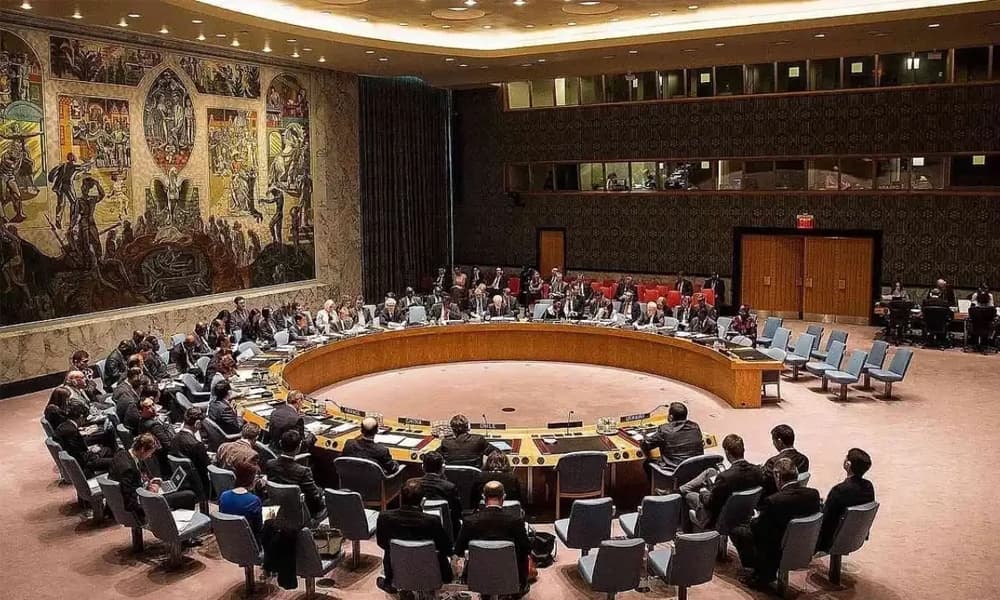
EDITORIAL: Despite mounting an intensive lobbying campaign, India has found itself grappling with a serious diplomatic disappointment at the United Nations Security Council (UNSC).
After the April 22 attack in Pahalgam, New Delhi sought to secure a strong international statement explicitly naming Pakistan and lending weight to its position on Kashmir. Instead, the UNSC’s final statement carefully avoided endorsing India’s narrative, leaving New Delhi in a diplomatic dilemma of its own making.
The Security Council condemned the attack in occupied Kashmir, extended condolences to the victims’ families, and reiterated its general stance against terrorism. Crucially, however, it neither named Pahalgam nor Pakistan, and it reaffirmed the region’s internationally recognised designation as “Jammu and Kashmir” — resisting any language that would bolster India’s territorial claims. For Pakistan, working closely with China, this represents a significant diplomatic success, demonstrating that the space for India’s unilateral narrative remains limited.
India’s frustration stems from its inability to translate its domestic political momentum into international endorsement. Despite its increasingly visible economic and strategic presence globally, New Delhi’s diplomatic offensive faltered because it failed to offer concrete evidence linking Pakistan to the Pahalgam incident. Islamabad, by contrast, struck a careful tone, offering cooperation for a neutral and transparent investigation while rejecting India’s accusations as baseless. In a world wary of flashpoints and escalation, calls for evidence and restraint resonated more than nationalist fervour.
Already, the White House’s early reaction had hinted at the prevailing mood. Instead of supporting India’s assertions, the US response called for cooler heads to prevail. Now, with the UNSC’s neutral statement, it is clear that while major powers are willing to condemn terrorism, they are unwilling to wade into the complexities of Kashmir without verified facts. India’s heavy-handed attempt to force the issue has instead exposed its diplomatic limits.
The roots of New Delhi’s dilemma lie as much in its domestic politics as in its international positioning. In seeking to galvanise domestic opinion with aggressive rhetoric, the Indian government has raised expectations of a forceful response. Yet, having failed to secure international backing for such a course, it now faces a stark choice: escalate without cover, or disappoint a home audience that had been primed for confrontation. Either path carries risks — both for India’s regional standing and for its credibility.
This outcome also signals a change from previous incidents, most notably Pulwama in 2019, when India found greater diplomatic sympathy. Then, the UNSC’s language was far closer to India’s preferred framing. Today, the same institutions display a far more cautious approach, unwilling to prejudge responsibility in the absence of evidence. Pakistan’s diplomatic machinery, learning from past experiences, worked effectively this time to prevent the council from drifting into one-sided narratives.
However, it would be a mistake for Pakistan to view this as a complete victory. International diplomacy seldom offers permanent wins. Islamabad’s measured and legally grounded approach must be sustained if it is to continue positioning itself as a responsible actor. Calls for neutral investigations, adherence to international law, and clear rejection of terrorism in all forms are the pillars on which this temporary success rests.
For India, the setback is less about isolation than about unmet expectations. Its status as a major power brings opportunities, but also scrutiny. The assumption that size or economic clout alone would override demands for proof has been tested — and found wanting. The UNSC’s response makes clear that serious allegations must be substantiated, particularly when the risks of escalation are high.
In the coming days, New Delhi will need to recalibrate its strategy. Domestically, it must manage the anger it helped inflame. Internationally, it must recognise that diplomatic capital is spent more wisely on careful persuasion than on pressure campaigns that overreach. The Kashmir dispute remains as intractable as ever — and attempts to redraw its international contours through forceful narratives are unlikely to succeed without the weight of evidence.
Ultimately, the UNSC’s caution reflects a deeper truth: that in international affairs, patience, proof, and prudence matter far more than passion. India’s setback at the United Nations is a reminder that even in an age of shifting power balances, certain fundamentals endure.
Copyright Business Recorder, 2025



















Comments
Comments are closed for this article.