



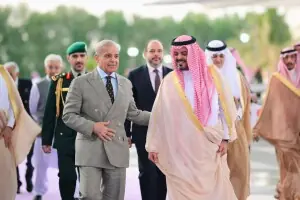
EDITORIAL: In a much-needed fillip for Pakistan’s floundering investment landscape, Prime Minister Shehbaz Sharif’s May 23 visit to the UAE has yielded pledges from the leadership of the Gulf state for investments worth $10 billion in various sectors of the economy. This follows close on the heels of Saudi Arabia committing to a $5 billion investment package.
Despite these welcome developments, as well as indications that the leadership understands the need for shoring up faltering investment figures – given that during his UAE sojourn, the prime minister stressed on the need to encourage investment that leads to sustainable economic growth – the reality on the ground reflects the shocking lack of progress on this front.
That reality is reflected in the latest figures released by the National Accounts Committee, which reveal that Pakistan’s investment ratio has fallen to its lowest level for 50 years, plunging to 13.1 percent of the GDP during the outgoing fiscal year, missing the target of a 15.1 percent investment-to-GDP ratio. In addition, both public and private sector investment-to-GDP ratios also saw significant reductions, with the latter plummeting to a 25-year low.
It is evident that despite the establishment of the Special Investment Facilitation Council (SIFC) in June 2023, the desired impact on the country’s investment landscape is yet to materialise, which has in turn resulted in continued sluggish economic growth.
The setting up of the SIFC, a body composed of high-level civilian and military leaders was rightly considered to be the need of the hour and is meant to significantly expand investment from foreign and domestic sources by providing an enabling environment for potential investors through identification of avenues for investments and by removing the various obstacles and bottlenecks that hinder productive economic activity.
And to a certain extent, it has succeeded in improving the ease of doing business in the country.
However, despite its efforts, the reality remains that we still haven’t moved significantly beyond the signing of MoUs and Declarations of Intent from investors belonging to friendly countries.
What is needed, perhaps, is an in-depth review at the highest levels of policymaking to analyse the reasons behind the continued inertia that plagues investment in the country, and explore the ways this could be rectified.
Our largely stagnant economic growth coupled with the galloping population growth rate has created more than a pressing need for substantial investments coming in from both domestic and foreign sources to stimulate economic activity, employment and sustainable development.
A cursory examination of the possible factors for the dismal investment figures will tell us that a narrow industrial base, a volatile security situation, decades of political instability, and inconsistent policies, coupled with their poor execution, have discouraged both FDI and domestic investment.
Furthermore, there is the perennial distrust of modern technology that Pakistani officialdom displays on a regular basis.
Whether it is the clampdown on digital freedoms or the resistance now palpable towards the use of renewable energy sources like solar power, this tendency to fight modern innovations instead of embracing them will not serve our interests in the long run.
While the prime minister may have waxed eloquent about the government’s plans on promoting Information Technology (IT) and use of Artificial Intelligence (AI) during the UAE trip, one wonders how his government plans on creating the kind of environment needed to encourage innovation and creativity that embracing these technologies entail as its recent actions with respect to stifling the digital space are the opposite of what is needed in this regard.
Our rulers need to understand that a favourable investment climate will, at the very least, require a stable political order based on the rule of law.
In addition, the development of a broad industrial base focused on the manufacture of value-added products, and embracing of technologies that are going to shape the future are the needs of the hour.
Copyright Business Recorder, 2024














Comments
Comments are closed for this article.