


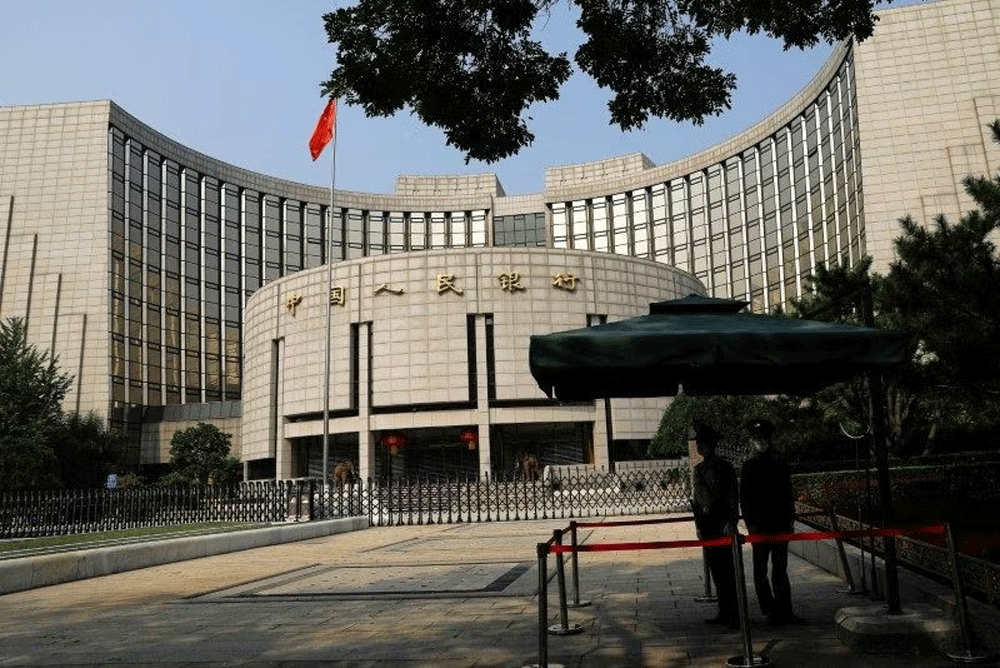
SHANGHAI/SINGAPORE: China cut its one-year benchmark lending rate on Monday as authorities seek to ramp up efforts to stimulate credit demand, but surprised markets by keeping the five-year rate unchanged amid broader concerns about a rapidly weakening currency.
The recovery in the world’s second-largest economy has lost steam due to a worsening property slump, weak consumer spending and tumbling credit growth, adding to the case for authorities to release more policy stimulus.
However, downward pressure on the yuan means Beijing has limited room for deeper monetary easing, analysts say, as a further widening of China’s yield differentials with other major economies could trigger yuan selloffs and capital flight.
The one-year loan prime rate (LPR) was lowered by 10 basis points to 3.45% from 3.55% previously, while the five-year LPR was left at 4.20%.
In a Reuters poll of 35 market watchers, all participants predicted cuts to both rates. The 10 bp cut in the one-year rate was smaller than the 15 bp cut expected by most poll respondents.
“Probably China limited the size and scope of rate cuts because they are concerned about downward pressure on the yuan,” said Masayuki Kichikawa, chief macro strategist at Sumitomo Mitsui DS Asset Management. “Chinese authorities care about currency market stability.”
Most new and outstanding loans in China are based on the one-year LPR, while the five-year rate influences the pricing of mortgages. China cut both LPRs in June to boost the economy.
The onshore yuan eased in early trade to 7.3078 per dollar, compared with the previous close of 7.2855, while benchmark Shanghai Composite index and the blue-chip CSI 300 index also declined.
The yuan has lost nearly 6% against the dollar so far this year to become one of the worst performing Asian currencies.
The reduction in the one-year LPR came after the People’s Bank of China (PBOC) unexpectedly lowered its medium-term policy rate last week.
The medium-term lending facility (MLF) rate serves as a guide to the LPR and is widely read by markets as a precursor to future changes to the lending benchmarks.
China’s central bank has also pledged to keep liquidity reasonably ample and its policy “precise and forceful” to support the economic recovery, amid rising headwinds, according to its second-quarter monetary policy implementation report.
But the steady five-year tenor caught many traders and analysts off the guard, with some expecting the troubled property sector and rising default risks at some developers would have led to deeper cuts to the benchmarks.
“We interpret the status quo of five-year LPR was a signal that the Chinese banks are reluctant to cut rates at the expense of rate differential margin,” said Ken Cheung, chief Asian FX strategist at Mizuho Bank.
“It flagged a problem on the effectiveness of PBOC’s policy guidance pass-through into the market, and the Chinese authorities may be lacking effective tools to stimulate the property sector and economy via monetary easing.”
Cheung added that the unexpected rate outcome should be “negative to China growth outlook and the yuan exchange rate”.
The central bank said it will optimise credit policies for the property sector, while co-ordinating financial support to resolve local government debt problems, it said in a statement on Sunday.






















Comments
Comments are closed for this article.