



Subscribing is the best way to get our best stories immediately.
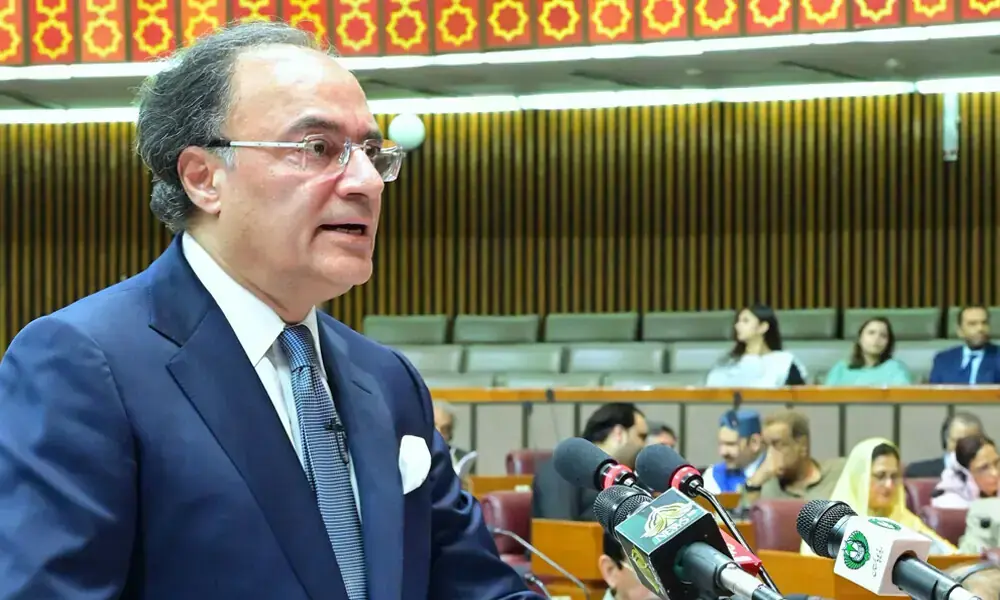
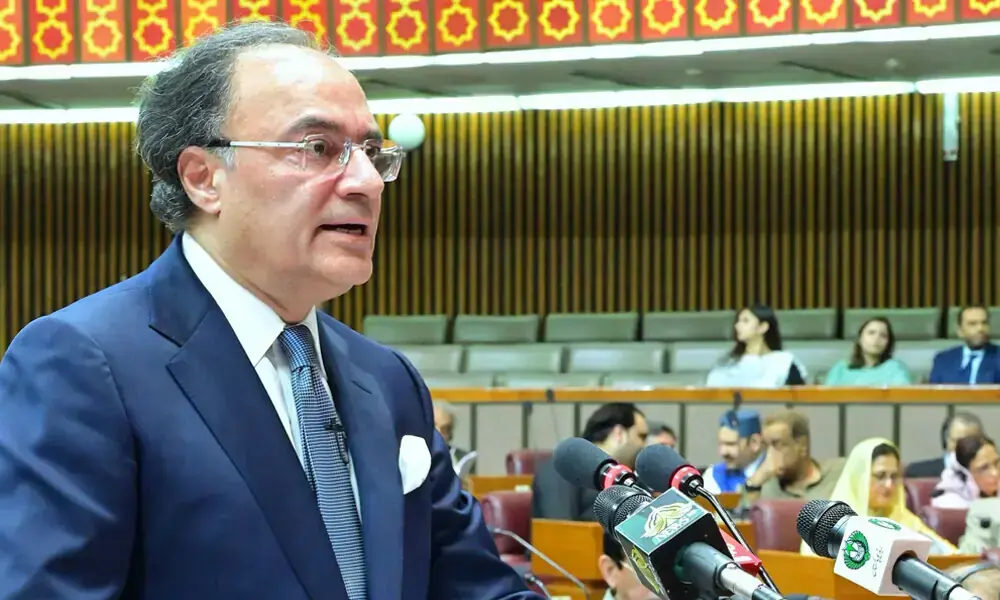
Finance Minister Muhammad Aurangzeb unveiled Pakistan’s federal budget for fiscal year 2026-27 on Friday, with the government seeking to achieve GDP growth of 4% and inflation at 8.2%.
Notably, the salaried group that had been at the receiving end of higher taxation for a number of years saw some relief. However, the income tax threshold of Rs50,000 per month remained unchanged.
The incumbent government’s third federal budget carries a total outlay of around Rs18.77 trillion ($67 billion), reflecting a moderate increase from Rs17.6 trillion in the previous year’s budget, as policymakers attempt to maintain macroeconomic stability while navigating a challenging external environment marred by the Middle East crisis.
Interestingly, inflation target has been set slightly higher at 8.2%, largely attributed to the ongoing Middle East war that has rattled energy markets.
Meanwhile, as per the budget documents, Rs8,054 billion has been earmarked for interest payments in FY27. While Rs17,495 billion has been allocated for the government’s current expenditure in FY27.
According to budget estimates, the government targets GDP growth of 4% in FY27, compared to an estimated 3.7% in the outgoing fiscal year. Sector-wise, agriculture, industrial and services are expected to post growth of 3.6%, 4.5% and 4.2%, respectively, in FY27.
The budget deficit is projected to be 3.6% of the GDP, and a primary surplus of 2% of GDP.
The budget projects a federal deficit of Rs7.02 trillion.
In his opening statement, the finance minister lauded the role of Pakistan’s armed forces, saying that the defence sector has emerged as a source of earning valuable foreign exchange.
He said the strategic defence agreement between Pakistan and Saudi Arabia is a moment of pride. “Pakistan will always steadfastly stand alongside KSA,” said Aurangzeb.
FBR tax target raised
The FBR has a tax collection target of approximately Rs15.26 trillion for FY27, representing an increase of over 8% compared to Rs14.13 trillion in the outgoing fiscal year.
An amount of Rs8,848 billion has been allocated for provinces from federal revenue.
Meanwhile, non-tax revenues are projected to exceed Rs5.34 trillion in FY27, supported by profits from the State Bank of Pakistan, petroleum levy collections, and proceeds from state-owned enterprises.
The government expects enhanced documentation, increased use of digital invoicing systems, and tighter monitoring of retail and wholesale sectors to contribute significantly towards achieving the target.
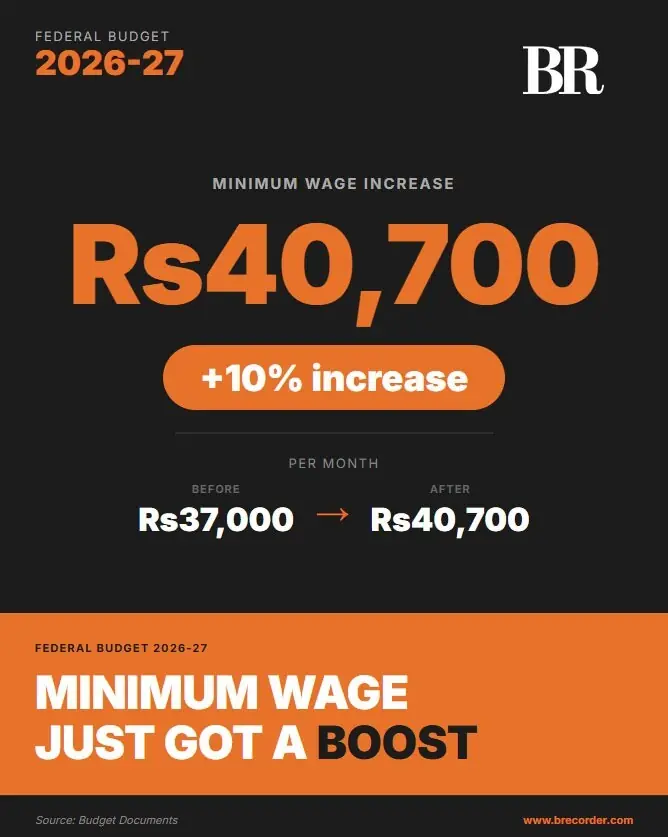
Minimum wage up 10%
Aurangzeb admitted inflation has increased the difficulties faced by salaried individuals.
“Recognising these challenges, the government is proposing a 7% increase in the salaries of public sector employees,” he said.
Moreover, a 7% increase in pensions for retired employees is also being proposed. Likewise, it is proposed the minimum monthly wage be increased by 10%.
Relief for the salaried class
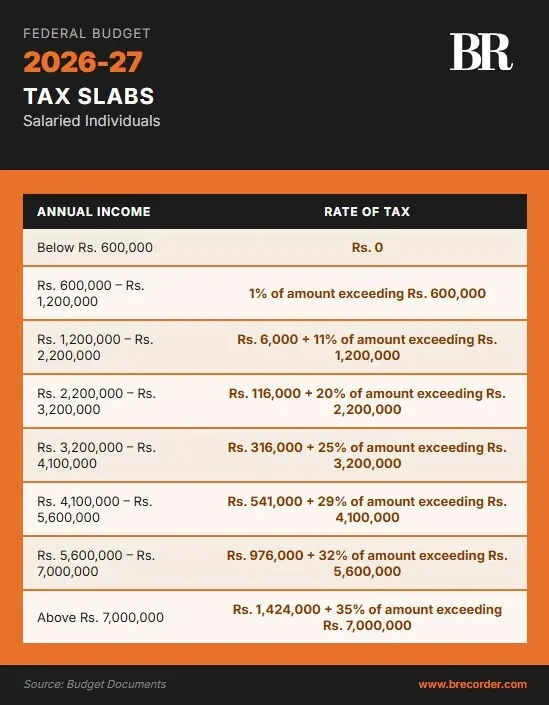
The government announced some tax relief for salaried individuals, particularly those in middle- and high-income brackets, amid concerns over the high tax burden on documented income earners.
Under the new measures, the tax rate for individuals earning between Rs2.2 million and Rs3.2 million annually falls from 23% to 20%, while those in the Rs3.2 million to Rs4.1 million bracket receive a reduction from 30% to 25%.
For high-income individuals, earning between Rs4.1 million and Rs5.6 million will now pay 29% income tax, as compared to 35% last year. Similarly, individuals earning between Rs5.6 million and Rs70 million annually will now pay 32% in taxes, as compared to 35%.
Moreover, the government has abolished the 9% surcharge on high-income individuals. “These measures will reduce the burden on the salaried class,” said Aurangzeb.
The government has proposed the removal of the first six super tax slabs. Furthermore, income exceeding Rs500mn will now be subject to a super tax rate of 8%, compared to the previous rate of 10%.
Relief for the construction sector
To support construction activity, the government has proposed reducing withholding tax rates on property transactions. For filers, the tax on property purchases has been reduced from 2.5% to 1.5%, said Aurangzeb, while the tax on property sales has been reduced from 5.5% to 2.75%.
“We believe that construction activity will boost from this measure,” said Aurangzeb.
Moreover, the government has abolished the Capital Value Tax (CVT) on the holding of foreign assets.
PSDP
The government allocated around Rs1 trillion under the Public Sector Development Programme (PSDP), with priority areas including water infrastructure, transport connectivity, energy transmission projects, digital transformation, and climate resilience initiatives.
Defence spending rises
In light of evolving regional security dynamics and heightened geopolitical tensions, defence spending registered another increase.
“Defence spending has been increased considerably to make the country invincible due to the uncertainty in the region,” Aurangzeb said.
The government allocated more than Rs3 trillion for defence in FY27, compared to Rs2.56 trillion in the previous fiscal year, reflecting a continued focus on military preparedness amid an increasingly uncertain regional environment.
Defence as a percentage of GDP stands at 2.1% in FY27E compared to the FY26 revised estimate of 2.03% of GDP.
The government has allocated Rs1,169 billion for pension expenses in FY27.
BISP allocation increased
The government raises the allocation for the Benazir Income Support Programme (BISP) to around Rs838 billion for FY27, up 17% as compared to last year, reflecting efforts to shield vulnerable segments of society from inflationary pressures.
The government has allocated Rs365 billion for the transport sector, including Rs100 billion for the N-25 expressway.
The government has earmarked Rs116.2 billion for the power sector.
Talking about climate change, the finance minister noted that last year’s floods dented Pakistan’s economy with losses to the tune of Rs822 billion. The government has allocated Rs103.1 billion for 43 hydro projects, including Rs14 billion for Diamer Bhasha and Rs10 billion for the K-IV project in Karachi.
Education and health
The government has earmarked Rs25.1 billion for the health sector under the Annual Development Programme 2026-27 (ADP), including tertiary healthcare and critical care. Meanwhile, under the ADP, Rs46 billion has been allocated for higher education and research, which is higher than the Rs34.9 billion allocated last year.
Exemption for the IT sector
The government has announced to extend the income tax exemption for the IT sector until June 2029.
Meanwhile, the government has decided to lower the tax collection on export proceeds from the existing 2% to 1.25%.
Taxes on contraceptives eliminated
In a bid to control population, which has crossed the 250 million mark, the government has decided to abolish taxes on contraceptives, announced Aurangzeb.
It has also eliminated the Federal Excise Duty (FED) on international business-class travel. “This measure will help in attracting foreign investment,” said Aurangzeb.
FED imposed on POL solvents
The government, in a bid to curb adulteration, has imposed a Federal Excise Duty (FED) of Rs80 per litre on petroleum-based solvents, particularly petroleum naphtha, which are primarily used in paints and thinners.
“These petroleum-based solvents are widely used for the illegal adulteration of petrol. The objective of this measure is not only to discourage such unlawful activities but also to deter those who harm the national economy by producing adulterated fuel at a lower cost and selling it in the market,” said Aurangzeb.
FEDs on SUVs
The government has imposed Federal Excise Duty on imported SUVs with engine capacities exceeding 2,000cc and up to 3,000cc. It has also proposed to increase the duty on vehicles above 3,000cc.
The tax will be imposed on luxury EVs worth over Rs20 million.
Aurangzeb said through telecom digital wallets, the government is easing public investment in government schemes. “In a week or two, we are inaugurating a project in this regard,” he said.
He said tax compliance and enforcement would ensure an increase in tax revenue collection instead of an increase in taxes.
The finance minister said that the government has provided the enablers “towards that journey from stabilisation to sustainable growth”.
He said the government that achieving stability is “is just the start of the journey”, expressing hope that the announced measures will put Pakistan towards a path of sustainable growth.
The government had earlier indicated that the announcement would be made on June 10 after revising the schedule from its initial plan.
The budget comes at a time when Pakistan remains under a multi-billion-dollar IMF programme, requiring the government to sustain fiscal discipline, broaden the tax base, reduce untargeted subsidies, and improve revenue collection.
At the same time, escalating tensions between the United States and Iran continue to add uncertainty to global energy markets, raising concerns over oil prices and import costs for Pakistan, a major energy-importing nation.
The government says it is closely monitoring developments in the Middle East amid fears that any prolonged disruption in regional trade routes could adversely impact Pakistan’s external account and inflation outlook.
Pakistan’s financial markets had also anticipated a friendlier, growth-oriented budget, talks suggested, with the KSE-100 ending the session up by nearly 2,700 points. Additionally, with the economy now having stabilised according to government officials, many also believed Islamabad will look towards faster GDP growth in the coming fiscal year.
On Thursday, the government unveiled the Pakistan Economic Survey (PES) for FY2025-26, according to which GDP growth was recorded at 3.7% in the outgoing fiscal year.
The growth was higher than the previous year’s figure of 3.18% but well short of its target of 4.2% announced in last year’s budget.
“The improvement owes to effective macroeconomic management, better fiscal account, growth in the large-scale manufacturing (LSM) sector, resilience of the agriculture sector to floods of 2025, exchange rate stability and reforms under the IMF Extended Fund Facility (EFF) Programme,” the survey stated.
Pakistan’s economic debate with the release of Economic Survey 2025-26 and federal budget for 2026-27 has again been reduced to a familiar quarrel: more taxes, more loans, more austerity, more conditions by the International Monetary Fund (IMF).
Missing from this noise is a simple principle understood by every prudent household, farmer, trader and industrialist: in hardship, first reduce waste, live within means, stop borrowing for consumption, and then work hard to repay what is owed.
Borrowing is not immoral or uneconomic in itself. Borrowing to create productive capacity can be wise. Borrowing to pay interest on earlier expensive loans is slow suicide. This distinction has disappeared from Pakistan’s fiscal policy.
A country may legitimately borrow for dams, railways, ports, universities, hospitals, technology, irrigation, climate resilience and reliable energy. Long-term low-rate loans for such purposes create assets. These assets raise productivity, expand incomes, improve social indicators and generate future tax capacity. Debt then becomes a bridge to development.
Pakistan’s tragedy is different. Much of its borrowing now finances debt servicing, current expenditure, losses of state-owned enterprises, circular debt, subsidies, administrative sprawl and survival of an elite rentier order. New debt does not sufficiently create new productive capacity. It merely keeps yesterday’s liabilities alive until tomorrow’s loan arrives.
Official fiscal operations of the Ministry of Finance tell this story year after year. Interest payments have become the largest federal expenditure. Development spending is treated as residual.
The Public Sector Development Programme (PSDP) remains compressed while mark-up payments grow. The federal government celebrates primary surpluses, but the overall fiscal deficit survives because debt servicing eats the budget before development begins.
This is not an accident. It is the result of a wrong economic model.
Pakistan’s rulers have followed the economics of postponement. When revenue falls short, borrow. When debt servicing rises, borrow more. When creditors demand adjustment, tax the already taxed. When development is squeezed, cut PSDP.
When provinces need resources for education, health and local services, create federal levies outside the divisible pool. When rentier sectors resist taxation, protect them. When loss-making state enterprises bleed, refinance them. When the next crisis arrives, call it unavoidable.
Even no household can survive this way. No business can survive this way. No state can survive this way indefinitely.
The first rule of fiscal recovery is discipline during
hardship. It does not mean blind austerity. It means distinguishing between expenditure that sustains life and capacity, and expenditure that sustains privilege. Schools, hospitals, water, sanitation, climate resilience, agriculture productivity, digital infrastructure and justice delivery are not waste.
Multiple ministries doing devolved provincial functions, subsidies for inefficiency, guaranteed returns to favoured sectors, tax exemptions for powerful lobbies and debt-funded current consumption are waste. Pakistan must therefore replace IMF-driven austerity with nationally owned prudence.
The second rule is that borrowing must be tied to productive assets. Every rupee borrowed should answer three questions. What asset will be created? How will it raise productivity or improve social welfare? How will it contribute to repayment capacity? Loans that fail this test should not be contracted.
This is especially important for external borrowing, where repayment requires foreign exchange. Projects financed by external debt must either earn foreign exchange, save foreign exchange, or create broad productivity gains strong enough to support future repayment.
The third rule is to stop confusing taxation with extraction. Pakistan does not lack taxable capacity. It lacks the courage to tax rent. Salaried persons, compliant businesses, bank account holders, electricity consumers, mobile phone users, exporters, contractors and professionals are repeatedly squeezed through withholding and indirect taxes. Meanwhile, large agricultural rents, speculative real estate gains, wholesale and retail margins and politically protected concessions remain inadequately taxed.
A state that taxes work more heavily than rent destroys productive incentives. It punishes documentation and rewards informality. It converts tax policy into a weapon against enterprise.
The fourth rule is to recover the hidden budget of the elite. The official Tax Expenditure Report 2026 has placed tax concessions at Rs. 2.353 trillion. This is not a footnote. It exceeds development allocations. A country pleading fiscal emergency cannot justify such a large hidden budget for selected beneficiaries while imposing new burdens on citizens already paying through withholding, utility bills, petroleum prices and inflation.
The fifth rule is to restore fiscal federalism. The growing reliance on petroleum levy instead of general sales tax (GST) on petroleum products has allowed the federation to retain revenues that would otherwise form part of the divisible pool. This may help Islamabad show better numbers. It weakens provinces and, indirectly, social services.
After the Constitution (Eighteenth Amendment) of Act 2010, education, health, agriculture, water supply and local development are largely provincial responsibilities. Extracting resources through non-divisible levies while demanding provincial cash surpluses undermines the constitutional design. This is how a fiscal crisis becomes a social crisis.
The sixth rule is to end the rentier state. A rentier state survives not by expanding production but by distributing privileges: plots, exemptions, guaranteed profits, protected markets, cheap public assets, regulatory favours and access to state contracts.
Such a state creates clients, not citizens; monopolies, not markets; and dependence, not productivity. Pakistan’s repeated bankruptcies are symptoms of this deeper disease.
The seventh rule is hard work after stabilisation. Once waste is reduced and borrowing is redirected toward productive use, the economy must move from consumption-led survival to production-led recovery.
Agriculture must be modernised. Small and medium enterprises must be formalised through low-rate, simple and predictable taxes.
Exports must be freed from policy uncertainty. Energy pricing must reward efficiency rather than theft and circular debt.
Cities must be empowered to finance local infrastructure through property-based revenues. Human capital must be treated as investment, not charity.
Debt repayment cannot come from slogans. It comes from higher productivity, higher exports, higher savings, better governance and fairer taxation.
Pakistan does not need another ritual of temporary stabilisation. It needs a fiscal covenant based on prudence: live within means during hardship, borrow only for capacity creation, tax rent rather than work, remove unjustified concessions, reduce waste, and repay debt through growth generated by real production.
The present model has made Pakistan dependent, indebted and externally supervised. The new model must make it self-respecting, productive and fiscally sovereign. The choice is no longer between austerity and growth. The real choice is between debt-funded rentier survival and disciplined productive reconstruction.
Copyright Business Recorder, 2026
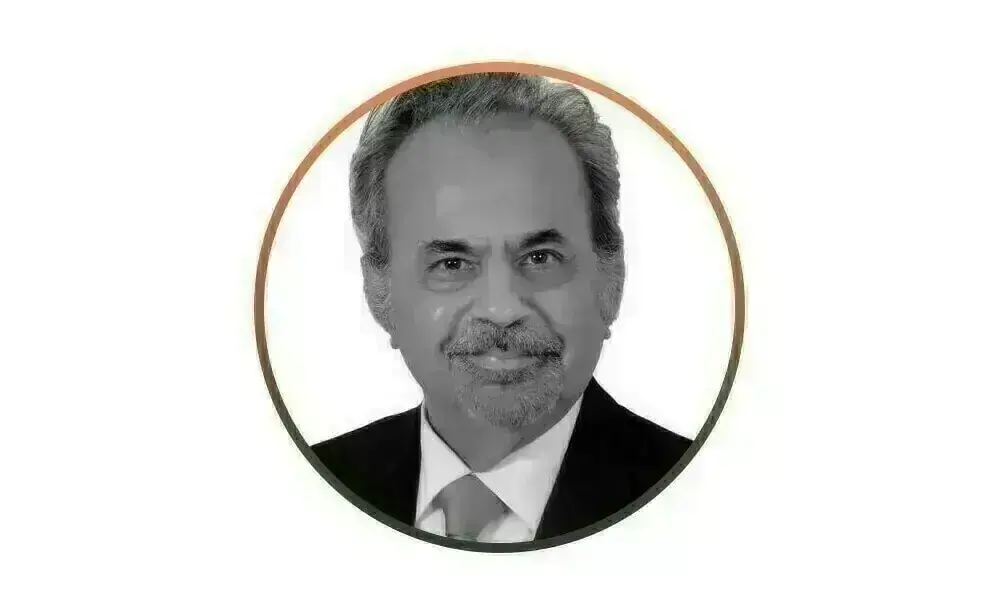
The writer, an Advocate Supreme Court, Adjunct Faculty at Lahore University of Management Sciences (LUMS), member Advisory Board and Visiting Senior Fellow of Pakistan Institute of Development Economics (PIDE), holds LLD in tax laws
The expectations - voluntary ceding of the annual rise in the provincial share of the divisible pool to the Centre - premised on a much publicised debate between the Centre and its federating units had been raised to a fever pitch only to be dashed by the budget 2026-27 bringing to mind T S Eliot’s famous proverb in his poem titled The Hollow Man - not with a bang but a whimper.
These expectations were reaffirmed a couple of hours before the budget was presented to parliament by Prime Minister Shehbaz Sharif during his televised address subsequent to formal cabinet approval of the budget as he praised his brother, the leader of his party, his niece, the Chief Minister Punjab, the leadership of the Pakistan Peoples’ Party as well as the Balochistan and last, but perhaps not least, the Khyber Pakhtukhwa governments for cooperating with the Centre in agreeing to key budgetary proposals. The declaration by Finance Minister Muhammad Aurangzeb that this measure has been postponed till next year raises questions about whether he will be able to deliver on this pledge when he clearly failed to get a consensus on other aspects of this year’s budget that required the intervention of the hybrid government as well as a 30- to 40-minute-long chat between the Prime Minister with the Managing Director of the International Monetary Fund (IMF).
Nonetheless, the budget does envisage generating about a trillion rupees more from the provinces in the current year – a rise that from an economic point of view cannot be supported: a rise in provincial surplus from 1379 billion rupees (revised estimates of 2025-26) to 1794 billion rupees in 2026-27 that would generate an additional 415 billion rupees for the Centre. And a reduction in the provincial budgeted allocation for development from 2.869 trillion rupees in the budget last year to 2.224 trillion next year or an additional 649 billion rupees that would accrue to the Centre.
Two observations are relevant. First, this accrual will be spent by the Centre on current non-development expenditure accounting for 93 percent of the total budget 2026-27 like last year, which is anti-growth and inflationary to boot as it is not backed by a rise in output. And second, it will further slow-down any move towards devolution, a policy that seeks to meet the needs/requirements of local communities. Instead, the Centre will take over project decision-making from the next tier of government, i.e., the provinces though one may assume that the more politically well-placed a party maybe the more the Centre will heed their demand for specific projects.
The question is: is there anything that is different about the budget from previous ones? There are five takeaways that show that little was changed in the budget.
First, the reliance on external borrowing is to rise to 23.3 billion dollars next year (at 290 rupees to the dollar parity) against the 19.9 billion dollars budgeted for the outgoing year but at last count only 11.068 billion dollars had been received in 2025-26 – an inflow that surely must be a source of concern to the government. This perhaps explains why the Finance Minister was at great pains during the unveiling of the Economic Survey a day prior to the budget presentation to emphasize the enhanced access to commercial borrowing, Panda ponds (only 250 million-dollars equivalent have been issued) and issuance of other debt equity instruments like Sukuk and Eurobonds. Total debt, including domestic debt and mark-up, is budgeted to rise next year by 16 percent – from the revised estimates of 6.9 trillion rupees to next year’s 8.05 trillion rupees.
Not included in debt figures noted above, but a debt nonetheless is the estimated closing guaranteed debt position for the issuance of contingent liabilities on 30 June 2025 estimated at 3.950 trillion rupees in last year’s budget, understated by 372 billion rupees as per the 2026-27 budget documents. The envisaged rise till 30 June 2027 is 5.005 trillion rupees or a rise of 16 percent.
Second, all components of current expenditure were raised and reflected the inability of the elite to show a reduction through either: (i) implementing reforms, pensions budgeted to receive 1.16 trillion rupees next year as opposed to 1.05 trillion rupees in the outgoing year, though
facetiously the documents note a 10 billion rupee pension fund though it is not clear whether this fund is set up at the taxpayers’ expense or whether this is the outcome of the policy announced last year that envisages employee contribution effective for only new entrants. Defence was also upgraded by 412 billion rupees though the bulk of this for operational expenses due to the uptick in terror attacks (and one would assume the 7 percent pay raise for all state employees).
Third the budgeted development outlay is contained at one trillion rupees in 2026-27, the same amount as budgeted in 2025-26. However, actual disbursement by the Finance Ministry (as opposed to the authorisations by the Planning Ministry) in the outgoing year has to-date been less than 50 percent. The allocations are indicative of a long-standing PML-N philosophy, notably big infrastructure projects will promote development as well as the party’s popularity. Sadly, here too the focus remained on roads rather than on water reservoirs, given that the country is now defined as severely water stressed.
Fourth, Federal Board of Revenue tax collections are budgeted to rise by 17.5 percent to 15.26 trillion rupees – the 2025-26 budgeted FBR collection was 14 trillion rupees that was revised downward to 12.9 trillion rupees (though FBR sources have revealed that the shortfall may still be in excess of 800 billion rupees). This indicates that the tax target, in yet another budget, is unrealistic.
In addition, the bulk of the government revenue is to be from sales tax whose incidence on the poor is greater than on the rich. It includes 4.9 trillion rupees under the head of sales tax, and another 5.3 trillion rupees from withholding taxes levied in the sales tax mode but credited under income tax (a practice that FBR does not desist from in spite of exhortation by the Auditor General of Pakistan). And kept outside the purview of the FBR (to ensure that it is not part of the divisible pool and therefore to be shared with the provinces) is the petroleum levy budgeted to generate 1.67 trillion rupees next fiscal year. In effect, the burden on the public through these three sales tax sources will be 11.8 trillion rupees next year – a fact that undermines the adequacy of the 838 billion rupees budgeted for the Benazir Income Support Programme, especially given poverty rate of 44 percent, if measured as per the calorific value.
And finally, the 4 percent growth next year may have to be revised downward given the severely contractionary monetary and fiscal policies in place due to the IMF’s harsh and upfront conditions and in the words of the Annual Budget Statement 2026-27 “a one percentage point decline in real GDP growth could lower government revenues through reduced tax collections, while also increasing expenditure pressures, particularly on social safety nets.”
Copyright Business Recorder, 2026
KARACHI: The Pakistan Banks Association (PBA) has welcomed the Federal Budget 2026-27, describing it as the first budget in years to shift the country’s focus from crisis management to sustainable economic growth while maintaining the fiscal discipline that underpinned Pakistan’s recent macroeconomic recovery.
The PBA expressed confidence that banks are well positioned to expand financing to the private sector, citing the budget’s commitment to fiscal consolidation, tax relief measures and incentives for exporters and the IT sector as key drivers of investment and economic growth.
READ ALSO: Budget for the people
According to PBA, the Budget keeps faith with fiscal discipline, holding the deficit at 3.6 percent of GDP and a primary surplus of 2 percent, while extending real relief through lower personal income tax, a reduction in super tax for the wider corporate sector, support for exporters, and an extension of the concessional regime for IT and IT-enabled services to 2029.
Growth is targeted at 4 percent, with independent analysts seeing further upside as confidence returns.
The Association sees this balance, caution on the fiscal accounts, ambition on growth, as exactly the right setting, and one in which private credit, rather than public borrowing, can do the heavy lifting.
Commenting on the Budget, Zafar Masud, Chairman PBA, said that this is a Budget the industry can build on.
“The conditions for priority-sector lending are the best in over a decade and we intend to use them for the benefit of our economy, our businesses, and our people”, he added.
Masud said that industry commitment is concrete: to drive SME financing from Rs 882 billion towards Rs 1.5 trillion by 2028, to revive mortgage & housing finance to achieve the 500,000 units target of the government by 2028, agriculture financing to cross Rs. 3.5 trillion disbursements during a year by 2028, promoting social impact projects, particularly in education and skill development, by leveraging the budgetary allocations to meet the international health and education funding commitment standard benchmark of 5 percent+ each, and to keep export credit flowing at competitive rates.
To make the most of this positive environment, we look forward to working with the Government and the State Bank of Pakistan on a consistent and predictable tax regime, documentation that reinforces financial inclusion, and risk-sharing that unlocks lending to priority sectors with both social as well as economic multipliers for sustainable growth, he added.
Measures in the Budget to revive property and housing, digital payments, exports and technology are expected to support a recovery in private credit. The breadth of recent progress underscores the point: workers’ remittances reached a record USD 38.3 billion, the Roshan Digital Account has channelled over USD 12 billion through formal channels, and the banking system now serves some 103 million depositors across nearly 268 million deposit accounts.
Muneer Kamal, CEO & Secretary General - PBA, said that this Budget is its shift from stabilisation towards growth, and the banking industry is ready to carry its share of that load.
“We will keep credit flowing to the productive sectors — housing, exports, technology and, above all, the SMEs that will drive the next phase of job creation. The foundations are strong, the outlook is encouraging, and the industry is fully committed to building on both”, he added.
Over the last two years the industry has delivered in an unparalleled fashion across SME, agriculture and housing and in low-cost housing the industry approved Rs 100 billion to some 67,000 beneficiaries in just two months, he informed.
The Association reaffirmed that, with these foundations in place, the industry stands fully behind the Government’s growth agenda as the recovery takes hold.
Accordingly to PBA, the banking industry has not waited to be asked. Over the past two years, it has repeatedly used its own balance sheet, at no cost to the exchequer and without sovereign guarantees, to unlock problems that had stalled the economy:
On Circular Debt, the industry coordinated the restructuring of Rs 1.225 trillion of power-sector circular debt at concessional rates, easing a burden that had choked the energy chain for years. It also restructured Rs 268 billion of PIA debt, clearing the way for the first major privatisation in two decades.
The industry also voluntarily reduced its margin on the Export Refinance Facility, bringing the cost of export financing down to 4.5 percent - acting ahead of the curve to keep exporters competitive.
Copyright Business Recorder, 2026
The federal budget for FY27 has been greeted with celebration in certain quarters. The celebration may prove premature.
This is not a pro-growth budget, nor an expansionary one. Overall development spending, federal and provincial combined is set to decline. The fiscal space that has been created is being redirected largely toward a narrow elite whose consumption patterns will not meaningfully move the growth needle. At the federal level, this is a relief budget, and one that is, on paper, being financed by cutting provincial development spending.
The government is attempting to address a structural flaw in fiscal federalism, but through unconventional means. The IMF noted as far back as its 2017 special report that Pakistan’s fiscal system is “somewhat unique compared to other countries”, a uniqueness rooted in the substantial asymmetry produced by the 7th NFC Award, where the provincial share in revenue far exceeded their share in resource mobilization.
For years, the federal government has done the heavy lifting on revenue generation while provinces have spent lavishly. The provincial surpluses generated in recent years have largely remained parked with the provinces, eventually financing federal fiscal gaps by flowing into T-bills. These accumulated surpluses are dry powder, held in reserve to be deployed once the IMF programme ends.
The FY27 budget attempts, on paper, to correct this by transferring just over Rs1 trillion to the federal government. This creates room for Islamabad to lower taxes without cutting expenditure, while maintaining the targeted fiscal balance. There are, however, technical complications. Provinces receive their full revenue share until FBR collections reach Rs13.35 trillion, beyond which the incremental share is transferred as a grant to the federal government. If the FBR misses its target, provinces retain full revenue exposure rather than the standard 43 percent. The arrangement also rests on voluntary provincial cooperation, which is not a structural fix.
The federal government has used this space to provide relief to segments of the formal, affluent, and middle-income population, including salaried individuals whose tax burden was raised sharply and disproportionately in recent years. They are paying less than before, though still more than they were in 2022. Exporters will see better earnings on paper. But there is little in this budget to drive investment in productive capacity. No one appears keen to commit to new projects.
The affluent will spend more, likely on imported goods and services. Salaried households will have marginally more disposable income. But neither creates the kind of demand multiplier that shifts growth trajectories. And for the poor and the informal lower- and middle-income classes, there is essentially nothing. Whatever benefit trickles down will barely offset the direct and indirect costs of higher petroleum levies already in the pipeline.
The FBR’s targets are ambitious to the point of implausibility. Direct tax collection is projected to grow by 18.3 percent against nominal GDP expansion of 13.2 percent, and this while offering
reliefs. Customs duty is expected to increase by 20 percent even as the SBP continues to discourage non-essential imports and trade tariffs trend downward. The arithmetic does not hold together comfortably.
When the gaps materialize, and they likely will, the pressure will fall back on the FBR to perform. That means squeezing the formal sector further: demanding advance payments, applying coercive collection measures, and revisiting the same taxpayers who are currently celebrating. The jubilation of the affluent may prove short-lived.
Meanwhile, the government has significant room to increase petroleum levies without passing through the full impact to consumers, particularly if a prospective Iran-US deal keeps oil prices contained. Other forms of indirect taxation remain available. These instruments, when deployed, land hardest on those least able to absorb them.
This budget has been received as a turning point by a small group of people looking only at the relief side of the ledger. They are not accounting for the other side. The relief is real, but it rests on paper targets.
When those targets are missed, as they have been in prior cycles, the IMF will push for enforcement, and the government will reach back into the same pockets it has just partially emptied, while leaning on indirect taxes that compress the living standards of ordinary Pakistanis.
Caution is warranted. Some inflationary consequences are likely. The central bank would be wise to maintain its hawkish stance.
Copyright Business Recorder, 2026

Ali Khizar is the Director of Research at Business Recorder. His Twitter handle is @AliKhizar
KARACHI: President of the Korangi Association of Trade and Industry (KATI), Muhammad Ikram Rajput, has described the federal government’s; Rs 18.771 trillion budget for fiscal year 2026-27 as a positive step toward restoring business confidence, reviving industrial activity, and promoting economic growth.
However, he emphasized that the budget’s success would ultimately depend on effective implementation, industrial facilitation, and tangible measures to enhance exports.
Rajput noted that the government has set ambitious targets of Rs15.264 trillion in tax revenue and Rs5.336 trillion in non-tax revenue. Given the prevailing economic conditions and Pakistan’s position as one of the highest-cost production environments in the region, achieving these targets would be a significant challenge, he said.
He stressed that sustainable economic growth requires expanding the tax base and documenting the economy rather than imposing additional burdens on existing taxpayers.
Welcoming the allocation of Rs10 billion for Karachi’s K-IV Bulk Water Supply Project, Rajput said Karachi remains the industrial and economic lifeline of Pakistan but has suffered for decades from inadequate infrastructure and basic public services. He remarked that the timely completion of the K-IV project is not only critical for Karachi but also for the national economy.
Also read: Privately owned substations by DISCOs: KATI urges Nepra to address ‘systematic and unlawful use’
However, he expressed concern that the budget lacks a clear policy framework for highways and broader infrastructure development.
Given Karachi’s contribution to industrial output, investment, and national revenue, he urged the federal government to allocate additional resources for the city’s development projects.
The KATI president also welcomed the abolition of the 9 percent surcharge on salaried individuals and the reduction in income tax slabs, describing these measures as positive for economic activity. He further appreciated the increase in the minimum wage but argued that the budget largely overlooks measures aimed at increasing industrial profitability and promoting industrialization across the country.
Rajput described the proposed reduction in super tax and the abolition of Capital Value Tax (CVT) on foreign assets as major relief measures for the business community.
He noted that the complete elimination of super tax on income up to Rs500 million and the reduction of the tax rate from 10 percent to 8 percent on higher incomes had long been key demands of the industrial sector. The reduction in super tax is expected to encourage investment, lower business costs, and support industrial expansion, ultimately generating positive impacts on employment and national income, he noted.
Commenting on the export sector, he acknowledged that the budget contains certain positive measures for exporters but cautioned that tax relief alone would not be sufficient to achieve substantial export growth.
He called on the government to reduce energy costs for industry, ensure timely payment of export refunds, strengthen export financing schemes, and introduce industrial reforms aimed at lowering production costs and improving competitiveness in international markets.
Copyright Business Recorder, 2026
KARACHI: While reacting to the budget, the President of the Federal B. Area Association of Trade & Industry (FBATI), Sheikh Muhammad Tehseen, stated that though the budget contained certain positive measures for the selected sectors, yet it had failed to fully address the critical challenges being faced by the industrial and export sectors of the country.
He expressed serious concerns over the government’s silence regarding the long-pending issue of industrial refunds and the absence of any meaningful relief in energy tariffs.
He said that delayed refund payments continued to create severe liquidity constraints for the industries, particularly for the exporters, while high electricity and gas costs had been significantly eroding the competitiveness of Pakistani products in international markets.
Sheikh Tehseen noted that the budget lacked a comprehensive roadmap for industrial growth and did not present a vision capable of triggering an industrial revival.
He said that small and medium-size enterprises (SMEs), which formed the backbone of the country’s manufacturing and export sectors, had not been provided with sufficient incentives, financing facilities, or tax relief measures. As a result, these industries would continue to face operational difficulties, limiting their ability to expand production, create employment opportunities, and increase exports.
The FBATI president emphasized that Pakistan’s economic stability and sustainable growth depended heavily on industrial expansion and export-led development. He said that without reducing the cost of doing business and providing a conducive environment for manufacturing, it would be difficult to achieve the government’s economic targets.
Commenting on the positive aspects of the budget, Sheikh Tehseen welcomed the relief measures announced for the property and travel sectors, stating that those initiatives might contribute to increased economic activity and investment.
However, he said that greater attention should have been given to the industrial and export sectors, which were the primary drivers of foreign exchange earnings and employment generation.
He urged the government to formulate a comprehensive post-budget industrial policy focused on export promotion, energy cost rationalization, timely refund payments, industrial modernization, and enhanced support for the SMEs. Such measures, he said, were essential for strengthening Pakistan’s industrial base, improving competitiveness, and ensuring long-term economic growth.
Sheikh Tehseen reaffirmed the commitment of the Federal B. Area Association of Trade & Industry to work closely with the government and relevant stakeholders for the development of industry and the promotion of exports, while continuing to advocate for policies that supported sustainable industrial growth and economic prosperity.
Copyright Business Recorder, 2026

LAHORE: Agriculture Republic, a think tank reflecting on agri issues, has claimed that the Finance Bill 2026-27 reflects the government’s commitment to maintaining macroeconomic stability and fiscal discipline while preserving existing tax reliefs for the agriculture sector.
However, Pakistan now needs a stronger focus on agricultural transformation, climate resilience, and post-harvest infrastructure to unlock long-term growth.
Aamer Hayat Bhandara, a progressive farmer, and Co-Founder of Agriculture Republic while talking to Business Recorder said that the continuation of tax concessions on seeds, fertilizers, tractors, livestock inputs, and agricultural machinery will help avoid further increases in production costs for farmers. However, these measures largely maintain existing support rather than introducing major new interventions.
“At a time when Pakistan’s agriculture is facing increasing threats from climate change, water scarcity, heat stress, droughts, floods, and declining productivity growth, there is a need for a more comprehensive climate finance framework for farmers,” Aamer added.
He emphasized that since climate change, food security, and water management fall within the federal government’s policy domain, greater coordination is needed among the Ministry of Climate Change, Ministry of National Food Security, Research, and Ministry of Water Resources to facilitate climate-smart investments, adaptation financing, water-efficient technologies, climate risk insurance, and resilient agricultural systems.
Bhandara welcomed initiatives such as Zarkhez and broader efforts under the Special Investment Facilitation Council (SIFC), which aim to attract investment into agriculture, improve value chains, and modernize the sector.
He noted that these initiatives can play an important role in improving productivity and strengthening food security if implemented effectively and made accessible to farmers. He further stressed that one of the most overlooked challenges in Pakistan’s agriculture sector remains post-harvest losses. Significant quantities of fruits, vegetables, grains, and other commodities are lost every year due to inadequate storage, cold chain facilities, processing capacity, and logistics.
Copyright Business Recorder, 2026
KARACHI: Speakers at a conference organised by the Pakistan Institute of Labour Education and Research (PILER) on Saturday called on the government to treat climate change as a labour crisis and demanded that the federal budget reflect the disproportionate burden the climate emergency places on the working class.
The conference, held in memory of PILER founder Karamat Ali at the Haseena Moeen Hall, Arts Council of Pakistan Karachi, brought together economists, human rights advocates, trade unionists and artists under the theme Workers and the Current Economic Situation.
Former State Bank of Pakistan governor Dr Ishrat Husain, speaking as a senior economist, warned that Pakistan’s informal sector — estimated at 80 to 85 per cent of the economy — remains entirely outside the protection of climate or social policy. “Manufacturing is being outsourced, the gig economy is expanding, and food delivery and ride-hailing workers are multiplying — yet none of this is captured in our budgetary frameworks,” he said.
Dr Husain pointed to deepening income inequality as a structural threat, noting that rising billionaire wealth in South Asia coexists with mass poverty in regions such as Bihar and Uttar Pradesh. “This inequality is snake venom for social cohesion,” he said.
Abbas Haider, Director of PILER, raised alarm over the recently proposed Sindh Labour Code, which he said was effectively stripping workers of hard-won rights through redefinition of key terms. He also highlighted research conducted by PILER in Karachi’s industrial areas showing that power loadshedding in working-class neighbourhoods had increased domestic violence and deepened economic precarity for daily-wage earners.
Haider also drew attention to the 2012 Baldia factory fire, in which 259 workers perished, he held employers and government agencies responsible for the tragedy, saying their criminal neglect of workplace safety had caused the deaths. He said due to weak prosecution workers were left without justice and sent a dangerous signal that corporate and state impunity for safety failures would go unpunished.
Architect and urban planner Arif Hasan, the guest of honour, told the audience that climate adaptation required structural changes at the household and community level. He recommended practical heat mitigation measures including cross-ventilation, insulated roofing and reflective wall coatings as low-cost interventions for working-class localities.
“The heat wave challenge can be solved,” he said, “but it requires research, root-level finding, and practical work.”
HRCP Chairperson Asad Iqbal Butt expressed concern over the broader human rights environment, describing enforced disappearances as Pakistan’s most critical ongoing crisis. He said that while laws existed on paper — covering forced conversions, child marriages and honour killings — implementation remained negligible.
Historian Dr Jaffar Ahmed, speaking on the constitutional vision of Karamat Ali, said the labour leader had focused his life’s work on three pillars: raising awareness of existing rights, ensuring their implementation, and securing constitutional reforms to extend protections to women, children and informal workers. “He urged the labour movement to gather its disintegrated forces,” Dr Ahmed said.
Trade union leader Abdul Latif Nizamani, Convener of the National Labour Council, called for the revival of the Pakistan Labour Council as a unified platform to carry forward Karamat Ali’s organisational legacy.
Women Action Forum leader Mehnaz Rahman said that progress on labour rights was inseparable from gender justice, arguing that women’s issues must be brought fully under the ambit of working-class struggles.
Artist and activist Sheema Kirmani, recalling the 1972 Feroz Textile Movement in which three workers were killed in police firing, criticised the erasure of women’s leadership from labour movement history.
Economist Qaiser Bengali noted that Karamat Ali had begun resisting injustice at the age of ten and had built a training infrastructure that gave trade unionists the tools to negotiate with governments, businesses and courts alike.
Copyright Business Recorder, 2026
KARACHI: Pakistan Yarn Merchants Association (PYMA) Chairman Saqib Goodluck has termed the budget an “elitist budget”, accusing the government of completely ignoring the small and medium enterprises (SMEs) and failing to fulfill longstanding commitments made to the textile trade community.
Goodluck said the PYMA had repeatedly demanded the removal of “discriminatory policies” that privileged the manufacturers and the industrial sector.
“Unless this divide is eliminated, equal business opportunities cannot be ensured, and the gulf between trade and industry will only widen,” he warned.
He noted that the PYMA had submitted detailed proposals to the government and the Federal Board of Revenue (FBR) ahead of the budget, urging measures to create a level-playing field for all the stakeholders. “Regrettably, none of those proposals were considered, leaving traders disappointed once again,” he added.
Goodluck criticized the government for neglecting the SME sector’s pressing challenges and failing to address structural imbalances in the textile value chain.
He pointed out that while fabric remained relatively cheaper, raw material and intermediate yarn had been expensive, raising business costs and putting the local traders under severe pressure.
“The budget neither reviewed the duty structure nor attempted to resolve fundamental issues undermining the competitiveness of the textile trade,” he said.
The PYMA chairman demanded of the government to honor its pre-budget commitments, extend genuine relief to the SMEs, and abolish “discriminatory” policies between manufacturers and traders.
“Only by ensuring equal opportunities across all business sectors can Pakistan’s economy and trade truly flourish,” he concluded.
Copyright Business Recorder, 2026
ISLAMABAD: The Upper House of the Parliament is scheduled to begin debate on the proposed federal budget for the financial year on Monday (today).
Chairman Senate Yousaf Raza Gilani had adjourned the Senate sitting till today after Finance Minister Muhammad Aurangzeb moved a copy of the Finance Bill 2026 in the Senate earlier on Friday, amidst protest by the opposition lawmakers who rejected the proposed federal budget for the upcoming fiscal year.
In the brief Senate sitting on Friday, the Finance minister laid a copy of the proposed Finance Bill 2025, shortly after presenting it in the National Assembly, in the Senate, in accordance with the relevant constitutional provisions, following which, the chairman Senate directed the senators to share their recommendations, if any, on the bill by 15th June (today).
The chairman then referred the bill to the Senate Standing Committee on Finance and Revenue with the direction to finalise its recommendations on the bill.
The opposition lawmakers in the Senate dismissed the Finance Bill 2026 as “anti-poor” and “anti-public.”
Legislatively, the Upper House of the Parliament has no practical role in the passage of the federal budget. The Senate can hold extensive debate on the finance bill and devise recommendations accordingly, but it has no role in budgetary legislation. It is completely up to the National Assembly to either accept those recommendations or reject them completely or partially.
The Article 73 of the Constitution of Pakistan, which deals with parliamentary business with respect to money bills, reads that a money bill shall “originate in the National Assembly: Provided that simultaneously when a money bill, including the finance bill containing the annual budget statement, is presented in the National Assembly, a copy thereof shall be transmitted to the Senate which may, within 14 days, make recommendations thereon to the National Assembly.”
Copyright Business Recorder, 2026
ISLAMABAD: In a heated National Assembly session on Sunday, the government’s claims of economic recovery were aggressively challenged by opposition lawmakers who dismissed the government claim of stabilisation of economy.
The discussion ostensibly focused on the federal budget for 2026-27, frequently veered into familiar political battlegrounds, with treasury and opposition members sparring over governance records, accountability cases and democratic norms. At several points, tempers flared, prompting noisy exchanges across the House.
Leading the opposition charge, senior PTI leader and ex-National Assembly speaker Asad Qaiser challenged the government’s portrayal of an economy on the mend, arguing that official claims stood in stark contrast to the hardships being experienced by citizens.
Questioning the government’s narrative of recovery, the PTI leader demanded a comprehensive parliamentary debate on the country’s mounting debt burden and asked lawmakers to examine how much debt had been inherited by the current administration, and how much had been accumulated during its tenure.
Turning to the agriculture sector, Qaiser painted a grim picture of the plight of wheat farmers in Punjab, accusing the government of pursuing policies that had compounded the difficulties of growers already grappling with escalating production costs.
He claimed that investment had declined, many multinational firms had exited the country and unemployment had increased despite official claims of economic improvement. “What practical relief has reached the people,” Qaiser asked, contending that economic challenges could not be addressed without political stability, transparent governance and public trust in state institutions.
Reaffirming PTI’s support for judicial independence and parliamentary supremacy, Qaiser said his party remained open to dialogue on a charter of economy and called for an election commission acceptable to all political stakeholders.
Drawing attention to issues in his constituency, he said nearly 70 per cent of Pakistan’s tobacco production came from his province, yet growers continued to struggle.
He also highlighted prolonged power outages in areas surrounding Tarbela Dam, saying residents remained subjected to load-shedding despite living near one of the country’s most important power-generating facilities.
His remarks provoked an immediate response from treasury benches, particularly Planning Minister Ahsan Iqbal, triggering heated exchanges and brief disorder in the House.
Responding forcefully, Iqbal accused the opposition of relying on political rhetoric rather than facts and sought to turn the spotlight back on PTI’s own record in government.
The minister alleged that democratic norms had suffered during the PTI administration and claimed opposition members at the time had repeatedly struggled to obtain production orders for detained parliamentarians.
He also accused the former government of weaponising accountability institutions against political opponents, recalling that several senior PML-N leaders – including Nawaz Sharif, Prime Minister Shehbaz Sharif, Maryam Nawaz, Khawaja Asif, Saad Rafique, Hamza Shehbaz and Rana Sanaullah – had spent time behind bars.
In a pointed rebuttal to Qaiser’s criticism, Iqbal cited federal development initiatives in Swabi and noted that a university had been established there, adding that he had personally laid its foundation stone.
Another PTI lawmaker, Shahid Khattak, shifted attention to household finances, saying soaring electricity and gas bills had made daily life increasingly difficult for households. He argued that indirect taxation had sharply increased fuel prices and added to pressure on consumers.
Khattak also accused the government of politically targeting PTI workers and alleged that the party’s founding chairman was being denied access to his personal physician while in custody.
He maintained that sustainable economic activity and tourism could not flourish without peace and stability and highlighted the difficulties faced by low-income households amid inflation and rising petroleum prices.
PTI’s Amir Dogar called for an immediate reduction in the petroleum levy, arguing that consumers deserved direct relief instead of promises of future benefits.
JUI-F lawmaker Shahida Begum pressed for a reduction in the general sales tax, saying the burden of indirect taxation was falling disproportionately on poorer segments of society.
PPP MNA Sharmila Faruqui delivered one of the sharpest critiques from the government’s ally benches, arguing that the budget appeared more responsive to affluent groups than to citizens struggling with the rising cost of living.
Questioning official poverty calculations, she said they bore little resemblance to realities faced by ordinary people.
Citing the price of a Samosa in Islamabad at around Rs50, she mocked official estimates suggesting an individual could meet daily needs with Rs32.
She further argued that the electricity and petroleum prices remained higher than those of several neighbouring countries despite repeated assurances of economic improvement.
Looking beyond the immediate budget cycle, Faruqui warned that the country’s population could reach 390 million by 2050, potentially creating severe social and economic pressures in the absence of serious long-term planning.
As criticism mounted from opposition benches, Information Minister Attaullah Tarar mounted a robust defence of the government’s economic record and, in a pointed appeal across the aisle, urged the opposition to come on board and sign a charter of economy to steer the country’s economy “once and for all.”
Citing official figures, he said inflation had fallen to single digits, the policy rate had dropped from more than 22pc to 11pc, foreign exchange reserves had increased to USD 17.2 billion and gross domestic product growth had reached 3.7pc.
He also pointed to record remittance inflows, growth in information technology exports and improvements in fiscal indicators as evidence that the economy was showing signs of improvement.
Defending the government’s revenue strategy, Tarar said reforms within the Federal Board of Revenue (FBR) had strengthened transparency and enforcement, enabling authorities to recover billions of rupees through administrative measures and action against tax evasion.
As the debate drew on, members from both sides remained deeply divided over the budget’s direction.
Opposition members dismissed it as “IMF-dictated”, “pro-industrialist” and “anti-poor”, arguing that it offered little relief to struggling households.
Treasury members, meanwhile, hailed it as evidence of economic recovery and credited Prime Minister Shehbaz Sharif and his economic team, led by Finance Minister Muhammad Aurangzeb, for steering the country towards stability.
Copyright Business Recorder, 2026
The FY27 budget leaves little room for ambiguity. In line with IMF expectations, the government has pencilled in petroleum levy (PL) collections of Rs1.7 trillion, up 27 percent from the estimated actual collection in FY26. With domestic petroleum sales assumed to remain broadly unchanged at around 17 billion litres, the math points towards an effective levy requirement of close to Rs100/litre each on petrol and high-speed diesel (HSD).
Add the existing pricing structure and the combined PL take would need to approach Rs180/litre, compared to roughly Rs160/litre currently being extracted from consumers. The government has, in recent years, shown little hesitation in maximising PL collections, even if it means lowering taxes on HSD and cross-subsidising it through higher charges on petrol.
One interesting deviation from expectations is the absence of any upward revision in the Carbon Support Levy (CSL) target. The previous trajectory implied collections doubling to around Rs48 billion, effectively raising the levy from Rs2.5/litre to Rs5/litre. That increase has, for now, been shelved, and it is difficult to imagine that happening without the IMF’s acquiescence.
The broader direction, however, remains unchanged. The IMF has consistently pushed for heavier taxation of fossil fuels, viewing it as a way to internalise the environmental and economic externalities associated with hydrocarbon consumption. Pakistan, unlike many jurisdictions, does not levy GST on petroleum products, and even after the recent increases, the tax burden still falls short of what the Fund and its development partners typically consider appropriate for transportation fuels.
From a revenue standpoint, the target looks attainable, particularly if international crude prices soften over the course of FY27. Lower oil prices create fiscal space for the government to capture a larger share through levies without triggering an immediate consumer backlash. There is also the possibility of some demand recovery if pump prices remain contained.
Yet the bigger story is the growing dependence on petroleum taxation to keep the fiscal engine running. Levies on fuel have increasingly become the backbone of non-tax revenue mobilisation, making the government’s finances more exposed to demand destruction, fuel substitution, or supply disruptions. With geopolitical tensions once again threatening volatility in global energy markets, putting an ever-larger share of the fiscal burden on petroleum consumption is not without risk.
LAHORE: Kissan Ittehad Pakistan on Saturday rejected the proposed federal budget for FY2026-27, terming it anti-farmer and accusing the government of ignoring the country’s agriculture sector despite its critical role in the national economy.
In his reaction to the proposed budget, Kissan Ittehad Chairman Khalid Hussain Bath said the farming community had pinned high hopes on the federal budget and expected substantial relief measures to reduce production costs. However, he said the government failed to provide any meaningful support to farmers.
Bath remarked that while the world acknowledges the diplomatic efforts of Field Marshal Syed Asim Munir and Prime Minister Shehbaz Sharif in easing tensions during the Iran-US conflict, the government had disappointed farmers by excluding their concerns from the budget.
He criticised the finance minister for not even mentioning agriculture and farmers during the budget speech, calling it a reflection of the government’s lack of seriousness toward a sector that remains the backbone of Pakistan’s economy.
“Neglecting agriculture and farmers is tantamount to neglecting the country’s economic development,” Bath said, adding that farmers had expected relief on five key agricultural inputs, including fertilisers, pesticides, seeds, diesel and electricity.
According to him, no relief was announced on any of these essential inputs, leaving farmers burdened with rising production costs and shrinking profitability.
The Kissan Ittehad chairman warned that if subsidies on fertilisers and diesel are not announced by June 30, the organisation will launch a protest movement across the country.
He maintained that farmers would play a decisive role in laying the foundation for economic growth during fiscal year 2026-27, but this would only be possible if they receive adequate policy support and financial relief.
Bath further vowed to expose what he termed as corrupt mafias operating within the agricultural system and asserted that farmers would not remain silent if their rights continued to be ignored.
“If farmers are not given their due rights, they will secure them through democratic struggle,” he said, adding that the entire farming community would take to the streets if the government failed to announce relief measures before the end of June.
The Kissan Ittehad urged the federal government to immediately review its budgetary priorities and introduce targeted support measures for the agriculture sector to safeguard food security, rural livelihoods and economic growth.
Copyright Business Recorder, 2026
ISLAMABAD: Speaker of the National Assembly Sardar Ayaz Sadiq on Saturday announced the establishment of a dedicated Budget Desk to assist MNAs during deliberations on the federal budget.
Addressing the House, the Speaker informed members that the Budget Desk had been set up at the National Assembly Library to provide comprehensive support throughout the budget session. He said the facility would offer budget briefings, research-based insights, and analytical assistance to lawmakers, enabling them to examine budgetary proposals in greater depth and participate more effectively in parliamentary discussions.
The initiative is aimed at strengthening the legislative review process and enhancing members’ capacity to scrutinize budgetary allocations and policy measures.
Copyright Business Recorder, 2026
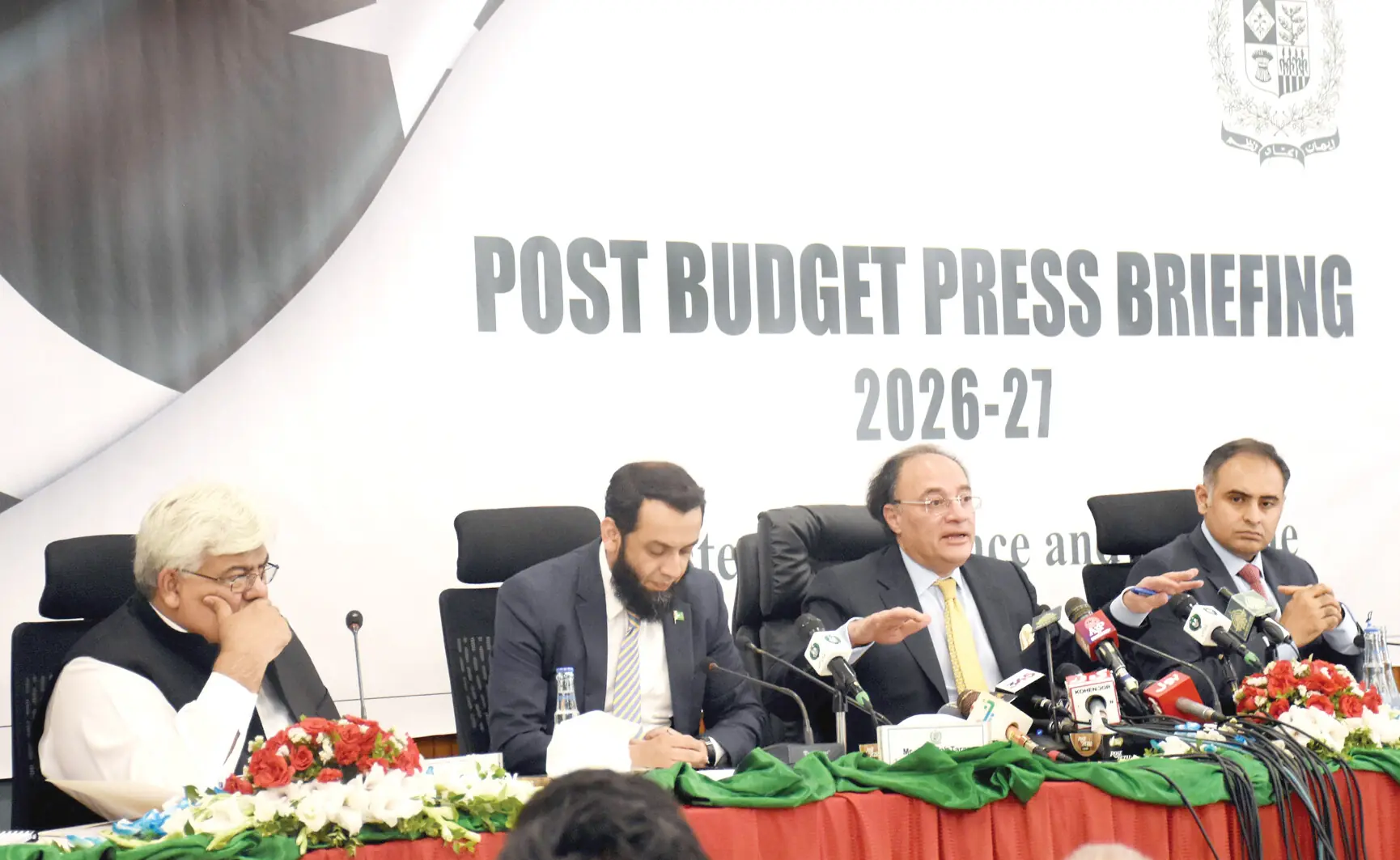
ISLAMABAD: Finance Minister Muhammad Aurangzeb on Saturday said that the 2026–27 Budget reflects the government’s commitment to shifting the economy from stability towards export-led growth, while embedding measures to create an enabling environment that are backed by tax incentives for various sectors.
“In this budget, we have made significant progress in the direction of travel — towards economic growth from economic stabilization, as steps have been taken envisaging exports promotion, including the abolition of advance tax and the proposed abolition of super tax for all exporters”, said Aurangzeb, flanked by Information Minister Attaullah Tarar, Minister of State for Finance Bilal Azhar Kayani, Finance Secretary Imdadullah Bosal, Federal Board of Revenue (FBR) Chairman Rashid Mahmood Langrial and Head of the Tax Policy Office Najeeb Memon, while addressing a post-budget press conference here on Saturday.
The minister called the Budget 2026-27 people-friendly, catering for all sectors, while saying the government has reduced the tax burden on the salaried class, provided additional subsidies, and laid the foundation for export-led growth. Aurangzeb said the government had made “extraordinary progress” in the budget and had fulfilled its promise to provide relief after difficult economic conditions.
READ MORE: Disgruntled salaried group gets some relief as Aurangzeb announces FY27 budget
He said a subsidy of Rs70 to Rs71 billion has been earmarked to ensure a conducive environment for exporters, who will also have access to easy financing at 4.5 per cent. He added that duties on the import of raw materials have been reduced to bring down production costs. He further noted the matter also pertained to “financing rather than just taxation”. He added that an additional subsidy of Rs70 billion has been proposed in the budget to take the Export Refinance Scheme (EFS) “to a different level”. “Some of those have been reflected in the defence budget,” he said, adding that the arrangement was expected to remain in place for the next three years.
On the 7 percent increase in salaries and pensions for all government employees, Aurangzeb said the benchmark was set on the basis of the inflation index and described the raise as “satisfactory,” given the accompanying tax relief. The Finance Secretary said the increase was granted by merging the ad hoc relief provided in 2022 and 2025. However, autonomous bodies will make their own decisions in this regard.
On taxation, the finance czar emphasised the aspects of “both deepening and broadening” the revenue collection. Affirming that digital monitoring and other measures were already leading to additional revenues, he noted that a “new tax model” presented in the parliament yesterday was in design.
“We want to take this towards automation and AI, and reduce human intervention,” he said, mentioning that the retailers’ scheme has been proposed to widen the tax base.
Noting that questions had been raised about economic growth, rather than stabilisation, Aurangzeb asserted: “We have fully utilised the fiscal space available to us. There is more to do […] The feedback we have received so far is that we have set out on the path to economic progress.”
Responding to a question, the finance minister clarified that the petroleum levy was not being increased. However, he acknowledged that the government “keeps interchanging the amount between petrol and diesel”, but there was no proposal to increase it.
Terming population growth an “existential issue”, he affirmed that the government was working on a comprehensive plan. “When the next NFC (National Finance Commission) award is allocated, this particular allocation driver has to be reviewed and has to change,” he said. Speaking about tariffs, the finance minister noted that the government was in the second year of the five-year plan “in terms of bringing the cost down in terms of intermediate goods and the raw material”
Copyright Business Recorder, 2026

ISLAMABAD: Finance Bill 2026 has increased the rate of minimum tax from 0.25 percent to 0.5 percent in case of distributors, dealers, and sub-dealers, wholesalers of packaged goods, fertilisers, locally manufactured mobile phones, sugar and electronics.
Tax experts explained that in the Second Schedule of the Income Tax Ordinance, Part II, many amendments have been proposed through Finance Bill 2026. They included:
(i); Tax under section 153 (1) (b) on terminal operators was 15 percent; now it has been proposed to be at the rate of 12 percent of the gross amount of payment.
(ii); The rate of minimum tax under sub section (1) of Section 113, in case of distributors, dealers, sub-dealers, wholesalers of packaged goods, fertilisers, locally manufactured mobile phones, sugar and electronics has been proposed to be increased from 0.25 percent to 0.5 percent.
(iii); Currently, tax on any payments received by manufacturers of iron or steel products relating to sale of goods manufactured by them is adjustable. The Bill has proposed to make such deduction as minimum tax.
(iv); The exemption from withholding tax under Section 153 on companies operating trading houses has been proposed to be revoked.
(v); The rates of taxes on sale or transfer or purchase of immovable for late filers have been proposed to be omitted.
Copyright Business Recorder, 2026
ISLAMABAD: The government has granted an exemption of sales tax on import of capital goods for upgradation and overhaul of existing refineries as part of a package of sales tax relief measures announced in the Finance Bill 2026-27 aimed at supporting key sectors of the economy and promoting investment.
The Finance Bill 2026-27 contains a series of sales tax relief measures covering the refinery, electric vehicle, aviation, shipping, publishing and healthcare sectors.
The Finance Bill proposes exemption from sales tax on magazines and abolition of sales tax on tampons.
READ MORE: Additional ST introduced: New measures proposed to curb abuse of import concessions
The Finance Bill has also extended till June 30, 2027 the exemption available on import of Completely Knocked Down (CKD) kits for electric vehicles. The sunset clause applicable to electric vehicles has also been extended up to June 30, 2027.
The Finance Bill further enhances the scope of sales tax exemption on aircraft parts imported or leased by Pakistan International Airlines Corporation Limited (PIACL).
The government has also granted exemption of sales tax to promote strategic investment in the shipping sector and provides exemptions on specified imports required for the Shanghai Cooperation Organisation (SCO) Summit and ongoing counter-terrorism operations.
The Finance Bill, however, proposes withdrawal of the existing sales tax exemption on family planning devices.
On the revenue side, the Finance Bill proposes expansion of the Third Schedule of the Sales Tax Act to ensure payment of sales tax at consumer prices by manufacturers at the manufacturing stage.
The Finance Bill also introduced withholding of sales tax by toll manufacturers from unregistered buyers and expands the scope of withholding sales tax by Associations of Persons (AOPs) and individuals on purchases from unregistered persons.
The Finance Bill further proposed recovery of three percent value-added tax from manufacturers where imported raw material is sold in the same state without being used in manufacturing.
The Finance Bill seeks rationalisation of penalties on certain sales tax offences and proposes inclusion of three additional offences in Section 33 of the Sales Tax Act for imposition of penalties.
The Finance Bill contains a wide range of measures aimed at streamlining sales tax administration through increased digitalisation and automation.
The Finance Bill introduces definitions relating to advance receipt invoice, algorithmic settlement mechanism, electronic invoicing system, national faceless centre and production monitoring system.
The government has also proposed streamlining the definition of Tier-1 retailers by including retailers having annual turnover of Rs200 million or more within the category.
The Finance Bill clarifies the timing of delivery of goods to recipients and authorises the Federal Board of Revenue (FBR) to outsource the valuation of goods.
The Finance Bill further proposes a new mechanism for taxation of the steel sector based on monthly electricity consumption through amendments in Section 6 of the Sales Tax Act.
The Finance Bill empowers the FBR to increase or decrease the limit of input tax adjustment under Section 8B and introduces electronic issuance of debit and credit notes for adjustment purposes. The government has also introduced a new Section 11H relating to faceless audit and assessment, while new provisions relating to faceless jurisdiction, faceless appeals and establishment of a National Faceless Centre have also been proposed.
The Finance Bill also seeks to discourage fake and flying invoices through amendments in Section 21 and makes issuance of invoices mandatory for exempt supplies through changes in Section 23.
Copyright Business Recorder, 2026
ISLAMABAD: The Federal Board of Revenue (FBR) has significantly increased the Active Taxpayers List (ATL) surcharge in the Federal Budget 2026-27, in a move aimed at accelerating documentation of the economy and broadening the tax base.
Under the revised rates announced through Finance Bill 2026, the penalty for non-filers to be added to the ATL has been raised across all categories. For individuals, the surcharge jumps from Rs. 1,000 to Rs. 25,000. For Associations of Persons, the range has been increased from Rs. 10,000 to Rs50,000, and for companies it rises from Rs. 20,000 to Rs. 100,000.
The ATL surcharge is applied to taxpayers who are not on the FBR’s Active Taxpayers List when availing services such as banking, vehicle registration, and property transactions. The steep increase signals the government’s intent to penalize non-compliance more heavily while offering relief to those who file returns.
This is a good and wise move towards documentation of the economy,” said Waheed Shahzad Butt, a tax lawyer. For too long, the cost of staying outside the tax system was trivial compared to the benefits of evasion. By raising the ATL surcharge to Rs. 25,000 for individuals and Rs. 100,000 for companies, the government has finally made non-compliance expensive. It creates a direct financial incentive for people to file returns and join the documented economy.
Butt noted that Pakistan’s tax-to-GDP ratio remains among the lowest in the region and broadening the base is critical for fiscal sustainability.
Penalizing non-filers while giving relief to compliant salaried individuals is the right balance. It rewards those who are already in the system and pressures the undocumented sector to come forward, Waheed added.
Effectiveness of the ATL surcharge hike will depend on FBR’s enforcement and ease of filing. Critics warned that without simplification of the return process, higher penalties could push more activity into the informal sector. Supporters argue that the sharp increase finally aligns the cost of non-compliance with the policy goal of documentation.
The revised ATL surcharge will take effect from July 1, 2026, along with other measures in the Finance Bill 2026.
Copyright Business Recorder, 2026
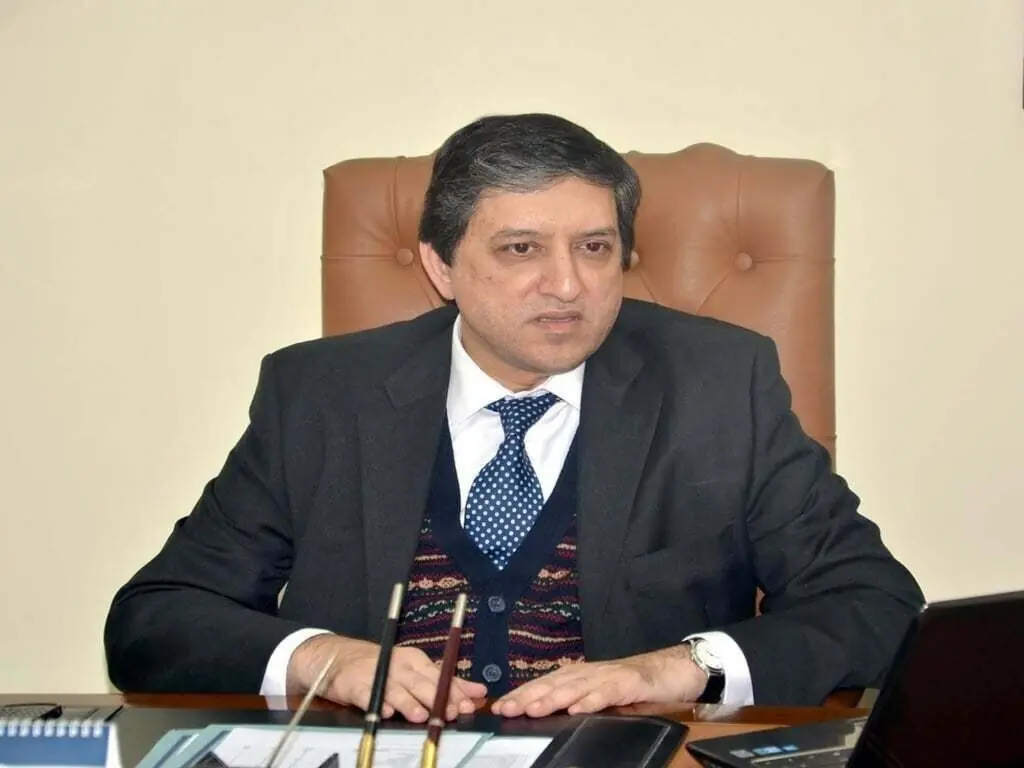
ISLAMABAD: The Senate Standing Committee on Finance Saturday approved a customs proposal under the Finance Bill 2026 to outsource the auction process of seized goods to third parties.
The Senate Standing Committee on Finance and Revenue, under the chairmanship of Senator Saleem Mandviwalla, met at Parliament House to consider and finalise its recommendations on the Finance Bill 2026-27, containing the Annual Budget Statement laid before the House on 12 June under Article 73 of the Constitution.
The preliminary session of the Committee commenced with a clause-by-clause examination of the Customs Act, 1969, during which recommendations and observations of Committee members were sought on the proposed amendments. It continued deliberations throughout the day on various provisions of the Finance Bill 2026-27, including customs and sales tax measures.
The meeting was attended by Federal Minister for Finance and Revenue Senator Muhammad Aurangzeb, Minister of State for Finance Bilal Azhar Kayani, Senator Sherry Rehman, Senator Abdul Qadir, Senator Syed Faisal Ali Subzwari, Senator Shahzaib Durrani, while Senator Anusha Rehman Ahmad Khan participated virtually.
During discussions on the budgetary proposals, Chairman Committee Senator Saleem Mandviwalla observed that new experiments were conducted every year through the federal budget. He noted that many changes introduced over the past ten years were subsequently withdrawn. He questioned the rationale of pursuing measures that did not produce accurate results.
Officials of the Federal Board of Revenue informed the Committee that the Prime Minister had established a Tax Policy Office to keep tax policy formulation separate from tax administration.
Senator Abdul Qadir expressed concern that the super tax was discouraging investment in Pakistan.
Senator Sherry Rehman observed that provincial tax collection performance was improving and, in some areas, showing better results than the FBR. She further stated that it remained uncertain whether the FBR would be able to achieve its annual tax collection targets.
The Committee also reviewed a proposal seeking authority for the FBR to impose fines for violations of customs laws.
Senator Anusha Rehman opposed the proposal, stating that such authority belonged to the government and should not be delegated to the FBR board. She informed the Committee that the authority had instead been placed with the Federal Finance Minister.
The Committee considered an FBR proposal to outsource the auction process of seized goods to third parties. Officials maintained that the private sector should conduct auction activities instead of customs officers. Following deliberations, the Committee approved the proposal.
A significant discussion took place on customs clearance procedures. It was proposed that a fixed customs clearance period for imports should be determined. The proposal received support from Chairman Committee Senator Saleem Mandviwalla and other Committee members.
Copyright Business Recorder, 2026
ISLAMABAD: National Assembly Standing Committee on Finance Saturday expressed serious concern over the proposed fixed tax scheme for traders, shopkeepers and retailers under the Finance Bill 2026, which it said would create distortions in the tax system.
A meeting of the Standing Committee on Finance and Revenue was held Saturday at the Parliament House under the Chairmanship of Syed Naveed Qamar, MNA. A team of financial experts presented the “Post-Budget Analysis of the Federal Budget FY 2026–27” before the Committee. The experts briefed the Committee on macroeconomic assumptions, revenue measures, expenditure priorities, development allocations, tax reforms, and the overall fiscal outlook.
The Committee reviewed tax policy measures announced in the budget, including relief for salaried taxpayers, reductions in selected customs duties, incentives for exporters, and reforms relating to the property sector. Particular concern was expressed over the newly proposed retailer tax scheme.
READ MORE: Govt to impose 1pc tax on retail sales up to Rs200m
The Committee observed that the scheme could create distortions within the tax system, discourage compliance under the normal tax regime, and potentially erode the existing tax base.
Syed Naveed Qamar observed that the Federal Budget FY2026-27 remains heavily focused on revenue generation and fiscal consolidation, while offering limited measures to stimulate economic growth, investment, and employment.
He expressed concern over the continued practice of setting ambitious revenue targets despite repeated shortfalls in tax collection. He questioned the rationale behind imposing additional taxation on citizens while simultaneously maintaining large primary surpluses and compressing development expenditure under International Monetary Fund (IMF) Programme requirements.
During the briefing, the Committee was informed that the budget has been formulated within the framework of Pakistan’s ongoing IMF Programme, with fiscal consolidation and achievement of primary surplus targets serving as the principal policy objectives. The government has projected GDP growth of 4 percent and inflation of 8.2 percent for FY2026–27, while total federal expenditure is estimated at approximately Rs18.7 trillion.
The Committee discussed the requirement for substantial provincial fiscal surpluses under the IMF Programme and questioned the policy rationale of collecting additional revenues from taxpayers while restricting public expenditure and development spending.
Copyright Business Recorder, 2026

ISLAMABAD: The trade bodies and business leaders nationwide have hailed the Federal Budget 2026-27 as a business-friendly, growth-driven and balanced fiscal roadmap, praising the government for introducing measures aimed at boosting economic activity, encouraging investment and supporting sustainable development.
Federation of Pakistan Chambers of Commerce and Industry (FPCCI) and other business organisations congratulated Prime Minister Shehbaz Sharif, Deputy Prime Minister Ishaq Dar, Finance Minister Senator Muhammad Aurangzeb and the economic team for presenting an excellent and public-oriented budget.
The FPCCI said the federal budget 2026-27 is a positive step for the stability of the country’s economy, promotion of investment and increase in business activities. The business community will continue to cooperate with the government and play a role in promoting economic growth and investment.
READ MORE: Business leaders offer mixed response to Budget 2026-27
It said that the budget is a positive step for the stability of the country’s economy, promotion of investment and increase in business activities. The business community will continue to cooperate with the government and play a role in promoting economic growth and investment.
It called the federal budget 2026-27 a positive step for the stability of the country’s economy, promotion of investment and increase in business activities.
The Pakistan Business Council, while congratulating the Finance team said that the government was taking key stakeholders on board in framing important economic policies
This is very refreshing and augers well for the future, it said, adding that this will greatly improve the business environment and improve the lives of many salaried individuals. It expressed the commitment to continue work closely with the government for the betterment of our country and the citizens in the country.
Meanwhile, President Rawalpindi Chamber of Commerce and Industry (RCCI) Usman Shaukat appreciating the federal budget said that the reduction in taxes for the salaried class and the decrease in super tax are welcome steps.
He also appreciated the tax relief provided to the IT sector, noting its vital role in promoting exports and employment. He welcomed the allocation of Rs. 88 billion under the Export Finance Scheme, describing it as a positive initiative.
RCCI Group Leader Sohail Altaf welcomed the Fixed Tax Scheme but pointed out that the mechanism for its implementation has not yet been clarified.
The Pakistan Banks Association (PBA) also welcomed the Federal Budget as the first in years to move beyond crisis management and make deliberate choices for growth, without abandoning the discipline that earned Pakistan its recovery.
Commenting on the budget, Zafar Masud, Chairman PBA said: “this is a budget the industry can welcome and build on. The conditions for priority-sector lending are the best in over a decade. We intend to use them”.
The Overseas Investors Chamber of Commerce and Industry (OICCI) also welcomes the Federal Budget 2025–26 and termed the budget crafted under significant fiscal pressure, IMF commitments, external imbalances and the residual weight of years of consolidation.
The OICCI welcomes the partial rationalisation of the super tax, abolition for income slabs between Rs150 million and Rs500 million, and a reduction from 10 percent to 8 percent for income above Rs500 million. It said that measures introduced in budget will eases pressure on mid-sized formal enterprises and is consistent with the chamber’s long-standing advocacy.
Similarly, the rationalisation of advance tax rates in the real estate sector — sections 236C and 236K reduced and converted to flat rates of 2.75 percent and 1.5 percent respectively — is a constructive step to revive the economic activity.

ISLAMABAD: The federal government has constituted two anomaly committees (business and technical) to identify and remove business and technical-related anomalies in the Finance Bill 2026.
In this regard, the FBR has issued two notifications here on Saturday.
According to an official notification issued by the Finance Division, the Technical-committee has been constituted by the Minister for Finance and Revenue and will review business-related anomalies submitted by stakeholders and advise the Federal Board of Revenue (FBR) on their removal.
READ MORE: Access Finance Bill 2026-27 here
The terms of reference (TORs) of the committee included reviewing anomalies identified and submitted by stakeholders and advising the Tax Policy Office on their removal.
The committee will be headed by Muhammad Raza of AF Ferguson & Co., Karachi, while Dr. Najeeb Ahmad Memon (Director General, Tax Policy Office), Hamid Ateeq Sarwar (Member Strategic Transformation), Sajjad Taslim Azam (Member IR-Policy, FBR), and Ashhad Jawad (Member Customs Policy, FBR) have been appointed as co-chairpersons.
The committee included representatives from tax bars, professional bodies, the business community and government departments, including AF Ferguson & Co., Karachi Tax Bar Association, EY Ford Rhodes, National Tariff Commission, Commerce Division, Institute of Cost and Management Accountants of Pakistan (ICMAP), and Pakistan Tax Bar Association.
The notification stated that anomalies related to the Finance Bill 2026 can be submitted to the committee by June 20, 2026 at Room No. 607, 6th Floor, Q-Block, Pak Secretariat, Islamabad. Stakeholders can also contact the committee through the provided email and telephone number.
Under the second notification, Ministry of Finance has constituted a high-level Anomaly Committee-Business to identify and remove business-related anomalies in the Finance Bill 2026.
The committee will be headed by Javed Kureishi, CEO Pakistan Business Council, while Dr. Najeeb Ahmad Memon, Director General Tax Policy Office (TPO) and Hamid Ateeq Sarwar, Member Strategic Transformation, will serve as co-chairpersons.
The committee includes senior officials of the Federal Board of Revenue (FBR) and representatives of leading business organizations, including FPCCI, Lahore Chamber of Commerce and Industry (LCCI), Karachi Chamber of Commerce and Industry (KCCI), Rawalpindi Chamber of Commerce and Industry (RCCI), Sialkot Chamber of Commerce, Pakistan Textile Exporters Association (PTEA), Overseas Investors Chamber of Commerce and Industry (OICCI), and Pakistan Business Council.
Copyright Business Recorder, 2026
ISLAMABAD: The federal government has reduced allocations under key climate spending categories in Budget 2026-27 but sharply increased disaster-related funding, while proposing a Rs50 billion Climate Support Levy and identifying Rs476 billion in green subsidies to support climate resilience efforts.
Budget documents show that adaptation spending has been reduced to Rs70.46 billion from Rs85.44 billion in the previous budget, while mitigation allocations cut to Rs124.07 billion from Rs603 billion and funding for supporting areas to Rs19.49 billion from Rs28.33 billion.
The allocations are part of the government’s climate-tagged expenditure framework covering adaptation, mitigation, and climate-supporting activities.
In contrast, the government has significantly expanded disaster-related spending. Allocations for preparedness have increased to Rs42.84 billion from Rs33.16 billion, while response-related spending has been more than doubled to Rs32.77 billion from Rs15.88 billion. Funding for recovery and rehabilitation has surged to Rs21.49 billion from Rs1.14 billion, while Rs19.14 billion has been earmarked for reconstruction activities, compared with no allocation under this head in the previous budget.
The budget also includes an Rs20 billion emergency provision for natural disasters triggered by natural hazards and Rs150 million for climate change conferences and forums, reflecting the government’s efforts to strengthen disaster resilience and engagement in international climate processes.
Separately, the government has identified Rs476 billion in green components of subsidies for FY2026-27. The largest allocation is in the energy sector, where Rs423 billion has been classified as mitigation-related spending under Category-A (directly favourable). The agriculture sector has been allocated Rs21 billion, and the food sector Rs19 billion under adaptation-related subsidies classified as Category-B (indirectly favourable).
Similarly, industries have been allocated Rs8 billion under mitigation-related green subsidies, while the transport sector has received Rs5 billion, also classified as mitigation spending. These subsidies form part of the government’s broader framework to promote cleaner energy, climate adaptation, and environmentally sustainable economic activity.
Analysts said the budget presents a mixed picture for climate financing. While direct allocations for adaptation, mitigation, and supporting climate measures have declined, the sharp increase in disaster preparedness, response, rehabilitation, and reconstruction spending suggests a greater focus on coping with the impacts of climate change and extreme weather events.
The allocations come as Pakistan continues to face growing climate-related challenges, including floods, droughts, glacial melt, and heatwaves, while seeking greater international climate financing under its adaptation and resilience agenda.
Experts say the effectiveness of the measures will depend on implementation and the government’s ability to translate budgetary commitments into tangible projects that strengthen climate resilience and protect vulnerable communities.
Copyright Business Recorder, 2026
ISLAMABAD: The federal government has included green subsidies in the budget for the next fiscal year, with Rs476 billion allocated for green equipment under the proposed plan.
According to budget documents, the subsidies will be provided under the Green Initiative project to support the environment-friendly measures across key sectors.
The energy sector has received the largest allocation under the green subsidy plan. According to the document, Rs423 billion has been allocated for green subsidies in the energy sector for the next fiscal year.
The budget document proposes Rs19 billion in green subsidies for the food sector. For the industrial sector, Rs8 billion has been allocated, while Rs5 billion has been proposed for the transport sector.
The agricultural sector will receive Rs21 billion in green subsidies during the next fiscal year. The allocation is aimed at supporting environment-friendly initiatives and reducing pollution linked to agriculture-related activities.
According to the document, every ministry will be required to take steps to reduce environmental pollution. The government will provide these subsidies under the Green Initiative project as part of its broader effort to promote cleaner practices and support green development.
Copyright Business Recorder, 2026
KARACHI: Ismail Suttar, founder chairman Salt Manufacturers Association Pakistan (SMAP) has expressed serious reservations over the federal budget for 2026-27, arguing that the government has failed to introduce measures capable of delivering meaningful growth in exports at a time when the country urgently needs foreign exchange earnings.
Suttar said the budget lacked a coherent roadmap for expanding Pakistan’s export base and addressing challenges confronting manufacturers. He noted that despite repeated assurances of support for the productive sectors, exporters had received little beyond marginal tax adjustments.
According to him, one of the biggest disappointments was the government’s decision not to restore the Final Tax Regime (FTR) for exporters. He said the export sector had sought a straightforward tax framework that would minimise compliance costs and reduce interaction with tax authorities. “Reducing the withholding tax rate while keeping exporters within the normal tax regime does not solve the problem,” he observed. “Businesses need predictability and simplicity, not additional paperwork and procedural complications.”
Suttar warned that Pakistan’s regional competitors were aggressively facilitating exporters through tax incentives, lower production costs and simplified regulations, whereas the latest budget had offered no comparable relief.
Copyright Business Recorder, 2026

KARACHI: The Pakistan Business Forum (PBF) has expressed concerns over several key aspects of the Federal Budget 2026-27, stating that the budget falls short of delivering the bold and transformative measures required to accelerate industrial growth, enhance exports, revive agriculture, and generate employment opportunities.
PBF President Khawaja Mehboob-ur-Rehman noted that the government has set a target of increasing petroleum levy collections by 18 percent, a move that raises concerns about continued inflationary pressures instead of providing meaningful relief to consumers and businesses. Higher petroleum-related taxation is likely to keep transportation and production costs elevated across the economy.
The Forum said that the budget does not offer significant incentives capable of boosting exports and improving Pakistan’s international competitiveness. At a time when export-led growth is essential for economic stability, the absence of strong export-oriented measures represents a missed opportunity.
PBF also highlighted the government’s silence on industrial energy tariffs.
According to the Forum, industries operating at nearly half of their production capacity cannot be revived without substantial reductions in energy costs. “While industry was expecting a more comprehensive package to restore competitiveness and attract investment, the relief measures announced remain limited”.
However, PBF welcomed the government’s decision to reduce the Super Tax by two percent and completely abolish Super Tax for businesses with annual turnover of up to Rs.500 million.
The Forum described this measure as a positive and commendable step that will provide relief to a significant segment of the business community included given relief to real estate and construction sector.
The Forum also expressed concern over the continued expansion of the undocumented economy.
“It noted that the size of the cash economy has reportedly increased from approximately Rs.9 trillion to Rs.12 trillion within a year, describing this trend as a clear indication of policy shortcomings and the failure to adequately document economic activity”.
PBF further viewed the continuation of the Minimum Tax on Turnover and Alternative Minimum Tax under Section 113 of the Income Tax Ordinance 2001.
The Forum maintained that these taxes impose an unfair burden on low-margin sectors, regardless of profitability, and discourage business expansion and investment.
On national security, PBF acknowledged the allocation of Rs.3 trillion for defence, stating that in the aftermath of Operation Bunyan-un-Marsoos and in view of prevailing regional security challenges, strengthening national defence preparedness and safeguarding territorial integrity are essential priorities.
PBF President also expressed deep concern over the lack of meaningful support for agriculture and cotton revival. PBF stated that expectations were high that the government would announce GST reduction on cotton seed, cotton by-products, and agricultural inputs to revive cotton cultivation. Unfortunately, these expectations were not met.
PBF warned that country may be forced to import nearly US$1 billion worth of cotton during the current year due to declining domestic production. The Forum further observed that achieving the national cotton production target may become increasingly challenging under current conditions.
Similarly farming community had also anticipated reductions in duties and taxes on fertilisers and other agricultural inputs to lower production costs. Such measures could have enhanced agricultural productivity and contributed significantly toward GDP growth targets.
However, agriculture, despite being a critical pillar of Pakistan’s economy, has once again received inadequate attention in the federal budget.
According to PBF, the budget is unlikely to reduce the cost of doing business for farmers and may instead maintain existing financial pressures on the agricultural sector.
Copyright Business Recorder, 2026
It makes sense for the government to take lesson from a Japanese saying: ‘If you get on the wrong train, get off at the nearest station, the longer it takes you to get off, the more expensive the return trip will be.’
While following the neoliberal, and austerity policy, successive governments over the decades have missed many ‘stations.’ Hence, the budget needs to take a bigger, more pro-active, and outcomes-based, mission-oriented approach, by adopting a non-austerity, counter-cyclical approach. Policy prioritization through budget – federal and those of federating units – should meaningfully reflect this policy direction.
In terms of the budget, this would mean preparing revenue, and expenditure policies that reflect this revised philosophical underpinning.
READ MORE: Policy philosophy correction budget needed–I
Overall, the budget revision should aim for a relatively balanced policy emphasis across both the demand and supply sides. To achieve this, it will be necessary to adjust the policy approach primarily within the IMF’s Extended Fund Facility (EFF) program, while also pushing for greater ambition on the Resilience and Sustainability Facility (RSF) side. Here, it needs to be pointed out that bringing this revision in policy is likely to be the only way to come out of a virtually endless cycle of IMF programmes over the last four decades or so.
On the revenue side, the principle of equitability in terms of tax burden, that is there should be progressivity of tax, keeping base of tax high and rates on lower side. Here, ability to pay tax should mean transitioning in a purpose-oriented way away from regressive, indirect, or consumption tax, to direct income tax to follow the principle of ability to pay, which, in turn, comes from income, and wealth. Moreover, the principle of the Laffer Curve should be kept in mind, whereby after a certain threshold, higher tax rates yield less revenue. This happens because people are disincentivized to work, only aspiring to earn the bare minimum since excessive taxes take such a large portion of their income. That, in turn, negatively impacts volume of taxable income, saving, investment – including investment in green transition – growth, and resilience, while likely enhancing overall poverty levels.
In addition, tax cuts should be used as an incentive to direct investment to reach higher levels of productive and allocative efficiencies. Here, Given the exceptional situation of the Middle East crisis, governments need greater fiscal space to reduce the tax burden on vulnerable sectors and consumers hardest hit by soaring input prices—such as oil and fertilizer. This requires creative taxation policies, such as implementing meaningful wealth taxes and taxing the windfall profits of energy companies.
All the above will result from non-neoliberal mindset with a much more proactive, symbiotic role of public sector with regard to private sector, and markets, while lowering transaction costs.
Here, in terms of giving tax breaks, government should make better contracts with private sector so that profits earned through such breaks are not invested in financial sector – for instance, in terms of share buy-backs – for the sake of enhancing profits, but are not invested in the real economy for positive impact on growth, employment, and poverty; all economic aspects, which are in very difficult situation. To augment this better reorientation of profits, deeper, and wider income taxes should be placed in the financial sector to disincentivize such investments.
Infrastructure spending, especially in terms of enhancing water resource management, for example, in terms of building more dams or for enhancing energy security, and transforming it in a mission-oriented way to move towards green sources of energy should mean tax incentives on important inputs involved – imported, and domestic – that are important to enhance infrastructural investment by both public, and private sectors. Such infrastructural investment, when employed in a non-neoliberal with greater economic direction provided by government towards reaching high level of productive and allocative efficiencies (China is a case in point) result in counter-cyclical policy emphasis, and that too in a highly meaningful way for bringing sustainability to the economy in general.
Overall, better rationalized revenue, and expenditure policies, should mean, for instance, removing the burden of indirect taxation in electricity bills to meet capacity charges needs being generated from the fossil-fuel based electricity grid, which should also mean removal of taxation on green sources of energy to retain traffic on the grid. The grid should be managed by involving greater targeted investments to utilize that energy with a special focus on industrial policy – and employing the budget in that direction – which would generate capacity to utilize excess electricity capacity while rolling back the grid as contracts of independent power producers (IPPs) expire, replacing them with green energy developed in a mission-oriented way during this time. Over the years, if fiscal resources can be generated, it is better not to wait for expiry of IPP-related contracts, and their expenditure is met through off-budget secondary market sources, and innovative ‘debt for development’ swaps. This approach addresses expenses in a way that helps build green energy base, and accelerate shift to greener sources at the earliest possible, reducing price distortions by adjusting how taxes reflect capacity charges in electricity bills.
Hence, revenue side of the budget, in the spirit of taking counter-cyclical policy approach to reach much-needed gains on stability, inclusivity, growth, and resilience aspects requires incentivizing agricultural productivity, and industrialization in a proactive, non-neoliberal way, which means giving targeted tax breaks and, on the expenditure side, giving subsidies and making higher level of development expenditure. To deter banks from lending to the government, it is important to increase taxes on interest earned from public sector lending while maintaining a much lower tax rate on loans to the private sector. This shift will incentivize banks to lower interest rates and increase the supply of loanable funds.
On the expenditure side, in addition to expenditure-related matters discussed above, development spending should be enhanced with greater footprint of public sector under the non-neoliberal policy approach to create much-needed policy space for private investment. This will also allow government to better direct investment in areas that enhance inclusivity, resilience, and growth. For that reason, it is important to move away from targeting primary surplus to reducing fiscal deficit, which would mean primarily putting pressure on government to enhance tax base and increase growth to reduce borrowing needs and, in turn, reduce interest payments-related expenditure, which is a huge ticket-item on the expenditure side. Here, taking a non-monetary austerity approach to rein in inflation through a much more balanced aggregate demand- and supply-side policies, would in turn mean much less interest payment related expenditure, and greater fiscal envelope to increase development spending.
Last but not the least, fiscal federalism needs to be restructured to better align the responsibilities shifted to the federating units under the 18th Constitutional Amendment with the expenditure requirements incurred from transferred resources under the National Finance Commission (NFC) award.
That would better rationalize expenditure side and revenue raising needs of the Centre and federating units.
Copyright Business Recorder, 2026
The writer holds a PhD in Economics degree from the University of Barcelona, and has previously worked at the International Monetary Fund. His contact on ‘X’ (formerly ‘Twitter’) is @omerjaved7
ISLAMABAD: The opposition Pakistan Tehreek-e-Insaf’s (PTI) farmers wing on Saturday rejected the federal budget 2026-27, terming it “anti-farmer” and insufficient to address structural problems in the agriculture sector, calling for a comprehensive agricultural policy along with immediate relief on key inputs.
Speaking at a press conference, PTI’s farmers wing spokesman Khalid Nawaz Sadhraich, along with other party leaders, said the budget failed to provide meaningful support to the rural economy and relied on “superficial incentives” instead of long-term reforms.
They also questioned inconsistencies in official data presented in the Economic Survey, noting that agricultural growth for 2024-25 had been revised from 0.56 percent to 1.53 percent without explanation, and demanded clarification from the government.
The leaders said the sector, which they claimed had shown strong growth above 6 percent two years ago, had now slowed sharply, with recent growth cited by them at around 0.65 percent, reflecting worsening structural conditions.
The wing highlighted a sharp decline in cotton production, cultivated area, and ginning activity, warning that it could affect exports, rural employment, and overall economic stability.
They also pointed to rising input costs, particularly fertilisers such as nitrophos and SSP, saying the increase had significantly raised the cost of production for farmers.
They said declining tractor production and sales reflected reduced affordability of agricultural machinery for small farmers, and criticised the government’s decision to exempt duties on farm machinery, arguing it could disproportionately benefit large landowners and importers.
The leaders further warned that rising poverty was contributing to reduced consumption of milk, meat, and pulses, describing it as a potential food security concern.
They said Pakistan’s heavy reliance on imported edible oil – about 90 percent of domestic demand – posed a serious vulnerability.
Describing water scarcity as a “national security issue,” they said recurring floods and droughts continued to damage agriculture, and criticised the absence of a comprehensive relief package for farmers affected by the 2025 floods.
On exports, they said insufficient attention had been given to cold chain infrastructure, export certification standards, residue limits, and logistics, arguing that weaknesses in agriculture were being masked by relatively stronger performance in livestock.
They also cited official figures showing agricultural growth at 2.89 percent while claiming food exports had fallen by around USD 1.5 billion, including a USD 1.1 billion drop in rice exports, which they said reflected policy failures.
The party’s farmers wing demanded immediate relief on agricultural electricity and diesel, restoration of targeted subsidies on fertilisers and seeds, and a clear support price mechanism for wheat and cotton.
They also called for reduced taxes on agricultural machinery, special tariffs for tube wells, and interest-free agricultural loans.
Among other proposals, they called for a cotton revival programme, irrigation and water storage investment, crop insurance, agri-tech funding, cold
chain expansion, and edible oil self-sufficiency.
Copyright Business Recorder, 2026
HYDERABAD: Hyderabad SITE Association of Trade and Industry Chairman Zubair Ghangra, Senior Vice President Aamir Shahab and Vice President Esar Kumar, in their detailed and joint response to the federal budget 2026-27, have said that the government’s tariff reforms, improvements in the tax system and some digitalization measures are partially positive developments for the industrial and commercial sector, however, overall this budget appears to fail to meet the country’s real economic needs, industrial development, employment promotion and export expansion goals.
He said that the reduction in the cost of industrial raw materials and machinery through reduction in customs duty, additional customs duty and regulatory duty under the National Tariff Policy 2025-30 is a positive step, while measures such as relief on agricultural machinery, reduction in withholding tax on exports, extension of incentives for IT exports and partial reduction in super tax can be expected to improve the investment climate. However, according to him, these measures are insufficient for real industrial revival as fundamental structural problems still exist.
Office bearers of the SITE Association said that the current budget highlights limited class incentives and administrative reforms rather than the common man and the productive economy. According to them, such measures that are related only to the high-income classes or limited financial activities do not have a wide impact on the overall economy. He said that the business community is currently the most vulnerable to high energy prices, expensive loans and unstable production costs, but the budget has not presented any comprehensive strategy to address these fundamental problems.
Chairman Zubair Ghangra said that the most important factor for industrial development is the cost of energy, but no clear measure has been included to reduce electricity and gas prices. According to him, the industrial zones of Sindh, including Hyderabad division, are constantly facing basic infrastructure problems, but no special package has been unveiled for their improvement, which is regrettable.
Senior Vice President Aamir Shahab said that the main focus of the budget is on revenue collection and increasing compliance, while there is no comprehensive program for industrial expansion, development of SMEs and creation of employment opportunities. He said that the country’s economy is already burdened by debt and this budget also continues to have a huge fiscal deficit and dependence on debt, which is a dangerous trend for long-term economic stability. According to him, the same types of budgets are being presented again and again, which lack basic structural reforms.
Vice President Asar Kumar said that Hyderabad, Kotri and other industrial clusters are facing serious problems in basic infrastructure like roads, water, drainage and industrial facilities, but no significant investment has been included in the budget for these sectors. According to him, without industrial development, neither employment can be created nor can exports increase.
HSATI officials jointly said that while tariff reforms, digital reforms and limited tax relief are welcome, overall the budget reflects a traditional, un-developmental and limited thinking, which is neither sufficient for industrial revival nor provides relief to the common citizen. They said that the country needs a comprehensive economic vision that gives centrality to production, exports, employment and investment. He demanded that the government immediately present a comprehensive industrial and economic package that includes a significant reduction in energy prices, provision of easy and cheap loans to SMEs, improvement of industrial infrastructure, and special incentives for other industrial areas including Hyderabad Division, so that real and sustainable economic growth is possible.
Copyright Business Recorder, 2026
KARACHI: President of the United Business Group (UBG) and former President of the FPCCI, Zubair Tufail has described the Federal Budget 2026-27 as a guarantor of economic stability.
While appreciating the government’s tax reform measures, he also expressed concerns over the lack of effective steps to accelerate exports, address flawed export-related policies, and resolve the energy crisis.
According to a statement issued by UBG Central Spokesperson Gulzar Firoz, President United Business Group Zubair Tufail said that the allocation of Rs71 billion for the “Apna Ghar Housing Scheme” and the construction sector is an excellent initiative that will stimulate growth in the housing industry.
He also welcomed the allocation of Rs88 billion for export refinancing and increased funding for development projects and higher education.
However, he emphasized that the government needs to introduce stronger measures to promote investment, industrial expansion, export growth, reduction in business costs, and the adoption of technology.
Welcoming the presentation of the Rs18.7 trillion Federal Budget 2026-27, Zubair Tufail praised the government’s efforts toward economic stabilization but stressed that the country must now move decisively toward sustainable economic and industrial development.
He noted that the GDP growth rate has improved to 3.7 percent, the fiscal deficit has been reduced to 0.7 percent of GDP, the primary surplus has reached 3.7 percent of GDP, and the cost of servicing public debt has declined by 33 percent.
He termed the expected increase in foreign exchange reserves to $18 billion by June 30 and the rise in per capita income to $1,901 as significant achievements reflecting economic stability and fiscal discipline.
Zubair Tufail stated that bringing retailers under a fixed tax regime would certainly generate revenue for the Federal Board of Revenue (FBR), but practical implementation remains essential.
He pointed out that retailers have largely remained outside the tax net, and increasing withholding tax rates on them may create additional difficulties.
He further said that the government should have introduced more meaningful and effective measures for the improvement of the agricultural sector.
He welcomed the abolition of super tax on incomes up to Rs500 million and the reduction of the super tax rate from 10 percent to 8 percent for higher-income brackets.
He also appreciated the reduction in withholding tax on overseas payments made through debit and credit cards, lower tax rates on property transactions for tax filers, and the abolition of Federal Excise Duty on international business-class travel.
Copyright Business Recorder, 2026

KARACHI: The Pakistan Business Council (PBC) has welcomed several growth-oriented measures announced in the Federal Budget 2026-27, describing them as clear signals that sustainable, inclusive economic growth is now a priority of the government.
While welcoming these measures, PBC emphasised that sustaining growth will require policy continuity and a continued focus on structural reforms which are imperative.
Commenting on the budget, Dr. Zeelaf Munir, Chairperson, Pakistan Business Council, said, “This budget reflects that the focus is beginning to shift towards sustainable economic growth, which is encouraging for businesses and investors alike. The relief measures announced, despite operating challenges and limited fiscal space, indicate an inclusive effort to support productive economic activity for all segments of society while also maintaining engagement with key stakeholders.
These measures are welcome and meaningful; they should be viewed as necessary first steps rather than the finish line. Consistency of Policy is the key.”
Javed Kureishi, Chief Executive Officer, Pakistan Business Council, said, “This budget sends an important signal that the government is listening to the stakeholders of Pakistan’s formal economy. We are pleased to see movement on the Super Tax, relief for the salaried class, and measures that reduce the tax burden on export proceeds, improving liquidity for exporters. These are issues PBC has consistently highlighted in its discussions with policymakers, so it is encouraging to see meaningful progress on them. We would particularly like to acknowledge the Prime Minister’s personal commitment and the Finance team’s hard work. We hope this collaborative approach continues as the government moves from budget announcements to implementation. A strong partnership between government and industry will be essential to achieving Pakistan’s economic ambitions.”
PBC called on the government to maintain momentum on broadening the tax base by bringing untaxed and undertaxed sectors into the formal economy, thereby reducing the burden on compliant taxpayers.
PBC also urged for accelerated energy sector reforms to bring industrial energy costs closer to regional benchmarks, faster privatisation of loss-making state-owned enterprises, and the adoption of a three-year reform framework that provides businesses with the certainty needed to plan, invest and grow.
Investor confidence will ultimately depend on consistency, predictability, and effective implementation. Businesses need confidence that reforms will continue beyond a single budget cycle. These reforms must remain central pillars of the government’s agenda if Pakistan is to achieve durable and inclusive economic growth.
PBC also acknowledges the hard work and commitment of the government’s economic team throughout the budget process and looks forward to continuing its engagement with policymakers to help advance Pakistan’s economic objectives.
The constructive dialogue between the government and the private sector in the lead-up to the budget is encouraging and reflects a shared commitment to the country’s long-term prosperity.
Pakistan’s long-term economic transformation will depend on sustained reforms, policy continuity, and a shared commitment between government and industry to build a more competitive and prosperous economy.
Copyright Business Recorder, 2026

Federal Minister for Maritime Affairs Muhammad Junaid Anwar Chaudhry said on Saturday that the government’s decision to abolish the 18% sales tax imposed on the shipping industry was an important step toward strengthening the maritime economy.
The minister said that the removal of sales tax will promote the maritime and logistics sectors and is expected to reduce business costs significantly.
He further said that the competitive strength of local shipping companies will improve and will create new investment opportunities.
“The growth of the local shipping industry will increase employment opportunities,” the minister said.
Aurangzeb on Friday unveiled a Rs18.77 trillion federal budget for fiscal year 2026-27, extending relief to the salaried class and offering tax incentives to the real estate and construction sectors, as well as exporters, to revive industry, promote investment, and steer the economy towards a 4% growth target.
Despite facing an estimated revenue shortfall of around Rs1 trillion in the outgoing fiscal year, the government has set an ambitious revenue target of Rs15.264 trillion for FY2026-27. Against the revised revenue estimate of Rs12.983 trillion for the current fiscal year, the target reflects a robust 17.6% growth in revenue collection for the next year.
KARACHI: Federation of Pakistan Chambers of Commerce and Industry (FPCCI) on Friday said the federal budget 2026–27 does not contain any meaningful measures to reduce industrial production costs for exporters, a key demand of the business community aimed at enhancing Pakistan’s export competitiveness in international markets.
Speaking at a press conference at Federation House following the presentation of the federal budget in the National Assembly on Friday, FPCCI President Atif Ikram Sheikh and Senior Vice President Saqib Fayyaz Magoon presented the business community’s detailed reaction to the federal budget 2026–27, which has a total outlay of Rs18.7 trillion.
They termed the budget a mixed package, acknowledging several positive measures while pointing out key gaps in structural reforms.
They congratulated the government on presenting its third federal budget, describing it as an important milestone reflecting policy continuity and an opportunity for long-term economic reforms.
They also appreciated the efforts of the government, its economic team, and FPCCI leadership for steering the economy towards stability under challenging conditions.
They noted improvements in key macroeconomic indicators, including GDP growth of 3.7 percent, fiscal deficit reduced to 0.7 percent of GDP, a primary surplus of 3.7 percent, and a 33 percent reduction in debt servicing costs.
Foreign exchange reserves are projected to reach USD 18 billion by June 30, while per capita income has risen to USD 1,901 from around USD 1,500.
However, they cautioned that investment remains low at 14.38 percent of GDP, savings at 14.3 percent, industrial recovery remains uneven, and urban unemployment has risen to 17 percent, indicating persistent structural weaknesses.
On the fiscal framework, they noted that the Rs15.2 trillion tax target reflects a required 17 percent increase in revenue efforts, while the Rs1.07 trillion petroleum levy could add inflationary pressure amid already elevated global oil prices.
On FPCCI’s proposals, they said several recommendations were accepted, including abolition of Capital Value Tax (CVT) on overseas assets, reduction in super tax (abolished up to Rs500 million income and reduced from 10 percent to 8 percent for higher slabs), extension of the 0.25 percent final tax regime for IT exports until 2035, reduction in withholding tax for construction-related transactions, relief for the salaried class through removal of surcharge and lower tax rates, abolition of FED on international business class travel, and introduction of a fixed tax scheme for retailers with annual sales up to Rs200 million to improve documentation.
They also welcomed allocations such as Rs71 billion for housing and construction and Rs88 billion for export refinance, along with increased development and higher education spending, and noted continued emphasis on compliance improvement and digitalisation.
However, they said several key demands were not addressed, including reduction in energy costs, corporate tax cuts, turnover tax reduction, restoration of the fixed tax regime for importers, abolition of minimum tax and further tax, reforms in Section 8B of the Sales Tax Act, and a comprehensive digital taxation framework. They also pointed out that no specific incentives were announced for overseas Pakistanis sending remittances.
Retailers, they warned, may face added pressure due to increased withholding tax rates, despite already low compliance in the sector.
FPCCI leadership said the Finance Bill would be reviewed in detail in consultation with stakeholders, after which a comprehensive response would be issued within the next few days.
They concluded that while the budget contains positive elements, it still lacks a clear roadmap for reducing production costs, expanding investment, strengthening industrial growth, boosting exports, and achieving technology-driven long-term economic transformation.
Copyright Business Recorder, 2026

ISLAMABAD: Under the Finance Bill 2026-27, the federal government has increased Federal Excise Duty on e-liquid for electronic cigarettes to Rs16,500 from Rs10,000 per kilogram, while removing the highest possible tariff of 65 percent of the retail price imposed under the previous regime.
The bill proposes a series of revenue measures under the Federal Excise Act, 2005. These include imposition of FED on naphtha, solvent oil, turpentine and other similar products. The government has also proposed imposition of FED on luxury electric vehicles and other luxury vehicles.
In addition, the bill proposes FED on base oil and base lubricating oil, in addition to lubricating oil. A new Table 1A is being inserted in the First Schedule to the Federal Excise Act, 2005, for imposition of FED on luxury imported vehicles.
The government has also proposed addition of a new entry in the Second Schedule to make FED levied on the above-mentioned petroleum products applicable in VAT mode.
On the relief side, the government has proposed reduction in FED on foreign travel. It has also proposed reduction in FED on import of acetate tow from Rs44,000 to Rs10,000.
The bill further proposes removal of FED on WHO-standard compliant sports and electrolyte-replenishing beverages. It also provides exemption to strategic imports of vehicles for the SCO summit and counter-terrorism purposes. The government has also extended exemption on import of CKD kits for electric vehicles for one year, up to June 30, 2027.
The Finance Bill also contains streamlining measures under the Federal Excise Act, 2005. These include insertion of definitions of advance receipt invoice, algorithmic settlement mechanism, electronic invoicing system, national faceless centre and production monitoring system. A new Section 7A is being added for adoption of faceless audit and assessment.
The bill proposes substitution of sub-section (1) of Section 18 for issuance of invoice for dutiable and zero-rated supply of goods.
It also proposes substitution of sub-section (4) of Section 19 regarding penalty for destruction of goods without approval of the Commissioner.
Sub-section (1) of Section 26 is being substituted for seizure of counterfeited cigarettes, beverages and other goods without tax stamps, barcodes and other required markings.
Copyright Business Recorder, 2026
ISLAMABAD: The government has taken enforcement and tax policy measures of nearly Rs 650 billion including rationalization of penalty regime, Federal Excise Duty (FED) on luxury vehicles and Naphtha, solvent oil and Rs70 billion worth measure to charge sales tax on the basis of printed retail price basis on 21 items to meet the target of Rs 15,264 billion for 2026-27.
However, the government has provided relief to the salaried class and the corporate sector by abolishing and rationalizing super tax, exporters, real estate and reducing Regulatory Duty as well as Additional Customs Duty on hundreds of import tariff lines, top FBR officials said.
During the Technical Press Briefing on taxation measures held at the Federal Board of Revenue (FBR), Dr Hamid Ateeq Sarwar FBR Member (Strategic Transformation) along with Zubair Bilal Member (Inland Revenue - Operations) and Ashaad Jawwad Member (Customs-Policy) explained salient features of the Finance Bill 2026.
READ MORE: Taxes & enforcement: Finance Bill may introduce Rs1trn measures
Dr. Hamid Ateeq Sarwar explained that only enforcement measures of Rs 600 billion to Rs 650 billion have been taken for the next fiscal year. “The government has announced a pro-growth budget. The FBR is now digitally capable to effectively take enforcement measures”, he said.
He said that the no new tax has been imposed, but distortions have been removed in the tax laws.
The DG Tax Policy Office Najeeb Memoon and senior officials of FBR including Dr Hamid Ateeq Sarwar gave a technical briefing to the reporters after the announcement of the budget for 2026-27 here at FBR’s headquarters on Friday. The enforcement and administrative measures will fetch additional Rs 400 billion while taxation measures will bring additional revenue of Rs 250 billion in the next fiscal year. With tax collection of Rs 13000 billion till June 30, 2026, the FBR will go close to Rs 14600 billion with the help of nominal growth (real GDP growth of 4 percent plus inflation of 8.2 percent) in the next budget while remaining Rs 650 billion will be materialized with the combination of taxation, enforcement and administrative measures, FBR Members projected. He said that the FBR will introduce Tax Operating Model and National Faceless Centre under reforms.
FBR Member clarified that the law, ie, section 114C (Restriction on economic transactions by certain persons) of the Income Tax Ordinance 2001 would be enforced from July 1, 2026 in the real estate sector.
Dr. Hamid Ateeq Sarwar insisted that the estimates of taxation or relief measures are only estimates based on a current economic environment For example, we estimated Rs 200 billion revenue loss on account of tariff rationalization, but the actual figure was lower in 2025-26.
For the expanding list of Third Schedule for bringing 36 items, the government will fetch additional Rs 70 billion. The Imposition of FED on Naphtha, solvent oil and turpentine will bring Rs 30 billion, enhanced tax rate on luxury EVs will bring Rs 25 billion. The FBR ended arbitrage between industrial and commercial importers as the rate of industrial import stood 1-2 percent Income Tax and 18 percent GST, while the commercial importer rate hovered at 3 and 6.5 percent plus 18 percent GST plus 3 Additional Sales Tax. It will curb the misuse of lower income and sales tax by industrial units on selling their material, and this will bring additional Rs 30 billion into the kitty.
The FBR expanded the list of Third Schedule of GST and brought 21 items whereby branded and packaged items of Fast Moving Consumer Goods (FMCG) will charge tax at the retail prices including electronics and several other items.
On the revenue measures side, the FBR imposed 5 percent Withholding Tax on social media platforms, imposition of FED at Rs. 16500 from Rs. 10000 per kg e-liquid for electronic cigarettes, FED on Naphtha, solvent oil and turpentine etc, imposition of FED on luxury EVs and other Luxury Vehicles and FED on base oil, base lubricating oil in addition to lubricating oil.
The turnover threshold for exemption from withholding tax for small traders has been increased from Rs. 100 million to Rs. 200 million. Funds and eligible non-profit organizations meeting prescribed conditions shall be entitled to issuance of exemption certificates for the whole financial year. The law has been clarified regarding determination of cost basis of inherited immovable property and tax treatment of family settlements after death.
On revenue measures on Income Tax side, a tax has been imposed on life insurance schemes. A withholding tax regime has been introduced on revenues received by digital content creators and social media influencers from platforms such as YouTube, Facebook, Instagram and TikTok. Banking and financial institutions shall deduct tax on such receipts.
The withholding tax structure on services has been revised. The rate for specified services such as courier, logistics, hotel, transport air cargo, car rental, HR outsourcing, oil drilling has been enhanced from 6 to 7 percent while independent professionals have been separately categorized and rates for certain other services have been rationalized. The reduced minimum tax rate for distributors, dealers, sub-dealers and wholesalers of specified sectors has been increased from 0.25% to 0.5%, subject to prescribed documentation requirements.
Banking companies and Electronic Money Institutions shall electronically provide information relating to high-value deposits and withdrawals for algorithmic comparison with tax declarations to identify significant mismatches and broaden the tax base
The Board has been empowered to require specified persons to install electronic resources and integrate business systems for real-time reporting of transactions. Failure to comply may result in disallowance of expenditure. The government abolished CVT on foreign assets from 1 percent to zero, abolish pink tax and contraceptives from 18 percent to zero, exemption of sales tax to shipping industry and exempting sales tax on import for upgrading of Brownfield refineries from 18 to zero tax.
Copyright Business Recorder, 2026
ISLAMABAD: The federal government on Friday proposed a defence budget of Rs3.01 trillion for FY2026-27, marking an increase of 17.7 percent over the budgeted allocation of Rs2.558 trillion in the outgoing fiscal year, as Pakistan seeks to strengthen military preparedness, modernise capabilities and address evolving security challenges.
Budget documents show the allocation for Defence Affairs and Services has increased by nearly Rs453 billion year-on-year.
Compared with the revised expenditure estimate of Rs2.596 trillion for FY2025-26, the allocation is higher by about 15.9 per cent.
The defence allocation accounts for roughly 17.2 per cent of total current expenditure of Rs17.495 trillion and nearly 16 per cent of the overall federal expenditure outlay of Rs18.771 trillion. Based on the government’s projected nominal GDP of Rs143.6 trillion, defence spending amounts to around 2.1 percent of GDP.
READ MORE: Tariff Policy Board greenlights duty relief to defence imports
A detailed breakdown indicates that employees-related expenses will consume Rs967.5 billion, compared with Rs846 billion budgeted last year. Operating expenses have been allocated Rs743.5 billion, up from Rs704.4 billion, while civil works will receive Rs363.2 billion, compared with Rs336.5 billion in FY2025-26.
The most significant increase is in physical assets, which have been allocated Rs925.8 billion, up from Rs663.1 billion a year earlier — a jump of nearly 39.6 per cent. The sharp increase suggests a stronger focus on military modernisation, procurement of equipment, capability enhancement and replacement of existing assets following heightened regional tensions and ongoing operational requirements.
The budget also earmarks Rs10.9 billion for defence administration. Meanwhile, allocations under Public Order and Safety Affairs have been increased to Rs389.5 billion from Rs351.7 billion last year, with spending on police and civil armed forces rising to Rs350.4 billion, reflecting continued emphasis on internal security and counter-terrorism operations.
Beyond the headline defence allocation, the government has provided Rs10.9 billion for the Defence Division and Rs980 million for the Defence Production Division under the Public Sector Development Programme (PSDP), taking their combined development allocation to nearly Rs11.9 billion.
However, the budget brief does not separately disclose the operational budget of the Defence Production Division. The PSDP funds are aimed at infrastructure development, equipment upgrades and other strategic projects.
The budget documents do not separately disclose allocations for the Strategic Plans Division (SPD) Force, which is responsible for the security of Pakistan’s strategic assets.
However, strategic-sector spending shows notable increases. The Pakistan Atomic Energy Commission (PAEC) has been allocated Rs40.66 billion under the PSDP, up sharply from Rs22.42 billion last year, while SUPARCO has received Rs11.57 billion. These allocations underscore continued investment in Pakistan’s strategic, nuclear and space-related capabilities.
Other defence-related allocations spread across the budget include Rs22.96 billion for Federal Government Educational Institutions in Cantonments and Garrisons, Rs1 billion for the Pakistan Maritime Security Agency (PMSA) and Rs1.315 billion for the Airports Security Force (ASF). These allocations, though outside the main defence services head, contribute to the broader national security framework. The government has also budgeted Rs1.169 trillion for pensions, including Rs822 billion for military pensions up from Rs742 billion in the outgoing fiscal year, showing an increase of Rs80 billion or 10.8 per cent. Military pensions are accounted for separately and are not included in the Rs3.01 trillion defence allocation.
The rise in defence spending comes as Pakistan continues counter-terrorism operations, border management efforts and military modernization programmes while maintaining operational readiness in a volatile regional environment. At the same time, the government has targeted an overall fiscal deficit of 3.6 per cent of GDP and a primary surplus of 2 per cent of GDP, underscoring the challenge of balancing security imperatives with fiscal consolidation. In absolute terms, defence remains the second-largest expenditure head after debt servicing, reaffirming its central place in the federal government’s spending priorities for FY2026-27. Defence analysts said the increase reflects operational and modernisation requirements rather than any major shift in force posture. They noted that Pakistan continues to face a complex security environment, including conventional deterrence requirements on the eastern border and counter-terrorism commitments on the western front, while much of the budgetary increase is likely to be offset by inflation and higher operating costs.
In regional comparison, India has allocated ?7.846 trillion for defence in FY2026-27, including pensions, while Bangladesh’s defence allocation stands at Tk42,462 crore. Pakistan’s proposed defence allocation of Rs3.01 trillion is equivalent to around 2.1 per cent of GDP, broadly comparable to India’s defence spending at around 2 per cent of GDP, though India’s economy and absolute defence outlay remain substantially larger.
Copyright Business Recorder, 2026
ISLAMABAD: The Finance Bill 2026 has proposed a significant shift in the taxation of income derived from social media platforms by introducing Section 154B of the Income Tax Ordinance, 2001, thereby bringing the revenue received from Social Media Platforms within a formal withholding tax regime.
Tax expert M Amayed Ashfaq Tola, President of Tola Associates told Business Recorder that under the proposed Section 154B, every banking and non-banking financial institution is required to deduct tax at the time of credit or receipt of any amount in respect of revenues generated from social media platforms.
The provision applies broadly to “digital content creators” or “social media influencers,” defined to include any individual or entity deriving income from monetisation of content on platforms such as YouTube, Facebook, Instagram, TikTok and other similar digital interfaces.
READ MORE: FBR to tax non-resident social media account holders
He further explained that the term “payment” has been expansively defined to include inward remittances, transfers, and credits received through banking channels, including payments routed through intermediaries such as online payment service providers or digital financial platforms. This effectively brings the entire system of digital monetisation within the withholding tax net, irrespective of the mode of receipt.
A critical feature of the proposed provision is the differential tax treatment between resident and non-resident persons. In the case of a resident person, the tax deducted is to be treated as minimum tax, whereas in the case of a non-resident person not having a permanent establishment in Pakistan, the deduction is to operate in the final tax regime.
It is provided that the rate of tax to be deducted under Section 154B shall be 5 percent in case of resident persons whose name appears on the Active Taxpayers’ List, and 5 percent in case of non-resident persons, with a proviso which states that the tax collected from non-resident persons shall be treated as final tax. The Board may prescribe by a notification in the official gazette the rules for implementation, including identification and reporting mechanisms.
However, previously FBR had issued draft amendments through SRO 545(I)/ 2026 and SRO 546(I)/ 2026 whereby a detailed computation framework was proposed based on Revenue per Mille (“RPM”), fixed at PKR 195 per 1,000 YouTube views, along with thresholds of 50,000 subscribers annually or 12,250 per quarter to determine systemic and continuous digital engagement. The said SROs sought to insert new Chapters VA and IIA into the Income Tax Rules, 2002, thereby introducing a special procedure for taxation of income from remunerative social media content for both resident and non-resident persons.
Under the proposed framework, the computation of income was to be carried out in two stages:
Firstly, the total remuneration was to be determined as the higher of (i) RPM multiplied by average views per content and total number of posts during the year, or (ii) actual receipts in cash or kind. Further, taxable income was to be computed by deducting expenses capped at 30 percent of total revenue. The rules further proposed interalia a quarterly advance tax liability, and mandatory disclosure in a special segment of the income tax return.
However, it is important to note that these SROs were issued as a draft amendment. Therefore, their status is unclear as SROs translated into permanent features of the Income Tax Rules, 2002.
Further, the previous SRO issued was based on an assumption of revenue per mille, whereas, the newly proposed Section 154B is based on revenue receipts. Considering the newly proposed withholding tax is minimum tax for residents and final tax on non-residents, the treatment of advance tax that was proposed to be submitted as per Rules 13ZL and 19O introduced vide the Draft SROs remains unclear, Tola added.
Copyright Business Recorder, 2026
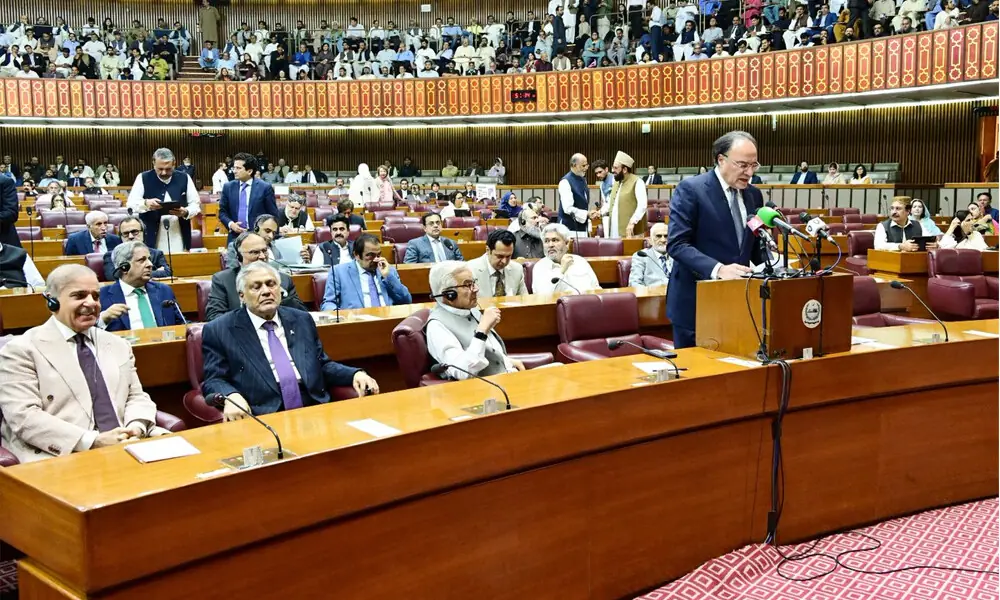
ISLAMABAD: Finance Minister Muhammad Aurangzeb on Friday unveiled a Rs18.77 trillion federal budget for fiscal year 2026-27, extending relief to the salaried class and tax incentives to exporters, real estate, and construction sectors to revive industry, promote investment, and steer the economy towards a 4 percent growth target.
Despite facing an estimated revenue shortfall of around Rs1 trillion in the outgoing fiscal year, the government has set an ambitious revenue target of Rs15.264 trillion for FY2026-27. Against the revised revenue estimate of Rs12.983 trillion for the current fiscal year, the target reflects a robust 17.6 percent growth in revenue collection for the next year.
The budget has an outlay of Rs18.8 trillion, of which Rs8,045 billion would be set aside for markup payment, Aurangzeb said in his budget speech.
READ MORE: FY26 growth target missed on 2025 floods, ME conflict, Trump tariffs
The finance minister said the economy was expected to grow 4 percent in 2026-27, and average inflation was expected to be recorded at 8.2 percent. He added that the fiscal deficit to GDP would be 3.6 percent of GDP (or Rs5.226 trillion) while the primary surplus would be 2 percent, as it seeks to keep the shortfall within the limit under the International Monetary Fund-mandated fiscal discipline.
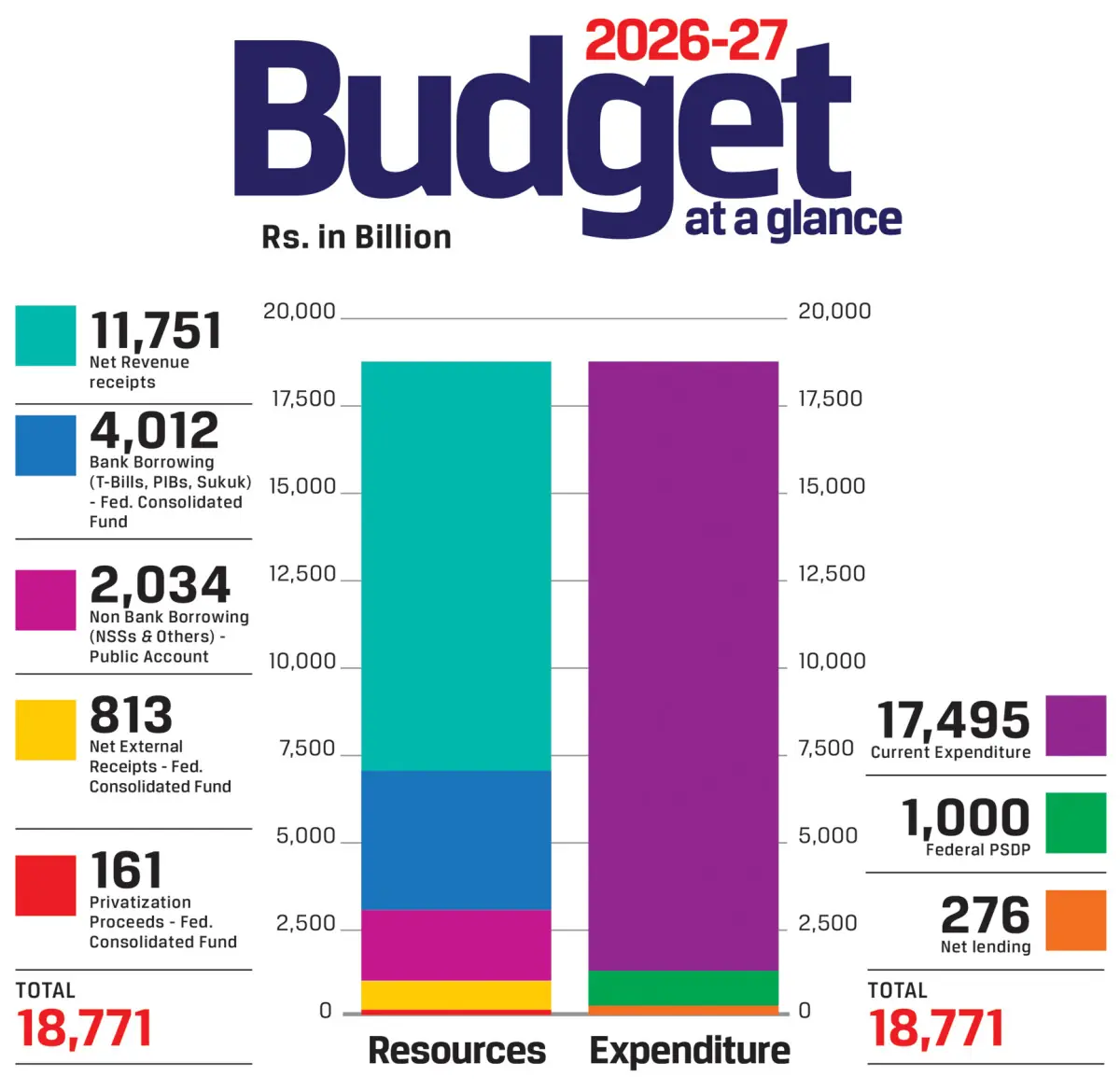
Aurangzeb told the National Assembly while presenting its third budget, saying, “This is not just a budget of numbers; this is a budget of transformation.” “We have moved from a fragile economy to one where Fitch, Moody’s, and S&P have upgraded Pakistan’s credit rating. Today, the world seeks our strategic partnership, not our sympathy.”
To stay on track with the IMF’s targets, the government has set a primary surplus of Rs2.83 trillion, or 2.0 percent of GDP, marking the fourth consecutive year of surplus - a key IMF benchmark.
The overall countrywide fiscal deficit is expected to be 3.6 percent of GDP, up from the revised 3 percent for fiscal year 2026. This is contingent on provinces generating a surplus of Rs1.794 trillion — a steep jump from Rs1.46 trillion this fiscal year and revised Rs 1,379 billion.
The minister also announced that the provincial share under the National Finance Commission (NFC) Award would remain unchanged. To provide relief to the salaried class, the government has proposed that the salaries of government employees are likely to be increased by 7 percent. Pensions are also proposed to be increased by 7 percent, while the minimum monthly wage is proposed to be increased by 10 percent.
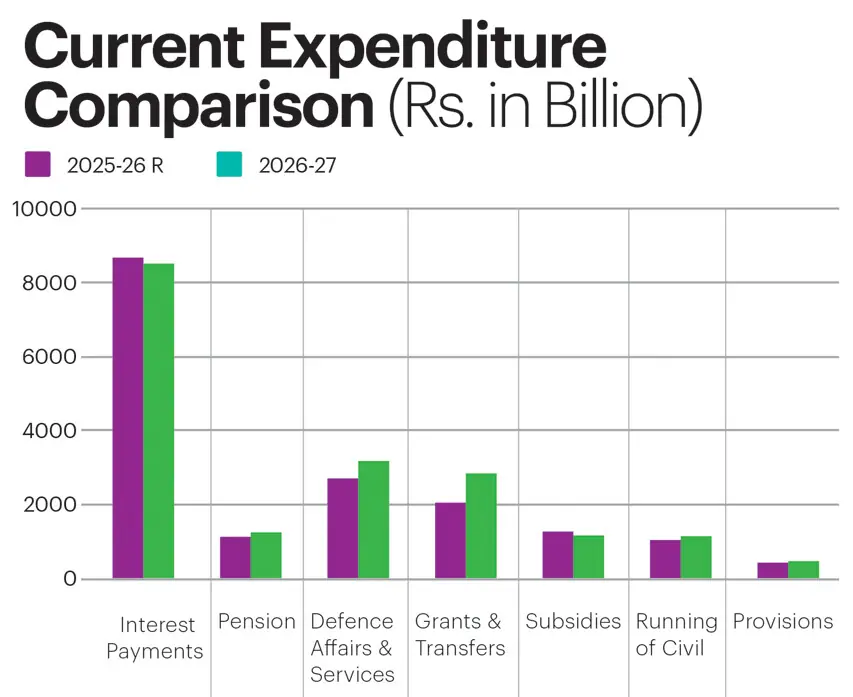
The Finance Minister proposed tax relief for salaried individuals, while saying that the tax rate for individuals earning between Rs2.2 million and Rs3.2 million annually has been proposed to be reduced from 23 percent to 20 percent.
The tax rate for those earning between Rs3.2 million and Rs4.1 million annually has been proposed to be reduced from 30 percent to 25 percent. The tax rate for individuals earning between Rs5.6 million and Rs7 million annually has been proposed to be reduced from 35 percent to 32 percent.
The government has also proposed to abolish the income surcharge imposed on the salaried class.
The government has also proposed the complete abolition of the super tax across six income slabs. Previously, individuals earning between Rs150 million and Rs500 million annually were subject to a super tax ranging from 1 percent to 7.5 percent. For incomes exceeding Rs500 million annually, the super tax rate has been proposed to be reduced from 10 percent to 8 percent.
However, for banks, oil and gas exploration companies, and fertilizer companies, the surcharge would remain in place.
In addition, the government has reduced income tax and withholding tax on property transfers and announced incentives for the construction sector to encourage investment and growth. The government has announced a significant reduction in property transaction taxes for tax filers.
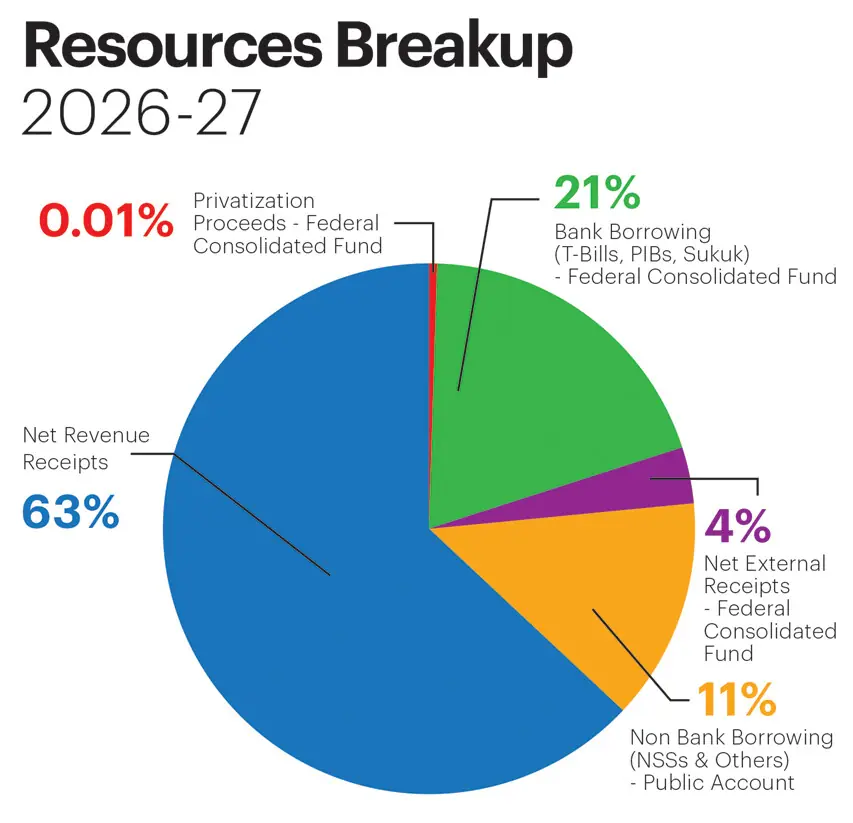
The tax rate on the sale of property for filers has been proposed to be reduced from 5.5 percent to 2.75 percent. The tax rate on the purchase of property for filers has been proposed to be reduced from 2.5 percent to 1.25 percent, intending to encourage investment in the real estate sector and promote documented economic activity.
The government believes these incentives will stimulate construction activity, generate economic growth, and create employment opportunities across the country.
To promote the growth of Pakistan’s IT industry, the government has extended the concessionary tax rate of 0.25 percent on IT export earnings for another three years. According to the budget speech, this relief will remain in place until June 30, 2029, and is expected to boost IT exports and strengthen the country’s digital economy.
The government also announced additional relief measures for the export sector in the new budget. Export tax was reduced from 2 percent to 1.25 percent, and the Export Development Surcharge was abolished. He added that the government is also considering removing the super tax on exporters.
In addition, withholding tax on international transactions made through debit and credit cards has been proposed to be reduced. The tax rate on such transactions has been proposed to be cut from 5 percent to 0.5 percent.
Proposal also made to abolish the Capital Value Tax (CVT) on holding foreign assets. The finance minister said the new measures are aimed at encouraging Pakistanis to declare and bring their foreign financial assets into the formal economy.
The finance minister announced the abolition of taxes on essential women’s healthcare products as part of the government’s relief measures in Budget 2026-27. The government has also proposed to abolish the tax on contraceptives.
Aurangzeb announced a fixed tax scheme for small shopkeepers and traders aimed at simplifying tax compliance and encouraging documentation of the economy.
Under the scheme, FBR officials will not be allowed to enter shops for questioning or inspections related to the scheme. A verification QR code will be displayed on the shop’s plaque, while eligible traders will be issued a special green plaque as proof of participation.
Small traders will be exempt from installing Point of Sale (POS) machines. Traders covered under the scheme will not be treated as withholding agents. Beneficiaries of the scheme will not be subject to tax audits. A minimum fee of Rs25,000 must be deposited when filing the annual tax return.
The business community will be allowed to adjust withholding tax payments against their tax liability. Eligible traders will pay a fixed tax of 1% of their annual sales. The scheme will apply to traders with an annual turnover of up to Rs200 million.
The government has decided to expand the scope of the Third Schedule of Sales Tax and broaden the scope of purchases from unregistered persons. A National Faceless Centre and Assessment System has also been introduced.
Under the new system, there will be no direct contact between taxpayers and tax officers, helping improve transparency and reduce discretionary interactions. The scope of production monitoring and digital invoicing has also been expanded to strengthen tax compliance and documentation.
The budget has proposed the imposition of a Federal Excise Duty of Rs80 per litre on white spirit and mineral turpentine oil. According to the budget speech, these products are commonly used for fuel adulteration. The tax has been imposed to protect millions of consumers from damage to their vehicles and machinery.
The government has also introduced new taxes on imported SUVs with engine capacities above 2,000cc and up to 3,000cc. In addition, duties on vehicles with engine capacities exceeding 3,000cc will be increased.
The government has abolished the Federal Excise Duty (FED) on international travel in business class, providing relief to travelers and the aviation sector.
The government has proposed to present a new auto sector policy in Parliament shortly after cabinet approval. The policy is expected to outline the future direction of Pakistan’s automobile industry, with a particular focus on electric vehicles and sustainable transportation.
The government has decided to maintain the concessional tax regime for Electric motorcycles, Electric rickshaws, Electric cars, and Electric buses. In addition, a proposal has been made to offer a reduced sales tax rate of 1% on imported electric trucks.
However, the finance minister clarified that luxury electric vehicles will not be eligible for these concessions and incentives.
The government has decided to abolish taxes imposed on the local production of medicines used to treat cancer and other serious diseases. The measure is intended to support domestic pharmaceutical manufacturers and improve the affordability of essential medicines for patients.
To reduce production costs and support industrial growth, the government has decided to eliminate customs duty on more than 100 categories of raw materials. The initiative is expected to lower manufacturing costs, improve competitiveness, and encourage investment across various sectors of the economy.
He said substantial allocations had been made for the newly merged districts of Khyber-Pakhtunkhwa, Gilgit-Baltistan and Azad Jammu and Kashmir.
Key fiscal and economic targets for 2026-27 include: Non-tax revenue is projected to increase to Rs5,336 billion. Rupees 8,848 billion will be transferred to the provinces under the National Finance Commission (NFC) Award. The federal government’s net revenue is estimated at Rs11,751 billion. The total federal expenditure has been budgeted at Rs18,771 billion.
The federal budget deficit is projected to remain at Rs7,020 billion. The government has set a provincial surplus target of Rs1,794 billion. The overall fiscal deficit is targeted at Rs5,226 billion, equivalent to 3.6% of GDP. A primary surplus of Rs2,828 billion, or 2% of GDP, has been projected. The government has set a GDP target of Rs143,604 billion for the fiscal year 2026-27.
The government has allocated Rs3,000 billion for defence in Budget 2026-27. This is an increase of Rs450 billion from the FY2025-26 allocation of Rs2.55 trillion. A total of Rs1,000 billion has been earmarked for development projects. The budget document shows that Rs17,495 billion will be spent on ongoing expenses in the next fiscal year.
Debt servicing remains one of the largest expenditure heads, with Rs8,054 billion allocated for interest payments on loans. The government has allocated Rs1,169 billion for pension payments. Another Rs1,071 billion has been set aside for running the civil government.
The federal budget also includes Rs430 billion for emergency measures in the new fiscal year. The allocation is expected to support the government’s response to urgent national needs during 2026-27.
According to the budget documents, a total of Rs8,848.49 billion has been allocated for transfers from the federal government to the provinces in fiscal year 2026-27. The government has proposed keeping the size of the divisible pool taxes for provinces at Rs8,635.21 billion, while Rs213.27 billion will be transferred through straight transfers.
The provincial share of federal taxes and revenues includes: Rs4,246.43 billion from income tax, Rs2,815.06 billion from sales tax, Rs946.77 billion from customs duties, Rs611.69 billion from Federal Excise Duty (FED), Rs69.39 billion from the Gas Development Surcharge (GDS), Rs93.10 billion from natural gas royalty, Rs44.59 billion from crude oil royalty.
Punjab will receive the largest share under the NFC Award, with an allocation of Rs4,402.83 billion. Other provincial allocations include: Sindh: Rs2,207.18 billion, Khyber Pakhtunkhwa: Rs1,443.34 billion, including the additional 1% share for counter-terrorism, Balochistan: Rs795.13 billion.
He added that the government was introducing a direct subsidy model aimed at improving targeting and efficiency in the power sector. “We are introducing a direct subsidy model… There is no increase in circular debt this year,” he said.
Aurangzeb said a nationwide exercise would be carried out to identify, register and verify all subsidised consumers, enabling the launch of a Direct Subsidy Mechanism from January 2027. “This is the same equitable model that we adopted through BISP,” he said. The finance minister said Pakistan had renegotiated LNG agreements with Qatar and Italy, resulting in a reduction of 35 cargoes for 2026 and saving around USD1.2 billion in foreign exchange.
He said an uninterrupted gas supply had been ensured to fertiliser plants across the country.
“We did not let fertiliser production halt even for a single moment,” he said, adding that supply had been maintained to 10 fertiliser factories. Aurangzeb said around 100 MMCFD of additional gas had been injected into the system since March 2024, while discoveries from 17 oil and gas reserves were yielding 108 MMCFD of gas and 16,000 barrels of additional oil.
“The priority of the budget is to increase productivity and exports, so our exporters can compete effectively in international markets,” he said.
Aurangzeb said the Export Development Surcharge on export income had been abolished, while the Export Finance Scheme mark-up rate had been reduced from 19 per cent to 4.5 per cent.
He said the only way forward was a strong private-sector-led growth model that generates jobs and investment. The finance minister said 6,860 acres of Pakistan Steel Mills land would be activated as a Special Economic Zone to promote industrialisation, attract investment, and create employment opportunities.
Aurangzeb said Rs71 billion has been allocated for the Prime Minister’s Apna Ghar housing scheme, under which low-cost housing loans are provided at a subsidised mark-up rate. He also recommended extending tax exemptions for residents of the former FATA and PATA regions.
Rs365 billion has been allocated for highways, railways, and ports projects to improve connectivity. He said work on the Karachi–Rohri section of the ML-1 railway line will start next year. Rs116.2billion has been allocated for sustainable and affordable energy.
Rupees 1,071 billion has been allocated for civil administration expenditures. Rs1,169billion has been allocated for pension expenses. Rupees s2,680billion has been allocated for grants. An additional Rs103 billion allocation was also mentioned under grants. Rs54 billion has been allocated for low-cost housing to support the construction of affordable homes.
Under Daanish Schools, Rs22billion has been earmarked to provide education to deserving and deprived students. The finance minister said floods caused losses of Rs822billion this year.
He said Pakistan faces serious water challenges, including a lack of storage capacity, declining reservoir efficiency, and climate-change-induced flood risks, requiring urgent investment in dams and reservoirs.
The finance minister said the area of taxation covers tax relief, tax rationalisation, and broader FBR reforms.
He said Rs3,695 billion has been allocated for the National Development Programme for the next fiscal year. He added that Rs365 billion has been allocated for transport infrastructure, while Rs157.5billion has been set aside for the construction and improvement of highways.
The finance minister announced that tax relief will remain in place for e-bikes and e-rickshaws.
He further said the government is removing customs duty on raw materials for more than 100 medicines for cancer and other critical ailments.
The finance minister said the country’s defence sector had become a source of foreign exchange earnings. “It is proof that strong defence is not just important for the country’s sovereignty but could also contribute to economic progress.”
“This defence capability has reshaped our strategic partnerships not just in the region but in the world,” he said, mentioning a defence pact signed between Pakistan and Saudi Arabia last year.
Aurangzeb said Pakistan and Saudi Arabia have reached a defence agreement, which marks a strategic partnership. Aurangzeb said Pakistan-China relations remained an important pillar of the economy. “Pakistan’s image has improved significantly, and its voice is being heard internationally,” he said.
He said last year’s defence pact had laid a new foundation of Pakistan-Saudi ties, crediting Prime Minister Shehbaz Sharif and Chief of Defence Forces and Chief of Army Staff Field Marshal AsimMunir for it.
The finance minister also elaborated on Pakistan’s efforts for peace between the US and Iran. “Pakistan’s efforts are directed towards establishing long-term peace in the region through an agreement and restoring the transit of oil through the Strait of Hormuz,” he said.
Aurangzeb said Pakistan had “complete support” of China in these efforts, further highlighting the importance of ties between Islamabad and Beijing.
“Pak-China relations are an important part of our foreign policy. China is Pakistan’s most important trading partner,” he said. Turning his attention to oil prices, he mentioned the US-Israeli war on Iran and noted that petrol and diesel had skyrocketed globally after the conflict. He said that, however, local prices in Pakistan did not fully reflect this rise in prices. “Had the government passed on the entire burden to the people, the local prices would have been much higher,” he said, saying that the government has given people relief through subsidies of Rs128 billion.
Copyright Business Recorder, 2026
ISLAMABAD: Prime Minister Shehbaz Sharif on Friday emphasised the need for strong national security as the federal cabinet approved the 2026-27 budget ahead of its presentation in National Assembly.
Addressing a federal cabinet meeting, the prime minister said that no nation could effectively manage its affairs or achieve progress without a robust and invincible security. “Today, we are presenting the third budget of our government,” he said, acknowledging the challenges faced during its preparation.
The prime minister outlined priorities including the construction of water reservoirs and dams, and the development of domestic energy resources, citing solar, wind, and battery technologies.
He also indicated that the budget would propose measures aimed at tax relief, fostering economic growth.
PM Sharif highlighted the government’s ongoing dialogue with the International Monetary Fund (IMF) as part of the budget process. He recounted a 30 to 45-minute phone conversation with IMF Managing Director Kristalina Georgieva, who praised Pakistan’s economic progress.
The prime minister also emphasised extensive consultations with the coalition partners, particularly the Pakistan People’s Party (PPP). “We had very detailed conversations with our ally PPP, which were successful,” he said, thanking other coalition members for their unconditional support.
PM Sharif noted that the federal government had engaged in comprehensive discussions with all four provinces over the past one and a half months to explain the need for additional funds.
He described these dialogues as very meaningful and said the PML-N and PPP had agreed to curtail development and other expenditures at all government levels to create fiscal space for strategic requirements.
During his remarks, PM Sharif acknowledged the support of key political figures, including PML-N President Nawaz Sharif, whom he described as his leader, and Punjab Chief Minister Maryam Nawaz for prioritising federal needs in defence and water security.
He also thanked Sindh leadership, including President Asif Ali Zardari and PPP Chairman Bilawal Bhutto Zardari for cooperating in the interest of the country, and expressed appreciation for the big-heartedness of Balochistan Chief Minister Sarfraz Bugti and the positive sentiments of Khyber Pakhtunkhwa Chief Minister Sohail Afridi. “There can be no grander demonstration of national unity, solidarity and cohesion than this,” he said.
PM Sharif acknowledged that past budgets had imposed taxes due to national and IMF requirements, noting that these measures were necessary to stabilise the economy and expand avenues for growth. He expressed gratitude to Pakistan’s 240 million citizens for enduring inflation with patience.
Highlighting economic indicators, he said inflation had fallen from 38 percent to single digits over the past two years, before rising slightly due to the ongoing Middle East conflict.
He noted that the policy rate had decreased from 22.5 percent to 11 percent but had to be increased due to the impact of the US-Iran war.
“Today, our economy is stable, and we should hope that with this third budget, the wheel of our economy will pick up pace, provided we collectively work hard and fulfil our responsibilities,” he said.
PM Sharif began his address by recalling attending the funeral prayers of personnel who had died in the line of duty, including two Christians. “It was a heart-wrenching scenario that brought tears to every eye,” he said, recalling his meetings with their families.
Copyright Business Recorder, 2026
ISLAMABAD: The opposition Pakistan Tehreek-e-Insaf (PTI) on Friday categorically rejected the federal budget for the fiscal year 2026-27, calling it a vehicle for elite self-preservation that offered little relief to ordinary citizens.
Sheikh Waqas Akram, PTI spokesman, criticised the budget, contending that it prioritised connected interests over the broader population.
“This is a particularly refined exercise in elite self-preservation,” he said, adding that the government’s projected 3.7 percent economic growth was being presented as evidence of a resurgence, despite the previous administration achieving near 6 percent growth under pandemic conditions.
Akram said poverty had sharply increased, pushing millions below the subsistence line, while the salaried class faced diminishing real incomes.
He noted that budget measures, such as reductions for higher income brackets, super tax adjustments for businesses, and construction-related tax changes, primarily benefited wealthier segments rather than addressing housing or everyday economic needs.
Inflation is projected at 8.2 percent in the coming year.
The PTI leader also warned that small businesses and traders would face stricter enforcement under a new fixed tax regime, expanded withholding tax on unregistered purchases, and increased penalties for non-compliance.
“This approach relies on harassment of already compliant taxpayers rather than broadening the tax base,” he said.
Akram criticised the government’s handling of debt and privatisation, highlighting that debt servicing now accounts for Rs8,054 billion out of total expenditure of Rs18,771 billion.
He described the planned privatisation of Pakistan International Airlines (PIA), distribution companies and other state assets as favouring connected interests rather than the public.
External financing, including Panda Bonds and Eurobonds, was framed by the government as a confidence signal but, according to PTI, deepens long-term dependence on foreign capital.
He said that the National Assembly proceedings were marked by sustained opposition protests, with lawmakers striking desks in rejection of the budget.
PTI said the response reflected widespread public dissatisfaction with a budget that, in its view, prioritised elites while ordinary citizens face worsening economic conditions.
“The budget is an exercise in deception and privilege protection,” Akram said, reaffirming the party’s commitment to an economic agenda focused on the security and dignity of the majority.
Copyright Business Recorder, 2026
ISLAMABAD: Finance Minister Muhammad Aurangzeb moved a copy of the Finance Bill, 2026 in the Senate on Friday amidst protest by the opposition lawmakers who rejected the proposed federal budget for the upcoming fiscal year.
In the brief Senate sitting, the finance minister laid a copy of the proposed Finance Bill 2025, shortly after presenting it in the National Assembly, in the Senate, in accordance with the relevant constitutional provisions, following which, Chairman Senate Yousaf Raza Gilani directed the senators to share their recommendations, if any, on the bill by June 15.
The chairman then referred the bill to the Senate Standing Committee on Finance and Revenue with the direction to finalise its recommendations on the bill.
Leader of the Opposition in the Senate Allama Raja Nasir Abbas did not attend the session. The Pakistan Tehreek-e-Insaf (PTI) senators, led by Parliamentary Leader Ali Zafar, resorted to sloganeering against the proposed federal budget dismissing it as “anti-poor” and “anti-public.”
The chairman Senate adjourned the Senate sitting till Monday.
The Upper House of the Parliament can hold extensive debate on the finance bill and devise recommendations accordingly, but it has no significant role in budgetary legislation, since it is completely up to the National Assembly to either accept those recommendations or reject them completely or partially.
The Article 73 of the Constitution of Pakistan, which deals with parliamentary business with respect to money bills, reads that a money bill shall “originate in the National Assembly: Provided that simultaneously when a money bill, including the finance bill containing the annual budget statement, is presented in the National Assembly, a copy thereof shall be transmitted to the Senate which may, within 14 days, make recommendations thereon to the National Assembly.”
Copyright Business Recorder, 2026
ISLAMABAD: The Federal Minister for Finance and Revenue Muhammad Aurangzeb on Friday presented the National Development Programme (NDP) worth Rs3.675 trillion in the National Assembly for approval for the fiscal year 2026-27, comprising Rs2.837 trillion in domestic funding and Rs838 billion in head of foreign assistance.
According to the Public Sector Development Programme (PSDP) 2026-27 budget documents, the Finance Minister presented a total development outlay of Rs 1 trillion, comprising Rs 745 billion in local funding and Rs 255 billion in foreign assistance for federal development projects. In addition, a total of Rs 2.224 trillion, including Rs 1.641 trillion in domestic funding and Rs 583 billion in foreign assistance, has been allocated for provincial development projects for the 2026-27fiscal year.
A total of Rs 451 billion has been proposed in the Budget 2026-27 for State-Owned Enterprise (SOEs) to accelerate economic growth and development.
The government has proposed an allocation of only Rs 1 billion for the China-Pakistan Economic Corridor (CPEC) Phase-II in the upcoming fiscal year 2026-27.
A total of Rs 312.515 billion, including Rs 176.657 billion in local funding and Rs 135.857 billion in foreign assistance, has been earmarked for national corporations for the fiscal 2026-27. Of this amount, Rs 224.515 billion, comprising Rs 165.265 billion in local funding and Rs 59.25 billion in foreign assistance, has been earmarked for development projects of the National Highway Authority (NHA). Similarly, Rs 88 billion, including Rs 11.392 billion in local funding and Rs 76.61 billion in foreign assistance, has been allocated for the Power Division (NTDC/ PEPCO).
The government has also proposed a total allocation of Rs 682.485 billion, including Rs 563.34 billion in local funding and Rs 119.142 billion in foreign assistance for federal ministries and divisions in the Budget 2026-27.
The government has proposed budgetary allocations of Rs 64.08 billion for the Cabinet Division, Rs 10.902 billion for the Defence Division, and Rs 36.3 billion for the Federal Education and Professional Training Division. In addition, Rs 233.385 billion, including Rs 231.085 billion in local funding and Rs 2.3 billion in foreign assistance, has been allocated for Provinces and Special Areas. This includes: (i) Rs 88.286 billion for provincial projects; (ii) Rs 56.076 billion for merged districts; and (iii) Rs 89.023 billion, including Rs 86.723 billion in local funding and Rs 2.3 billion in foreign assistance, for Azad Jammu and Kashmir (AJK) and Gilgit-Baltistan (G-B) during fiscal year 2026-27.
The government has further proposed Rs 16.064 billion, including Rs 14.764 billion in local funding and Rs 1.3 billion in foreign assistance, for the National Health Services, Regulations and Coordination Division; Rs 17 billion for Balochistan flood-related projects; Rs 40.657 billion for the Railways Division; and Rs 103.086 billion for the Water Resources Division.
Copyright Business Recorder, 2026
KARACHI: Small traders on Friday welcomed the federal government’s proposal to introduce a fixed tax of one percent in the fiscal budget for 2026–27 but expressed disappointment over the absence of relief on fuel oil prices and electricity tariffs, which they described as major obstacles to economic growth.
Mehmood Hamid, President of the All Pakistan Small Traders and Cottage Industry Association, Karachi chapter, said the trading community supported the fixed tax regime and hoped it would remain unchanged in future budgets.
“If no further taxation is imposed, local businesses can adjust to the fixed tax system,” he said.
However, he voiced concern over record-high fuel prices and electricity tariffs, noting that small traders had expected a larger reduction in these input costs. He said industrial and business growth could only gain momentum if production costs were rationalised to affordable levels.
“These high input costs are a stumbling block to economic growth,” he said.
Hamid said the cottage industry had suffered the most due to expensive fuel and power, and called for concessions for grassroots industries. He stressed that the fixed tax system should continue without bureaucratic interference, which would also help improve tax collection.
He appreciated the government’s plan to introduce a faceless tax audit system to eliminate direct interaction between tax officials and businessmen.
Copyright Business Recorder, 2026

KARACHI: Business leaders at the Karachi Chamber of Commerce and Industry (KCCI) gave a mixed response on the federal budget 2026-27, with the chamber’s top voices united on one point: the budget offers nothing for exporters and nothing for Karachi.
Despite the federal government’s own economic survey claimed about improved economic indicators, Zubair Motiwala, Chairman of BMG Group at a post-budget presser said the proposed budget offered no incentive to the export sector. “If the fiscal space exists as shown in the economic survey, its benefits should be passed on to the public,” he said, adding: “There is nothing in this budget for exporters. If exports don’t grow, where will the dollars come from ”
The government has declined a KCCI proposal to replace the minimum tax on exporters with a fixed tax regime, a long-standing demand of the business community, while, the budget proposed reducing the minimum tax rate from 2 percent to 1.5 percent.
“The measures proposed in this budget are not for broadening the tax base but to squeeze the already registered taxpayers,” Motiwala said.
On energy, he was equally critical of the budget’s ‘complete silence’. No measures were proposed to reduce gas or power tariffs or address circular debt, despite industries operating well below their production capacity, he said.
He argued the omission directly undermines any export competitiveness the government claims to have built through its economic reforms. The government also reneged on an earlier assurance to abolish excise duty, with no such proposal appearing in the budget, he maintained.
The sharpest criticism; however, was reserved for Karachi’s infrastructure allocation.
The budget earmarked only Rs. 10 billion for the K-IV water supply project against a stated requirement of Rs. 40 billion, a shortfall Motiwala said would push the project’s completion back by one to two more years, leaving millions in Pakistan’s largest city without adequate water supply. “This budget has nothing for Karachi,” he lamented.
Motiwala did acknowledge a handful of the positives. He welcomed the retention of 1 percent duty on EV kit imports, a 10 percent increase in the minimum wage, relief measures for salaried persons, and a reduced withholding tax on the construction sector.
He also expressed support for the introduction of a faceless income tax system and electronic returns filing, saying both initiatives would reduce human interaction in tax offices and help curb corruption.
However, acting President KCCI Muhammad Raza offered a broadly similar but a slightly more measured view. He welcomed the abolition of super tax and the removal of tax on real estate as positive steps, but said no concrete measures had been proposed to grow exports.
Former KCCI president Idrees Memon pointed to two specific unmet demands: the business community had called for eliminating the distinction between industrial and commercial imports, and exporters had sought restoration of the fixed tax regime. “Neither was addressed in the budget.”
Former Vice President Ibrahim Qasim urged the business community to withhold final judgment, cautioning that the full picture would only emerge once the Finance Bill is tabled. “The real
budget will be visible when the Finance Bill comes.”
The broader business community collectively flagged that energy cost reduction, which was their primary and most consistent demand, has entirely been ignored in this budget.
A large number of KCCI members attended the post-budget presser.
Copyright Business Recorder, 2026
A BILL to give effect to the financial proposals of the Federal Government for the year beginning on the first day of July, 2026, and to amend certain laws WHEREAS, it is expedient to make provisions to give effect to the financial proposals of the Federal Government for the year beginning on the first day of July, 2026, and to amend certain laws for the purposes hereinafter appearing;
It is hereby enacted as follows:-
(2) It shall, unless otherwise provided, come into force on the first day of July, 2026.
“SCHEDULE
[see section 3]
========================================================================
Table 2
========================================================================
S.No Category Tax Rates for ICT
(1) (2) (3)
========================================================================
1 Engine capacity upto 1000 CC 20,000
2 Engine capacity from 1001 to 1300 cc 0.25 % of Invoice Value
3 Engine capacity from 1301 to 1500 cc 0.25 % of Invoice Value
4 Engine capacity from 1501 to 2000 cc 0.25 % of Invoice Value
5 Engine capacity from 2001 to 2500 cc 0.35 % of invoice Value
6 Engine capacity from 2501 and above 0.35 % of invoice Value
========================================================================
Table 3 Motor Cabs
========================================================================
S.No Category Tax Rates for ICT
========================================================================
(1) (2) (3)
========================================================
1 Engine capacity upto 1000 CC 600
2 Exceeding 1000cc but not more than 1300cc 1,000
3 Exceeding 1300cc but not more than 1500cc 1,700
4 Exceeding 1500cc but not more than 2000cc 2,500
5 Exceeding 2000cc but not more than 2500cc 3,400
6 Exceeding 2500cc 4,200
========================================================
Table 4
========================================================
Public Service Vehicle
========================================================
S.No Category Tax Rates in ICT Per
seat per annum
(1) (2) (3)
1 Vehicle (8 seater) 350
2 Vehicle (13 seater) 400
3 Vehicle (15 seater) 500
4 Vehicle (16 seater) 600
5 Vehicle (42 seater) 700
6 Vehicle (52 seater) 850
========================================================
Table 5
========================================================
Commercial Vehicle/Loading Vehicles
========================================================
S.No Category Proposed Rates
(1) (2) (3)
1 Vehicles not exceeding 1250 KG in
laden weight 500
2 Vehicles with maximum laden capacity
        exceeding 1250 KG but not
        exceeding 2030 KG                      1,000
3 Vehicles with maximum laden capacity
        exceeding 2030 KG but not
        exceeding 4060 KG                      1,000
4 Vehicles with maximum laden capacity
        exceeding 4060 KG but not exceeding
        6090 KG                                6,600
5 Vehicles with maximum laden capacity
        exceeding 6090 KG but not
        exceeding 8120 KG                      6,600
6 Vehicles with maximum laden capacity
exceeding 8120 KG 12,000
7 Vehicles with maximum laden capacity
        exceeding 8120 Kg, but not
        exceeding 12000 Kg                    12,000
8 Vehicles with long trailers or other
        vehicles with maximum laden capacity
        exceeding 12000 Kg, but not
        exceeding 16000 Kg                    18,000
9 Vehicles with long trailers or other
        vehicles with maximum laden capacity
        exceeding 16000 Kg                    24,000
10 Tractor (With trolley) 2,600
11 T ractor (Without trolley) 2,600.”.
========================================================
Amendments of the Petroleum Products (Petroleum Levy and Climate Support Levy) Ordinance, 1961 (XXV of 1961).- In the Petroleum Products (Petroleum Levy and Climate Support Levy) Ordinance, 1961 (XXV of 1961), the following further amendments shall be made, namely:—
in section 2,-
(a) for clause (1), the following shall be substituted, namely:-
“(1) “company” means an oil marketing company and includes a person engaged in the manufacturing, refining or reclaiming of lubricating oil from used lubricating oil under a license granted by OGRA;”;
(b) after the omitted clause (4D), the following new clauses shall be inserted, namely:
“(4E) “Oil Marketing Company” means a company, other than lubricant marketing company, engaged in purchasing or obtaining of petroleum products from refineries or blending plants or through sources abroad for selling, distributing or marketing, directly through his agents or dealers at his dispensing outlets or filling stations; and (4F) “OGRA” means the Oil and Gas Regulatory Authority of Pakistan established under the under the Oil and Gas
Regulatory Authority Ordinance, 2002 (Ordinance XVII of 2002);”;
(c) for clause (7), the following shall be substituted, namely:-
“(7) “refinery” means a facility or industrial plant where crude oil is refined to produce petroleum products.”;
(a) for sub-section (1), the following shall be substituted, namely:- “(1) The payment of Petroleum Levy and Climate Support Levy shall deemed to be a license condition of every company, refinery or licensee from the date of issue of license by OGRA and such company, refinery or licensee shall pay to the Federal Government, Petroleum levy and Climate Support Levy on petroleum products at such rates as may respectively be notified by the Federal Government in the official Gazette, from time to time.”; and
(b) sub-section (3) shall be omitted;
(1) of section 40D of the Public Finance Management Act, 2019.
3C. Recovery of amounts due under this Ordinance.— (1)
Notwithstanding anything contained in the Public Finance Management Act, 2019 and subject to sub-section (2) of this Act, if the Petroleum Levy and Climate Support Levy due or the late payment surcharge are not paid within ninety days, the relevant department responsible for collecting the Petroleum Levy and Climate Support Levy under subsection (2) of section 3A of this Act, may request the Commissioner (Inland Revenue) to exercise powers of recovery in the same manner as income tax arrears under Part IV of Chapter X of the Income Tax Ordinance, 2001 (XLIX of 2001) or rules made thereunder in this behalf: Provided that the Commissioner (Inland Revenue) shall have no authority to grant extension of time to the notice of recovery or allow payments of outstanding levies under this Ordinance including late payment surcharge in instalments of equal or varying amounts.
(2) The relevant department under sub-section (2) of section 3A of this Act, as it deems fit and proper, may either, separately or simultaneously, initiate recovery of the Petroleum Levy and Climate Support Levy, or, the late payment surcharge, as the case may be.
(3) Any irregularity or infirmity in the recovery proceedings under this section shall not be grounds of challenge before a tribunal or courts of law.
(4) The Commissioner (Inland Revenue) shall be bound to submit a report every fortnight to the divisions concerned to whom subjects of finance and petroleum are allocated under the Rules of Business, 1973
on the progress of recovery proceedings, and failure to recover the amounts due shall be explained in writing.
(5) Prior to commencement of the Finance Act, 2026, where any amount of the Petroleum Levy and Climate Support Levy or the late payment surcharge are due under sections 40B and 40D of the Public Finance Management Act, 2019, it shall be recoverable under this section.”;
(2) Every company, refinery or licensee under this Ordinance shall furnish an annual audited certificate to the Petroleum Division, issued by the Authorized Audit Firm, certifying the accuracy of the levy and or levies accrued and paid under this Ordinance.
Explanation: For purposes of this section, Authorized Audit Firm means an audit firm registered with the Audit Oversight Board under the Securities and Exchange Commission of Pakistan Act, 1997 (XLII of 1997).
(3) The costs and expenses of such audit shall be borne solely by the relevant company, refinery or licensee.”;
said Ordinance, the Second Schedule shall be omitted.
said Ordinance, the Fourth Schedule shall be omitted.
(1) in section 2, after clause (ssss), a new clause shall be added, namely: - “(ssssa) “State warehouse” means any place authorized by the Collector of Customs to store the detained, seized or confiscated goods, as the case may be”;
(2) in section 19, in sub-section (5), in the second proviso, for the figure “2026”, the figure “2027” shall be substituted;
(3) in section 32, —
(a) in sub-section (3), in the first proviso, the words “in a case” shall be omitted; and
(b) in sub-section (3A), in the proviso, the words “in a case” shall be omitted;
(4) in section 80, in sub-section (4), —
(a) after the word “examined”, a comma shall be inserted and thereafter the word “scanned” shall be inserted; and
(b) in the proviso, after the word “examined”, the words “or scanned” shall be inserted;
(5) in section 82, —
(a) in sub-section (1), —
(i) for the words “Federal Government”, the word “Board” shall be substituted; and
(ii) in the first proviso, after the word “waive”, the words “or reduce” shall be inserted and for the full stop at the end a colon shall be substituted and thereafter the following new proviso shall be added, namely: -
“Provided further that the Board may notify the rules to regulate the implementation of above provisions, including the process of appeal against imposed penalties and the Customs stations, goods or class of goods, where the provisions of sub-section (1) shall not be applicable.”; and
(b) in sub-section (2), after the fifth proviso, the following new proviso shall be added, namely; -
“Provided also that the Board may authorize any person, to auction any auctionable goods, in the manner as notified by the Board.”;
(6) in section 156, in sub section (1), in the Table. —
(a) against S.No. 7A, in the third column, for the words “five hundred thousand”, the words “ten million” shall be substituted;
(b) after S.No.62, the following S.No. shall be added, namely: -
========================================================================
“62 A If any person is found to such person shall be liable
========================================================================
General
be involved or abetting in        to a penalty not exceeding
the removal, substitution,        two times the value of the
damage or otherwise                 goods involved; and upon
tempering with any                   conviction by a Special
goods, whether or not                Judge, shall further be
confiscated, at any such        liable to imprisonment for a
place as authorized by             period not exceeding five
the Collector as a State       years, or fine or the both.”;
Warehouse.and
========================================================================
(c) against S.No. 83, in the second column, for the existing entry, the
following shall be substituted, namely: —
“If an officer of any authority who is duty bound under section 170 to deposit the impugned goods with customs, neglects so to do.”;
(7) in section 157, after sub-section (2), the following explanation shall be added, namely: —
“Explanation: — The word “removal” includes, and shall be deemed to have always included, every act of carrying, transporting, depositing, harbouring, keeping, concealing, retailing, or any other act involving movement of smuggled goods.”;
(8) for section 170, the following shall be substituted, namely: —
“170. Procedure in respect of goods seized or detained by other authorities.- Notwithstanding anything contained in any other law for the time being in force, when any goods liable to confiscation under this Act are detained or seized by any other authority on any violation, irrespective of any pending proceedings under the laws of that authority, the customs authorities upon confirmation that such goods are liable to confiscation shall intimate that authority in writing and that authority shall be bound to deposit the impugned goods with customs for further processing under this Act.”;
(9) in section 179, after sub-section (5), the following sub-section shall be added, namely: —
“(6) Notwithstanding anything contained in this Act, or any other law for the time being in force, the Board may notify a procedure for faceless adjudication whereby adjudication proceedings shall be conducted without any face-to-face interaction between the adjudicating officer and the respondent. The virtual mode shall be in such manner as may be prescribed by the Board from time to time.”;
(10) in section 185A, after sub-section (5), the following sub-section (6) shall be added, namely: —
“(6) Where a Special Judge during trial of an offence punishable under this Act, is satisfied that there is any reasonable grounds for believing that the accused has committed an illegal transfer of funds into or out of Pakistan, he may order the freezing of the assets of the accused, whether in his possession or in the possession of any other person on his behalf.”;
(11) after section 196J, the following section shall be added, namely; — “196JJ. Independent case scrutiny committee.- (1) Any Civil petition, reference, civil petition for leave to appeal or review petition before the High Court, the Federal Constitutional Court or the Supreme Court of
Pakistan shall only be filed by the Collector or Director of Customs, or any officer of Customs not below the rank of Deputy Collector or Deputy Director authorized by the Collector or Director of Customs, in writing, subject to approval by an independent case scrutiny committee, as constituted by the Board under sub-section (3).
(2) The Board may constitute one or more such committees and assign them jurisdiction which shall exercise the powers and functions in a manner, and from the date, as may be notified by the Board.
(3) The independent case scrutiny committee shall comprise of the following Members, namely: —
(a) a retired judge of superior judiciary who shall also act as Chairman of the Committee;
(b) an advocate having not less than fifteen years of experience in customs and commercial litigation before the High Court or Supreme Court of Pakistan; and
(c) a serving or retired officer not below the rank of Director or Collector of Customs.
(4) The members shall receive such renumeration as may be prescribed by rules.
(5) Recommendations of the committee shall be binding upon the concerned Collector or Director of Customs.
(6) No suit, prosecution or other legal proceedings shall lie against the members of the committee in relation to the decisions made under this section.”;
(12) in section 215, in clause (c), for the full stop at the end, the expression “ ;or ” shall be substituted and thereafter the following new clause shall be added, namely: —
“(d) in the manner prescribed for service of a summons under the Code of Civil Procedure, 1908 (Act V of 1908).”;
(13) The amendment set out in the First Schedule to this Act shall be made in the First Schedule to the Customs Act, 1969 (IV of 1969): and
(14) The Fifth Schedule to the Customs Act, 1969 (IV of 1969), shall be substituted in the manner provided for in the Second Schedule to this Act.
(1) in section 2,-
(a) after clause (1A), the following new clauses shall be inserted, namely:-
“(1AA) “advance receipt invoice” means an invoice in the format as may be notified by the Board from time to time; (1AAA) “algorithmic settlement mechanism” means algorithmic settlement mechanism provided under section 26AAA of this Act”
(b) after the omitted clause (9AA), the following new clause shall be inserted, namely:-
“(9AB) “electronic invoicing system” means such electronic system or mechanism as may be prescribed or approved by the Board for issuance and recording of sales tax invoices in electronic form;”;
(c) after clause (17), the following new clause shall be inserted, namely:-
(17A) “National faceless centre” means National faceless centre as defined in section 32C of the Act;”;
(d) after clause (22), the following new clause shall be inserted, namely:-
“(22)(1A) “production monitoring system” means any system or technology, used for the purposes of monitoring production and sale of goods, whether in real-time or otherwise, including such systems or technologies as may be prescribed by the Board from time to time;
(e) in clause (43A),-
(i) in sub-clause (d), after the expression, “wholesaler-cum- retailer”, the expression “having turnover more than two hundred million” shall be inserted;
(ii) sub-clauses (f) and (g) shall be omitted;
(iii) after omitted sub-clause (ga), the following new sub-clause shall be inserted, namely:-
“(gb) a retailer having turnover exceeding two hundred million rupees either by way of declaration or from worked back value of turnover from tax deduction under section 236G or 236H of Income Tax Ordinance, 2001 (XLIV of 2001) during the immediately preceding twelve consecutive months; and” and
(iv) in sub-clause (h), for full stop at the end, a colon shall be substituted and thereafter the following proviso shall be added, namely:-
“Provided that the Board may also exclude any person or class of persons through a notification in the official gazette.”.;
(f) in clause (44), after sub-clause (a), the following explanation shall be added, namely:-
“Explanation.- For the removal of doubt, the term goods are delivered or made available mean the goods become ready for dispatch from the business premises including but not limited to factory, warehouse, godown or branch.”; and
(g) in clause (46), in sub-clause (j), in the first proviso, at the end, for the colon, the full stop shall be substituted and thereafter the following expression shall be added, namely:-
“For this purpose of valuation, the Board may use the valuation of such goods as notified by Pakistan Bureau of Statistics immediately before the start of tax period. The Board may also where deems fit outsource the functions of valuation of goods to third party in the mode and manner as may be prescribed:”;
(2) in section 6, in sub-section (2), after the first proviso, for full stop at the end, a colon shall be substituted and thereafter the following new proviso shall be added, namely:-
“Provided further that in the case of steel melters, steel re-rollers and composite units, the tax shall be collected on the basis of per unit electricity consumption at the rate as prescribe by the Board, through notification in the official Gazette. The tax so collected shall be adjustable and the excess amount, if any, shall be refunded on monthly basis through Board’s automated refund system to those registered persons who integrate with the Board’s prescribed production monitoring and digital invoicing systems.”;
(3) in section 8B, in sub-section (1), in the second proviso, for full stop at the end, a colon shall be substituted and thereafter the following new proviso shall be added, namely:-
“Provided further also that the Board may by notification in the official Gazette, reduce or enhance the limit provided in this sub-section for any registered person on the basis of compliance or non-compliance with the production monitoring, digital invoicing, e-bility, POS, or any other electronic system prescribed by the Board for digital integration of data.”;
(4) in section 9, for full stop at the end, a colon shall be substituted and thereafter the following proviso shall be added, namely:-
“Provided that the issuance of debit and credit notes shall be governed by the mechanism including electronic adjustments, as may be prescribed by the Board.”;
(5) after section 11G, the following new section shall be inserted, namely:- “11H. Faceless audit and assessment.- (1) Notwithstanding anything to the contrary contained in any other provision of this Act, any audit under sections 25 and 72B, any order made under section 11E, and rectification under section 57 with respect to the cases referred to in subsection (2), may be made in a faceless manner as may be prescribed by the Board from time to time.
(2) The faceless assessment under sub-section (1) shall be made in respect of such persons or class of persons, or incomes or class of incomes, or cases or class of cases, as may be specified by the Board.
(3) The provisions of section 25 shall apply to the audit conducted in faceless manner under this section:
Provided that where opportunity of being heard is to be provided to the taxpayer during the course of this audit or a statement under oath is required to be obtained from a taxpayer or any other person under section 37 of this Act, the same shall be done through E-hearing:
Provided further that the identity of the officer, including facial and voice identity, conducting such E-hearing shall be kept confidential.”;
(6) in section 21, in sub-section (2), after the word “invoices”, the expression “, has committed non-compliance of sub-sections (5) and (6) of section 23 or section 40C” shall be inserted;
(7) in section 23, in sub-section (1),-
(i) for the words “supply shall issue a serially numbered tax invoice” the expression “as well as exempt supply shall issue a tax invoice
including an advance receipt invoice, bearing a verifiable and unique FBR invoice number” shall be substituted; and
(ii) in clause (b), after the Explanation, for the existing provisos, the following shall be substituted, namely:-
“Provided that the Board may notify any person or class of persons who may be allowed to issue an advance receipt invoice within the notified system:
Provided further that the condition of verifiable and unique FBR invoice number shall be applicable from a time as notified by the Board.”;
(8) in section 25,-
(i) after sub-section (8), the following new sub-sections shall be inserted, namely:-
“(8A) If, at any stage of the proceedings before him, if the Commissioner is of the opinion that having regard to, —
(a) the nature and complexity of the accounts; or
(b) volume of the accounts; or
(c) doubts about the correctness of the accounts; or
(d) multiplicity of transactions in the accounts; or
(e) specialized nature of business activity of the registered person, and interests of the revenue, is of the opinion that it is necessary so to do, he may, after giving the registered person a reasonable opportunity of being heard, and with the previous approval of the Chief Commissioner, direct the registered person to get either any or all of the following:—
(i) accounts re-audited by an accountant, and to furnish a report of such audit duly signed and verified by such accountant including answers to the specific queries as the Commissioner may require; or
(ii) inventory re-valued by a cost accountant, and to furnish a report of such inventory valuation duly signed and verified by such cost accountant including answers to the specific queries as the Officer of Inland Revenue may require; Explanation:- The accountant or the cost accountant, as referred to in this sub-section shall be nominated by the Commissioner for the purposes of the said sub-section from amongst the panel of such accountants or cost accountants nominated by the Board.”; and
(8B) After completion of the audit, the officer of Inland Revenue shall, after obtaining the registered person’s explanation on all the issues raised in the audit, issue an audit report containing audit observations and finding.”;
(ii) in sub-section (9), for the words “completion of the audit”, the words “issuing the audit report” shall be substituted; and
(iii) in sub-section (11),-
(a) for the words “wishes to deposit”, the word “deposits” shall be substituted; and
(b) in the second proviso, for the words “full amount”, the words “fifty percent” shall be substituted;
(9) after section 30A, the following new section shall be inserted, namely:- “30AA. Faceless jurisdiction. - (1) Notwithstanding anything contained in this Act, the Inland Revenue tax authorities appointed in National faceless center shall perform all or such functions, and exercise all or such powers under this Act as may be assigned to them in respect of such persons, or classes of persons, for such tax periods of a person through algorithms developed by the Board.
(2) The jurisdiction so assigned may be exclusive or concurrent.
(3) The Board may transfer jurisdictions in respect of persons or classes of persons, for a specific tax period, for which the jurisdiction has already been assigned under this section, from National faceless center to the officer of Inland Revenue having jurisdiction under section 30 of this Act, on the recommendation of the Chief Commissioner or on its own accord.
(4) The Chief Commissioner appointed in the National faceless center may request the Board to direct the officer of Inland Revenue having jurisdiction under section 30 or any other Authority under this Act, as it may deem fit, to conduct physical verification including nature and size of the business, assets, investments, expenditures, and any other information or verification required by the Chief Commissioner for conducting any proceedings assigned to the National faceless centre:
Provided that the Board may exercise its power of allocation of verification through an algorithm based system.
(5) Notwithstanding anything contained in any law for the time being in force, the identity of the authority exercising jurisdiction in the National faceless centre shall be kept confidential from the registered person, the authorized representative of the registered person, and any unauthorized person.
(6) No notice, order , or other communication by an authority appointed at the National faceless centre shall be called in question or set aside merely on the ground that such authority did not have jurisdiction over the taxpayer under section 30 of this Act, or lack of notified delegation of power under section 32 of this Act, or because of the fact that identity of the authority has been kept confidential from the taxpayer as per sub-section (5).”;
(10) after section 30DDDA, the following new section shall be inserted, namely:-
“30DDDB. Directorate General (Field Compliance) Inland Revenue.- (1) The Directorate General (Field Compliance) Inland Revenue shall consist of a Director General and as many Directors, Additional Directors, Deputy Directors, Assistant Directors and such other officers as the Board may, by notification in the official Gazette, appoint.
(2) The Board may, by notification in the official Gazette,–
(a) specify the functions and jurisdiction of the Directorate General and its officers; and
(b) confer the powers of authorities specified in section 30 upon the Directorate General and its officers.”
(11) after section 32B, the following new section shall be inserted, namely:- “32C. National faceless centre.- (1) Notwithstanding anything to the contrary contained in any of the provisions of this Act, the Board may, for the purposes of proceedings under this Act in faceless manner, establish a National faceless center (hereinafter referred to as “the Centre”) and specify its jurisdiction, powers, and functions.
(2) The centre shall comprise a Director General and as many officers of Inland Revenue along with support staff, as the Board may deem fit for the purposes of this section.
(3) The Board may design algorithms for assigning any function or jurisdiction under this section to any of the authorities mentioned in subsection (2).
(4) The centre shall comprise as many wings and units as may be prescribed by the Board.
(5) The functions of audit, assessment, and quality control in a specific case for a specific tax period shall be performed by separate officers.
(6) All communications, among the units, or with the registered person, or an authorized representative of the registered persons, or with any other person with respect to the information or documents or evidence or any other details, as may be necessary, shall be through electronic means.”;
(12) in section 33, in the Table, in column (1),-
(a) against S. No. 1, in column (2),—
(i) for the word “ten “, the word “fifty “ shall be substituted; and
(ii) in the proviso, for the word “ hundred“, the word “ thousand “ shall be substituted;
(b) against S. No. 2, in column (2), for the expression “five thousand rupees or three per cent”, the expression “twenty-five thousand rupees or five per cent” shall be substituted;
(c) against S. No. 3, in column (2),—
(i) for the word “ten “, the word “fifty” shall be substituted; and
(ii) for the word “five”, the word “ten” shall be substituted;
(d) against S. No. 5, in column (2),—
(i) for the expression “ten thousand rupees or five per cent of the amount of the tax involved, whichever is higher”, the expression “fifty thousand rupees or five per cent of the amount of the tax involved, whichever is higher” shall be substituted; and
(ii) in the first proviso, for the word “ hundred“, the word “thousand” shall be substituted;
(e) against S. No. 7, in column (2), for the word “ten”, the word “fifty” shall be substituted;
(f) against S. No. 8, in column (2), for the word “ten”, the word “fifty” shall be substituted;
(g) against S. No. 25, in column (1) and entries related thereto in column (2), the following shall be substituted, namely:-
====================================================================
required to integrate a penalty up to one million rupees,
his business for if he continues to commit the
monitoring, tracking, offence after one month of the
reporting or recording imposition of first penalty, he shall
of sales, production be liable to second penalty of up
and similar business to five million rupees.
transactions with the Notwithstanding, his business
Board or its premises shall be liable to be
computerized sealed with or without imposition
system, fails to get of penalty by an officer of Inland
himself registered Revenue in the manner as may be
under this Act, and if prescribed.
registered, fails to
integrate in the
manner as required
under law within the
stipulated time as
====================================================================
notified by the Board.
(h) after S. No. 28, the following new S. Nos. and entries relating thereto in columns (1), (2) and (3) shall be added, namely:—
====================================================================
registered pay a penalty equal to
person issues a the face value of the
tax invoice for a transaction simulated or fictitious
which is simulated or invoice r invoices.
fictitious, or for which (ii) The Board shall,
no actual supply of goods after issuance of a show
or services has taken cause notice and an
place, as established after opportunity of being
notice and adjudication heard, place the name
and registration
number of such
person on a
publicly accessible
simulated invoice issuers
register maintained on
the Board's
computerized system.
(iii) Any input tax credit
claimed by a counterparty on
the basis of invoices issued
by a person on the
simulated invoice issuers
register shall be reversed
automatically and treated as
inadmissible with effect
from the date of listing.
(iv) Listing on the
register shall be removed
upon full payment of
the penalty and default
surcharge, and upon
satisfactory demonstration
of compliance.
computerized system a penalty of twenty
identifies that input tax per cent of the unmatched
credit claimed by a input tax amount, in
registered person in addition to reversal
respect of any tax of the inadmissible
period cannot be matched credit and payment
to corresponding output tax of default surcharge
declared by the supplier under section 34.
for the same or
proximate tax period, and
such mismatch is confirmed
after issuance of notice
and provision of opportunity
of being heard.
has claimed input tax pay a penalty of twenty 33 (S.No.29)
credit on the basis per cent of the
of invoices issued by a unreversed input
person who is subsequently tax credit, in addition
placed on the simulated to the reversal of
invoice issuers register such credit and
under S. No. 29, and default surcharge
such registered person under section 34.
fails to reverse the inadmissible
input tax credit within
sixty days of the listing of
the invoice issuer on the register.
======================================================================
(13) in section 40C,-
(a) for sub-sections (2) and (3), the following shall be substituted, namely:-
“(2) From such date as may be prescribed by the Board, no taxable goods shall be removed or sold by the manufacturer or any other person unless such goods are affixed with tax stamps, band role stickers or labels are monitored through a Production Monitoring System, video analytics or any other prescribed monitoring mechanism, etc. in any such form, style and manner as may be prescribed by the Board in this behalf;
(3) Such tax stamps, banderols, stickers, labels, barcodes, production monitoring equipment etc., shall be acquired by the registered person referred to in sub-section (2) from a licensee appointed by the Board.”; and
(b) after the omitted sub-section (5), the following new subsection shall be added, namely:-
“(6) Any taxable goods in respect of which monitoring, tracking or identification has been prescribed under this Act or rules made thereunder, which are manufactured, produced, removed, transported, supplied or otherwise dealt with or without affixing the prescribed tax stamps, banderoles, stickers, labels, barcodes or without compliance with the prescribed monitoring system, shall be liable to seizure and confiscation in the prescribed manner, along with the conveyance used for the movement, carriage or transportation of such goods.”; after section 40E, the following new section shall be inserted, namely:-
Sale of confiscated goods by auction.- (1) Where any goods liable to confiscation under any provision of this Act have been confiscated, these goods, without prejudice to other action specified against such goods, shall be sold by public auction.
(2) The goods may be sold under sub-section (1) through electronic means, as prescribed by the Board.
(3) For the purpose of sub-sections (1) and (2) of this section, the Board shall be bound by Public Procurement Regulatory Authority Rules, 2014.
(4) The sale proceeds shall be applied to the following purposes in their respective order, namely:-
(a) first to pay the expenses of the sale;
(b) then to pay the sales tax, other taxes and dues including penalty and surcharge payable to the Federal Government in respect of such goods; and
(c) the balance in respect of confiscated goods excluding those liable for outright confiscation, if any, shall be paid to the owner of the goods, provided he applies for it within six months of the sale of the goods failing which the balance amount shall be deposited into government treasury:
Provided that, in case wherein goods declaration has been filed, the share of importer in sale proceeds shall not exceed the declared value of the goods.”;
(15) after section 45B, the following new section shall be inserted, namely:-
“45C. Faceless appeals. - (1) Notwithstanding anything contained in this Act, any appeal filed under section 45B of this Act may be processed through the National faceless center as may be prescribed by the Board.
(2) The provisions of section 45B of this Act, shall apply to faceless appeals accordingly.
(16) after section 47A, the following new sections shall be inserted, namely: -
“47AA. Algorithmic settlement mechanism.- (1)
Notwithstanding anything contained in this Act, the Board may establish digitally operated algorithmic settlement mechanism (hereinafter referred to as “the mechanism”) for settlement of tax proceedings at any stage before any order under sections 11D or 11E of the Act.
(2) In case, the mechanism calculates and presents to the registered person a settlement offer as per the criteria provided under sub-section (3), the registered person may avail the offer as provided in sub-section (4).
(3) The system generated settlement offer shall be calculated on the basis including but not limited to:
(a) the stage of proceedings at which settlement is offered;
(b) the registered person’s compliance history, as maintained in FBR’s data;
(c) the nature and character of the discrepancy; and
(d) any other basis the Board may consider relevant.
(4) A registered person who opts to avail this mechanism shall within ten days from the date of settlement offer to accept the settlement offer on IRIS and deposit the settlement offer amount.
(5) The issues confronted to the registered person, if any, through a notice or an audit report under this Act shall stand abated if the registered person deposits the settlement amount as provided in sub-section (4).
(6) Payment of tax consequent upon acceptance of offer under sub-section (4) of this section shall not preclude proceedings in respect of any other issue or discrepancy not covered by the settlement offer, nor shall it affect proceedings for any other tax period.
“47AAA. Independent case scrutiny committee. - (1) A reference under section 47 before the High Court, or an appeal or review before the Federal Constitutional Court or the Supreme Court of Pakistan, as the case may be, shall only be filed by the Commissioner Inland Revenue after the same has been approved by an independent case scrutiny committee as constituted by the Board.
(2) The Board may constitute one or more such committees and assigned them cases or classes of cases decided by the Appellate Tribunal Inland Revenue or the High Court as the case may be.
(3) The Committee shall comprise of the following Members as nominated by the Board -
(a) a retired judge of Supreme Court of Pakistan, the Federal Constitutional Court, or any of the High Courts of Pakistan who shall also act as Chairman of the Committee;
(b) an Advocate having not less than fifteen years of experience in tax and commercial litigation before the High Court or Supreme Court of Pakistan, to be nominated from a panel notified by the Board from time to time; and
(c) a senior serving or retired officer of the FBR (BS 20 or above).
(4) The powers, functions, and procedure of the Committee along with remuneration of its Members shall be governed as prescribed.
(5) Recommendations of the committee shall be binding upon the Commissioner Inland Revenue having jurisdiction over the case.
(6) Notwithstanding anything contained in any other law for the time being in force, no suit, prosecution, or other legal proceedings shall lie against the Members of the Committee and the Commissioner Inland Revenue having jurisdiction over the case, in relation to the decisions made under this section.;
(7) The Committee constituted under this sub-section shall exercise its powers and functions with effect from the date of its constitution as notified by the Board.”;
(17) in section 56B, after sub-section (2), the following new subsection shall be added, namely:-
“(3) Notwithstanding anything contained in sub-section (1), the Board shall have the power to share data contained in Sales Tax returns of registered persons belonging to a sector amongst all registered persons of the same sector under strict non-disclosure agreements to create market equity and to enhance tax compliance subject to such limitations, restrictions and conditions as may be specified by the Board.”;
(18) in the Third Schedule, in the Table, in column (1), after Serial No. 55, the following new Serial Nos. and entries relating thereto in columns (2) and (3) shall be added, namely:—
=======================================================================
“56. Vegetable and animal fats and Respective
oils, sold in retail packing. headings
     Sugar Confectionary, sold in retail packing.    Respective

     headings
     Pasta, whether or not cooked or stuffed (with meat

     or other substances) or otherwise prepared,
     such as spaghetti, macaroni, noodles, lasagne,       19.02
     gnocchi, ravioli, cannelloni; couscous, whether
     or not prepared, sold in retail packing.
     Sauces, ketchup and other preparations

     therefor; mixed condiments and mixed
     seasonings; mustard flour and meal and
     prepared mustard, sold in retail packing.       Respective
     headings
     Fermented beverages, sold in retail packing.    Respective

     headings
60 Petroleum jelly, paraffin wax,
         micro-crystalline petroleum wax, slack wax,
         ozokerite, lignite wax, peat wax, other mineral      27.12
         waxes, and similar products obtained
         by synthesis or by other processes, whether or
         not coloured, sold in retail packing.
     Insecticides, rodenticides, fungicides,

     herbicides, anti- sprouting products
     and plant- growth regulators, disinfectants
     and similar products, put up in forms or
     packings for retail sale or as preparations
     or articles put up in forms or packings for retail sale.  38.08
     Plates, sheets, film, foil, tape, strip

     and other flat shapes, of plastics, whether
     or not in rolls, sold in retail packing.   39.19,
     39.20,39.21
63 Tableware, kitchenware, plastic furniture,
         storage items, hygienic or toilet articles, and
         allied other household articles of plastics,
         sold in retail packing.                        Chapter 39
     Trunks, suit- cases, vanity- cases,

     executive- cases, briefcases, school satchels,
     spectacle cases, binocular cases, camera
     cases, musical instrument cases, gun cases,
     holsters and similar containers; travelling- bags,
     insulated food or beverages bags, toilet bags,
     rucksacks, handbags, shopping- bags, wallets,
     purses, map- cases, cigarette- cases,               42.02
     tobacco- pouches, tool bags, sports bags,
     bottle- cases, jewellery boxes, powder- boxes,
     cutlery cases and similar containers, of leather
     or of composition leather, of sheeting of
    plastics, of textile materials, of vulcanised
    fibre or of paperboard, or wholly or
    mainly covered with such materials or
    with paper, put up for retail sale.
    Footwear (all types)                                 Respective

    headings
    Bathroom accessories and bath items,

    sanitaryware including taps, showerheads,
    fittings, mixers, valves and other washroom
    accessories and fixtures, sold in retail packing      Respective
    headings
    Crockery Items, sold in retail packing                 Respective

    headings
    Car and automobile accessories, sold in retail packing  Respective

    headings
    Milk, fat filled milk, preparations suitable

    for infants, and other products of milk,
    sold in retail packing                                  Respective
    headings
Preparations for use on the hair, sold in retail packing 33.05
71 Pre- shave, shaving or after- shave
        preparations, personal deodorants, bath
        preparations, depilatories and other perfumery,
        cosmetic or toilet preparations, not elsewhere
        specified or included; prepared room
       deodorisers, whether or not perfumed or
       having disinfectant properties, sold in retail packing    33.07
   Toilet or facial tissue stock, towel or napkin

   stock and similar paper of a kind used
   for household or sanitary purposes, cellulose
   wadding and webs of cellulose fibres,
   whether or not creped, crinkled, embossed,
   perforated, surface- coloured, surface-decorated
   or printed, in rolls or sheets, put up for retail sale.  4803.0000, 48.18
  Jams, fruit jellies, marmalades, fruit or

  nut puree and fruit or nut pastes, obtained
  by cooking, whether or not containing
  added sugar or other sweetening matter,
  other fruit and vegetable preparations, sold in
  retail packing                                                20.07, 20.08
  Household utensils, including Stainless steel,

  aluminum, melamine and other utensils
  and tableware.                                                  Respective
  headings
  Ceramic Products including wash basins,

  commodes, tiles and allied ceramic                                  69.10”;
  sanitary products, put up for retail sale.
=====================================================================================
Note: Where the Federal Government has notified that the sales tax shall be charged, levied and paid at a rate higher than eighteen percent, the same rate shall continue to be charged, levied and paid after their inclusion under the Third Schedule.
Copyright Business Recorder, 2026
1. GUIDING PRINCIPLES:
• Strategic tariff rationalization via the National Tariff Policy (NTP) 2025-30.
• Simplification, trade facilitation, and enhancement of system efficiency.
• Targeted public health relief and economic stimulus for key sectors.
2. TARIFF RATIONALIZATION (NTP 2025-30):
• Reduction of the existing Customs Duty (CD) from 20% to 15% and 10%, existing 15% and 10% to 10% and 5%, and existing 5% to 0% respectively for input goods of different industrial sectors on 92 tariff lines.
3. REDUCTION IN ADDITIONAL CUSTOMS DUTY (ACD) RATES:
• Reduction of ACD from 6% to 4% on 449 Tariff Lines.
• Reduction of ACD from 4% to 2% on 2,107 Tariff Lines.
• Elimination of ACD from 2% to 0% on 569 Tariff Lines.
4. REVIEW OF REGULATORY DUTY (RD) REGIME:
• RD greater than 20% are brought down and capped at 20% for 359 Tariff Lines.
• 20% reduction on all RD rates between 2.5% and 20% across 1,347 Tariff Lines.
• RD rates of 2.5%, 2% and 1 % are reduced by 20% or completely eliminated - 208 Tariff Lines
5. REVIEW OF EXEMPTION REGIME (FIFTH SCHEDULE):
• Deletion of entries from the Fifth Schedule where concessionary CD equals or exceeds the First Schedule general tariff.
• Exemption of CD on critical cancer-related Active Pharmaceutical Ingredients (APIs) under the Fifth Schedule.
• Reduction of Customs Duty from 20% to 10% on specialized construction- related vehicles for construction sector.
• Exemption of CD on import on Defence Imports.
6. Exemption of CD, ACD and RD on import of Agricultural Machinery.
7. Exemption of CD on import of bullet proof vehicles for Shanghai Cooperation Organization Summit and for the import of bullet proof vehicles by Federal or Provincial government, for the on-going war against terrorism.
8. 15 new PCT Codes created and description of 2 PCT Codes amended for trade facilitation and statistical purposes.
9. State warehouses authorized by Collector of Customs have been defined to bring legal clarity in the type of warehouses.
10. To remove a legal lacuna, it has been clarified that the threshold of exemption for framing of misdeclaration case shall be irrespective of the number of Goods declaration involved and shall only be limited by the amount of revenue involved; by removing the words “in a case”.
11. Scanning of cargo has been given legal cover to facilitate non-intrusive process of “Scanning” under the Act.
12. The Board is authorized to rationalize the penalties and prescribe appeal mechanism and exempt specified class of goods or Customs stations from such penalty through Rules; for delayed GD filing/clearance of goods at ports, and also authorized Collectors to reduce such penalties.
13. The Board may authorize any person, as defined under the Customs Act, to conduct auctions of auctionable goods in the prescribed manner, thereby improving efficiency and transparency.
14. The maximum penalty on terminal operators for failure to honor Delay Detention Certificates issued by Customs has been increased from Rs. 500,000 to Rs. 10 million.
15. A new penal clause added to prescribe specific penalty for unauthorized removal and misappropriation of goods from customs state warehouses.
16. An explanation is introduced for legal clarity of the word, “removal” which shall include carrying, transporting, depositing, harboring, keeping, concealing, retailing, or any other act facilitating the movement or possession of smuggled goods.
17. Any authority is now required to hand over seized goods liable to confiscation to the Customs authorities for proceedings under the Customs Act, irrespective of any pending proceedings under any other law for the time being in force with corresponding change in its penal clause.
18. Faceless Adjudication introduced to avoid face to face interaction between adjudicating officer and the respondents through virtual proceedings to enhance transparency, efficiency and quick disposal of cases.
19. Special Judges is being empowered to freeze assets of accused persons involved in illegal transfer of funds into or out of Pakistan to prevent dissipation of their assets during trial.
20. Independent Case Scrutiny Committees being introduced to examine and decide matters relating to filing of appeals before courts to avoid frivolous litigation.
21. Provision has been introduced allowing service of summons through newspaper publication where the accused person is not traceable.
SALIENT FEATURES
BUDGET 2026-27 SALES TAX ACT 1990
The proposed budgetary measures pertaining to Sales Tax for FY 2026-27 are:
1. RELIEF MEASURES
i. Grant of exemption from sales tax to magazines
ii. Extension in exemption on import of CKD for electric vehicles till 30.06.2027
iii. Enhancement in scope of exemption on parts of aircrafts for import and lease by M/s PIACL
iv. Withdrawal of exemption of sales tax on family planning devices
v. Abolition of tampon tax
vi. Exemption of sales tax to boost strategic investment in shipping
vii. Exemption to strategic imports for SCO summit and counter terrorism
viii. Exemption of sales tax on import of capital goods for upgradation and overhaul of existing refineries.
ix. Addition of new S. No. in the Sixth Schedule
x. Extension in date of sunset for electric vehicles till 30.06.2027
2. REVENUE MEASURES
i. Expansion of Third Schedule to ensure payment of sales tax at consumer price by the manufacturers at manufacturing stage
ii. Withholding of sales tax by the toll manufacturers from unregistered buyers
iii. Enhancement in scope of withholding sales tax by AOPs and individuals from unregistered persons
iv. Imposition/recovery of 3% VAT from the manufacturers if the imported raw material is sold in same state
v. Rationalization of amount of penalty on certain offences and inclusion of three more offences in section 33 for imposition of penalty
3. STREAMLINING MEASURES
i. Insertion definition of advance receipt invoice, algorithmic settlement mechanism, electronic invoicing system, national faceless centre and production monitoring system
ii. Streamlining of definition tier-1 retailers. Inclusion of retailer having two hundred million or more annual turnover, in the category of tier-1 retailer
iii. Insertion of explanation to clarify the time of delivery of goods to the recipient
iv. Grant of power to Board to outsource the function of valuation of goods
v. Addition of new proviso in section 6 to impose tax on steel sector on the basis of monthly electricity units consumed
vi. Addition of new proviso in section 8B to enhance or decrease limit of input tax adjustment
vii. Insertion of proviso in section 9 for adjustment through issuance of debit and credit notes electronically.
viii. Insertion of new section 11H for faceless audit and assessment.
ix. Substitution of sub-section (2) of section 21 to discourage fake/flying invoices and fraudulent activities
x. Substitution of sub-section (1) of section 23 for issuance of invoice against exempt supplies also.
xi. Insertion of new sub-section (8A) in section 25 for audit by the Chartered Accountant or Cost and Management Accountant
xii. Insertion of section 30AA - faceless jurisdiction
xiii. Insertion of section 30DDDB for establishment of Directorate General (Field Compliance) by Inland Revenue
xiv. Insertion of new section 32C for creation of National Faceless centre
xv. Substitution of section (2) and (3) of 40C for production monitoring system and video analytic
xvi. Addition of new sub-section (6) in section 40C for seizure and confiscation of goods without affixing tax stamps, stickers etc.
xvii. Insertion of new section 40F for auction of confiscation goods
xviii. Insertion of section 45C - faceless appeal procedure
xix. Insertion of section 47AA - Algorithmic Settlement Mechanism
xx. Insertion of section 47AAA - Independent case scrutiny committee
xxi. Addition of new sub-section (3) of section 56B for maintaining centralized directory
xxii. Addition of proviso under Twelfth Schedule to restrict sale of imported same state goods.
SALIENT FEATURES BUDGET 2026-27
INCOME TAX ORDINANCE 2001
1. RELIEF MEASURES:
i. Reduction in tax rates for salaried individuals: Income tax rates for salaried taxpayers have been reduced through restructuring of tax slabs. Additional intermediate slabs have been introduced and the threshold for the maximum tax rate of 35% has been increased from Rs. 4.1 million to Rs. 7 million.
ii. Abolition of tax on deemed income from immovable property: Section 7E, relating to taxation of deemed income from capital assets situated in Pakistan, has been omitted.
iii. Rationalization of Super Tax: Super Tax has been abolished for persons having income of up to Rs. 500 million. The rate has been reduced from 10% to 8% for persons having income of more than Rs. 500 million. However, these concessions do not apply to banking, ENP and fertilizer sectors.
iv. Reduction in advance tax on sale and purchase of immovable property: Advance tax rates under sections 236C (4.5 to 5.5 percent) and 236K (1.5 to 2.5 percent) have been reduced and converted into lower flat rates of 2.75% and 1.5% to encourage documentation and facilitate transactions in the real estate sector.
v. Rationalization of tax collection from exporters: Tax collection on export proceeds (1 % withholding tax and 1 % advance tax) has been reduced from 2 % to 1.25% in order to encourage exports.
vi. Extension of concessionary tax rate for IT and IT-enabled services exports: The reduced tax rate of 0.25% for exporters of IT and IT-enabled services has been extended from 2026 up to Tax Year 2029.
vii. Reduction in tax on foreign payments through cards: Advance tax on foreign remittances made through debit, credit and prepaid cards has been reduced from 5% to 0.5%.
viii. Adjustability of tax on e-commerce transactions: Tax deducted on e- commerce transactions shall be adjustable for sellers having turnover exceeding Rs.200 million.
ix. Tax credit for integration with FBR systems: A tax credit equal to 10% of the investment made in electronic resources for integration with FBR’s computerized systems has been introduced to facilitate documentation and digital compliance.
x. Withdrawal of advance tax on foreign TV plays and advertisements:
Advance tax on payments for foreign television plays and advertisements has been withdrawn.
xi. Exemptions for welfare and charitable entities: Income tax exemption has been extended to specified charitable and welfare organizations including Pakistan Red Crescent Society, Shaheen Foundation, Bahria Foundation, SIUT and Dawat-e-Hadiya. These entities already had approval u/s 2(36) of the Ordinance and two exemption as available in Clause 66 of Part I of the First Schedule. This exemption facilitates the entities as they are not required to obtain exemption from the Commissioner every year.
xii. Exemption for Special Purpose Vehicles under asset-backed securitization: Income of qualifying Special Purpose Vehicles established for asset-backed securitization has been exempted to facilitate capital market development.
xiii. Facilitation for Resident Pakistanis on ownership of foreign moveable and immovable assets: Currently Capital Value Tax is being charged on foreign movable and immovable assets of resident Pakistanis. The same is proposed to be abolished.
xiv. Enhanced turnover threshold for withholding exemption of small traders: The turnover threshold for exemption from withholding tax for small traders has been increased from Rs. 100 million to Rs. 200 million.
xv. Automatic issuance of exemption certificates for whole year: Funds and eligible non-profit organizations meeting prescribed conditions shall be entitled to issuance of exemption certificates for the whole financial year.
xvi. Determination of cost of inherited immovable property and family settlements: The law has been clarified regarding determination of cost basis of inherited immovable property and tax treatment of family settlements after death.
2. REVENUE MEASURES:
i. Tax on sham life insurance policies: In order to discourage misuse of life insurance policies and to reduce arbitrage through sham life insurance policies, a tax has been proposed on such schemes.
ii. Withholding tax on income from social media platforms: A withholding tax regime has been introduced on revenues received by digital content creators and social media influencers from platforms such as YouTube, Facebook, Instagram and TikTok. Banking and financial institutions shall deduct tax on such receipts.
iii. Rationalization of withholding tax rates on services: The withholding tax structure on services has been revised. The rate for specified services has been enhanced, independent professionals have been separately categorized and rates for certain other services have been rationalized.
iv. Revision of minimum tax rate for distributors and wholesalers: The reduced minimum tax rate for distributors, dealers, sub-dealers and wholesalers of specified sectors has been increased from 0.25% to 0.5%, subject to prescribed documentation requirements.
v. Algorithmic cross-matching of banking and tax information: Banking companies and Electronic Money Institutions shall electronically provide information relating to high-value deposits and withdrawals for algorithmic comparison with tax declarations to identify significant mismatches and broaden the tax base.
vi. Strengthening of electronic integration of businesses: The Board has been empowered to require specified persons to install electronic resources and integrate business systems for real-time reporting of transactions. Failure to comply may result in disallowance of expenditure.
vii. Rationalization of penalty regime: Penalties for non-compliance, including failure to furnish statements, integration failures, late inclusion in ATL and incorrect withholding tax claims, have been enhanced to improve deterrence and adjust inflation.
viii. Application of Tenth Schedule to capital gains on listed securities: The
exclusion available from enhanced tax rates applicable to non-ATL persons on capital gains from listed securities has been withdrawn to encourage tax compliance and return filing.
3. STREAMLINING MEASURES:
i. Establishment of National Faceless Centre: A National Faceless Centre is being established to conduct faceless audits, assessments and appeals through technology-driven processes, reducing taxpayer interface and enhancing transparency.
ii. Introduction of Algorithmic Settlement Mechanism: A new automated settlement mechanism has been introduced to allow taxpayers to settle identified discrepancies through a technology-based process without separate penalty or default surcharge.
iii. Independent Case Scrutiny Committee: An independent mechanism has been introduced for scrutiny of departmental litigation to improve quality and consistency of tax litigation management.
iv. Streamlining of Alternative Dispute Resolution (ADR): The ADR framework has been revised to improve efficiency and facilitate quicker resolution of tax disputes.
v. Streamlining taxation of shipping income of non-residents:
Comprehensive provisions have been introduced to define Authorized Shipping Agents and strengthen taxation and compliance relating to non¬resident shipping operations.
vi. Streamlining computation of capital gains on listed securities: The role of NCCPL in computation and determination of capital gains on listed securities has been expanded and clarified.
vii. Mandatory electronic filing and machine-readable financial statements: Companies shall be required to submit financial statements in electronically readable formats to facilitate automated processing and analysis.
viii. Special audit through accountants, cost accountants and actuaries:
The Commissioner has been empowered to require re-audit, inventory valuation or actuarial valuation by independent experts in appropriate cases.
ix. Engagement of audit experts and rationalization of disclosure provisions: The Board has been enabled to engage specialists and strengthen disclosure mechanisms to improve audit effectiveness and compliance.
x. Establishment of Directorate General (Field Compliance), Inland Revenue: A dedicated Directorate General (Field Compliance) has been created to strengthen compliance functions.
xi. Broadening of special procedure for small traders and shopkeepers:
The scope of special procedures for small traders and shopkeepers has been expanded through amendments in section 99B.
xii. Technical, consequential and administrative amendments: Various streamlining, administrative and consequential amendments have been made to improve clarity, implementation and administration of the Income Tax Ordinance, 2001.
SALIENT FEATURES BUDGET
2026-27 FEDERAL EXCISE ACT 2005
The proposed budgetary measures pertaining to Federal Excise for FY 2026-27 are:
1. RELIEF MEASURES
i. Reduction in Federal Excise Duty on foreign travel
ii. Reduction in FED on import of acetate tow Rs. 44000 to Rs. 10000
iii. Removing Federal Excise Duty on WHO standard compliant sports/ electrolytes replenishing beverages
iv. Exemption to strategic imports of vehicle for SCO summit and counter¬terrorism
v. Extension of Exemption on Import of CKD kits for electric vehicles for one year extended to 30.06.2027
2. REVENUE MEASURES
i. Imposition of FED at Rs. 16500 from Rs. 10000 per kg e-liquid for electronic cigarettes. This measure also remove the highest possible tariff of 65% of the retail price imposed under the previous regime.
ii. Imposition of FED on Naphtha, solvent oil and turpentine etc.
iii. Imposition of FED on luxury EVs and other Luxury Vehicles
iv. Imposition of FED on base oil, base lubricating oil in addition to lubricating oil
v. Insertion of New Table 1A of the First Schedule to the Federal Excise Act, 2005 for imposition of FED on luxury imported vehicles
i. Insertion definition of advance receipt invoice, algorithmic settlement mechanism, electronic invoicing system, national faceless centre and production monitoring system
ii. Addition of New Section 7A, for adoption of Faceless Audit and Assessment
iii. Substitution of Sub-Section (1) of Section 18 for issuance of invoice for dutiable and zero-rated supply of goods
iv. Substitution of Sub-Section (4) of Section 19 - penalty for destruction of goods without approval of the Commissioner.
v. Substitution of Sub-Section (1) of Section 26 - seizure of counterfeited cigarette and beverages and other goods without tax stamp, barcodes etc.
vi. Substitution of Sub-Section (1) of Section 27 - seizure and destruction of counterfeited cigarettes and beverages
vii. Insertion of Section 34AA - establishment of Independent Case Scrutiny Committee
viii. Substitution of Section 45A of The Federal Excise Act, 2005 - monitoring or tracking by electronic or other means of excisable goods
ix. Insertion of New Sub-Section (3A) In Section 46, hiring of auditors or accountant for conducting for specialized where the Commissioner deem necessary on account of complexity of financial transaction
x. Addition of new entry in Second Schedule to make FED levied on above mentioned petroleum products in VAT mode.
Copyright Business Recorder, 2026
ISLAMABAD: The government has allocated Rs19.58 billion for the Information Technology and Telecommunication Division under the Public Sector Development Programme (PSDP) for FY2026-27, compared with Rs16.23 billion in the previous fiscal year, registering an increase of about 20.7 percent.
The budget also includes Rs5 billion for IT-related initiatives, Rs3 billion for Universal Service Fund (USF) and R&D Fund programmes, and Rs500 million for the Pakistan Software Export Board (PSEB) to support technology exports and digital infrastructure development.
The enhanced allocation reflects the government’s focus on digital transformation and innovation-led growth. The move comes after Pakistan’s ICT export remittances increased by 19.7 percent to a record USD 3.38 billion during FY2025-26, strengthening the sector’s role as a key source of foreign exchange earnings and employment generation.
Copyright Business Recorder, 2026
ISLAMABAD: The government has allocated Rs4.183 billion for the Ministry of National Food Security and Research (MNFS&R) in the annual budget for the fiscal year 2026-27 under the Public Sector Development Programme (PSDP), compared to Rs4.25 billion in the budget 2025-26.
The budget document showed a decrease of 1.58 percent in funds allocated for various attached departments of MNFS&R. Rs2.2billion would be spent on the completion of nine ongoing developmental projects, and Rs1.983 billion has been earmarked for one new scheme during the current financial year.
Under the PSDP 2026-27, Rs1,983 million has been allocated for the national food security & productivity enhancement program, Rs800 million for the national program for animal disease surveillance and control, track and traceability compliance with national and international standards and another Rs400 million for promotion of olive cultivation on a commercial scale in Pakistan, Phase-II (Revision).
In the budget 2026-27, Rs375 million has been earmarked for national oilseed enhancement program (PSDP Share: Rs4,090.32 million), Rs150 million for Pak-Korea joint program on certified seed potato production system,Rs100 million for the national program for enhancing command area in Barani Areas of Pakistan, Rs100 million for professional capacity building in agriculture (TEVT National reforms program and another Rs100 million establishment of seed certification laboratory Khuzdar & Turbat.
The government has allocated Rs75 million for the project planning and development unit of MNFS&R and Rs50 million for the establishment of the agriculture research institute, Sheikhupura.
Copyright Business Recorder, 2026
ISLAMABAD: Federal government employees on Friday staged a protest demonstration outside the parliament during the budget session for the 2026–27 and urged the government to incorporate their demands into the budget and ensure the immediate implementation of all clauses of the agreement reached on March 10, 2025.
The government employees, including lady health workers, lady teachers, and PWD employees, marched from the Pakistan Secretariat and gathered outside the Parliament House after passing through barricades erected by the police.
Protesters were holding placards and banners inscribed with slogans in favour of their demands. A heavy contingent of police was deployed on the occasion in order to avert an untoward situation. Minor clashes between police and protesters reportedly occurred.
The employees had been staging protests outside the Ministry of Finance for the last two days.
Chief Organizer of the All Government Employees Grand Alliance (AGEGA), Rehman Bajwa, while speaking on the occasion, said that “we will continue our protest until our demands are approved.”
He demanded that the government merge all ad hoc relief allowances into basic pay and introduce a new Pay Scale 2026. He also sought the inclusion of a 100 percent Ad Hoc Relief Allowance 2026 in salaries.
The other demands of protesting employees include a 50 percent salary increase for employees earning less than Rs50,000 per month, along with a 200 percent increase in conveyance, medical, and house rent allowances.
The protesters also urged the government to withdraw pension reforms and to continue the existing pension system. To address salary disparities, they demanded an additional 30 percent Disparity Reduction Allowance.
Other demands include the abolition of the 25 percent tax slab imposed on teachers and researchers, along with refunds of previously deducted amounts. The employees have also urged the government to take immediate steps toward the regularization of daily-wage and contract workers.
Additionally, they have demanded the restoration of employment quotas for children of government employees who die during service and the formation of joint committees for institutions included in the government’s privatization programme.
Copyright Business Recorder, 2026
KARACHI: The Overseas Investors Chamber of Commerce and Industry (OICCI) has welcomed the Federal Budget 2026–27 and said that crafted under significant fiscal pressure, IMF commitments, external imbalances and the residual weight of years of consolidation, this is a budget that shows restraint, some structural ambition, and meaningful forward movement in select areas.
“It is not a perfect budget which will magically bring FDI into the country, but in difficult times, it is not an unserious one,” it said.
FBR’s collection of Rs13 trillion as pointed by the Finance Minister is a milestone worth acknowledging. But the chamber must also state plainly that most of it was collected from those who were already paying.
Organized businesses, formal sector companies and salaried taxpayers bore the brunt, visible, reachable and compliant while the informal economy continued to expand unchecked.
The cash economy has grown from Rs9 trillion last year to Rs12 trillion this year, a 33 percent surge in a single year. That is not a rounding error; it is a policy failure. Inaction on formalization carries a measurable cost, and this number makes it undeniable.
The OICCI welcomes the partial rationalization of the super tax, abolition for income slabs between Rs150 million and Rs500 million, and a reduction from 10 percent to 8 percent for income above Rs500 million. It eases pressure on mid-sized formal enterprises and is consistent with the chamber’s long-standing advocacy. But the core corporate income-tax rate remains unchanged; the OICCI looks to the Finance Bill for further clarity and urges a broader rate reduction in due course.
The reduction in withholding and advance tax on export proceeds from 2 percent to 1.25 percent is a sensible step. Similarly, the rationalization of advance tax rates in the real estate sector — sections 236C and 236K reduced to flat rates of 2.75 percent and 1.5 percent respectively — is a constructive step to revive the economic activity. The IT sector and selected input categories also benefit from targeted relief. These are good measures, and the OICCI commends them.
The proposed National Faceless Assessment Centre and system-based assessment regime is among the more significant structural announcements in this budget. It promises to reduce taxpayer-officer contact, curtail field discretion and lower harassment risk for compliant companies, concerns OICCI members have raised for years. The intent is right; delivery will be what counts.
Copyright Business Recorder, 2026
EDITORIAL: The federal finance minister, Senator Muhammad Aurangzeb, presented yesterday the third budget of the incumbent government for the fiscal year 2026-27 in the National Assembly that has a total layout of 18,771 billion rupees; an increase of 8.33 percent over the revised outlay of 15,642 billion rupees for the outgoing FY26.
Total FBR revenue has been estimated at 15,264 billion rupees of which 8,848 billion rupees (57.5 percent) shall go to the provinces under the National Finance Commission award.
Non-tax revenue of the federal government (primarily through the petroleum levy and State Bank profits) has been estimated at 5,336 billion rupees.
The net revenue of the federal government would then be 11,751 billion rupees. To augment its resource mobilization to fund its strategic projects the federal government has had to rely on the provincial governments and they have risen to the occasion and agreed to freeze their receipts from the divisible pool at last year’s level.
To do this, the provincial governments would have to apply cuts to their public sector development programmes. It is estimated that the subvention by the provinces would amount to about 1,790 billion rupees, thus reducing the fiscal deficit from 7020 billion to 5230 billion rupees, representing 3.6 percent of GDP.
The growth rate in the economy has been estimated at 4 percent of the GDP; it is a considerably doubtful figure considering the overhang of the Middle East conflict, the ensuing supply chain disruptions and the increasing sentiment in the developed world towards protectionism in trade.
Conspicuously absent from the budget proposals is any attempt to broaden the tax base in any meaningful manner. The so-called agreement reached with the traders to tax them on the basis of turnover is neither here nor there in terms of the quantum of tax to be generated, and more importantly, it would not broaden the tax net in any significant manner. To do this the government should ensure application of the already existing Shops and Establishment Act, making it incumbent on every trader to register their establishment under this law and display their registrations prominently in their respective establishments. That would provide the government with the data base necessary to bring them under the tax net and ensure compliance.
The guiding principles for the budget have been described as: 1) Strategic tariff rationalization via the National tariff Policy 2025-30; 2) Simplification, trade facilitation and enhancement of system efficiency and; and 3) Targeted public health relief and economic stimulus for key sectors.
In pursuance of the stated guiding principles a 5 percent reduction in all slabs of existing Customs Duties has been proposed for input goods of different industrial sectors on 92 tariff lines. Additional Customs Duties on nearly 700 tariff lines have been reduced by 2 percent and Regulatory Duty regime has been pared down by over 1700 tariff lines.
The abolishment of Capital Value Tax (CVT) on ownership of foreign immovable and movable assets is a welcome step as it has militated against capital formation and also violated express assurances extended under the various tax amnesty schemes of the government.
In compliance with the judgment of the Federal Constitutional Court declaring tax on deemed income from immovable property section 7E of the Tax Ordinance as unconstitutional the same has been abolished. It would be interesting to know if the tax already collected under this defunct law would be refunded or adjusted accordingly in taxpayers’ future tax liabilities.
Super tax has been abolished on persons having income of up to 500 million rupees while rates are reduced for the incomes above that level.
Similarly, tax collected on export proceeds and IT and IT-enabled services have been reduced. There was a 5 percent tax on foreign payments made through cards; now it has been reduced to 0.5 percent in view of the fact that unofficial channels were being used to effect such payments.
The hefty Federal Excise Duty of 200,000 rupees imposed on airline travel tickets for Business Class has been withdrawn.
An outstanding feature of the ongoing year is extraordinary increase in home remittances that have exceeded forty billion dollars mark already. There is an obvious contribution of the disturbed conditions in the Gulf where a large Pakistani diaspora resides and a number of them seek to move their liquid assets from there. It would help their cause if the government would reinstate no-questions-asked allowable limit to ten million rupees, which has been reduced to five million in a year.
Remittances have definitely allowed the country to avoid severe external pressure; however, remittances cannot be a substitute for export proceeds as they feed consumption but do not directly create industrial capacity for export-led transformation, which is the stated objective of the government, and rightly should be if we are ever going to break the vicious cycle of twin deficits.
It is plausibly argued that depreciation in industrialised economies generally provides a fillip to exports; in Pakistan, however, it simply raises the debt servicing costs and cost of industrial raw materials because of our import substitution model of industrialisation.
The economy will continue to face its current challenges owing to a variety of reasons, including high population growth rate, poor allocations for education and health, lack of employment opportunities for hundreds of thousands entering the job market every year and the increasing number of people living below the poverty line.
The fact that heavy reliance of the government on borrowing stokes inflation and prompts the central bank to hike the policy rate which, in turn, increases the government’s need for debt servicing cannot be over-emphasized. However, what determines a country’s resilience is the strength of its economic fundamentals, including industrial capability, export competitiveness, logistics infrastructure and fiscal capacity.
Pakistan with weaker industrial capabilities and woefully inadequate fiscal space experiences far greater economic strain that other countries with similar inflation levels, according to a study conducted by the Asian Development Bank recently.
Concluding, a profound question that always begs for an answer is: does Pakistan’s seemingly beleaguered economy have any solution? This newspaper’s answer would be in the affirmative. Structural reforms or long-term policy changes that fully take into consideration the economic facts on the ground - both in the country and the region or the globe - will constitute the main pillar of a framework.
Such a set of rules, enjoying a strong political will along with higher judiciary’s support, will surely help the policymakers conceive, plan and execute policies aimed at bringing about an economic turnaround, albeit gradually and incrementally. First, we need to delineate the right path and commit to protecting and preserving it.
Copyright Business Recorder, 2026
Pakistan’s budget can be interpreted in five words: “A Ritual of Fiscal Survival.”
This raises a more fundamental question: “Has Pakistan’s budget become merely an annual exercise in fiscal firefighting rather than a strategic instrument for national transformation?
For years, budgets of the country have increasingly resembled a series of short-term trade-offs—taking resources from one sector to finance another, raising taxes to satisfy revenue targets, and reducing subsidies to meet external obligations. What is often missing is a coherent long-term vision rooted in national priorities, empirical evidence and strategic planning.
Pakistan’s annual budget has gradually evolved into an exercise of managing crises rather than shaping the future. Every year, policymakers juggle competing demands amid fiscal constraints, negotiate revenue targets with international lenders, and redistribute limited resources among various sectors.
While such adjustments are unavoidable in a developing economy facing persistent economic challenges, the larger question remains: where is the long-term national vision that should guide these annual fiscal decisions?
The reality is that Pakistan’s budget-making process has increasingly become a “business as usual” affair. Successive governments, regardless of political affiliation, have largely focused on immediate fiscal pressures rather than strategic economic transformation. The outcome is a budget framework that often appears reactive rather than proactive.
A significant factor behind this trend is the growing influence of short-term stabilization programmes. The International Monetary Fund (IMF), by necessity, emphasizes fiscal discipline, revenue generation, reduction of deficits and rationalization of subsidies.
These objectives are important and often unavoidable for a country struggling with recurring balance-of-payments crises. However, IMF programmes were never intended to substitute a nation’s own long-term development strategy.
The challenge arises when external fiscal benchmarks become the primary drivers of economic policy. In such circumstances, budget discussions revolve around taxation measures, electricity tariffs, petroleum levies and subsidy reductions, while broader questions regarding industrial modernization, technological advancement, agricultural productivity, human capital development and export competitiveness receive comparatively limited attention.
The result is apparent: ‘Pakistan had fallen far behind its peers in the South Asia region. Up to 2008 Pakistan and Vietnam were among the fastest growing economies of South Asia locking in a GDP growth of over 7 percent. While Vietnam leaped forward as a great regional economic power Pakistan lost track and limped on the crutches of IMF programmes.
Pakistan was not always devoid of long-term planning. There was a time when the Planning Commission of Pakistan occupied a central position in national policymaking. Staffed by economists of international standing and supported by a robust statistical apparatus, the institution prepared comprehensive Five-Year Plans that outlined developmental priorities across sectors. These plans served as roadmaps for economic growth and provided a strategic framework within which annual budgets were formulated.
The country’s statistical institutions also played a critical role. Reliable data enabled policymakers to assess demographic trends, productivity patterns, sectoral performance and development gaps. Evidence-based policymaking was considered an essential component of economic governance rather than a secondary consideration.
Today, both these once great institutions, brimmed with great minds and great ideas, have lost much of their former influence. While they continue to exist, their role in shaping national discourse appears significantly diminished and much side-lined. This omission has deprived the nation of its once cherished vision of becoming a great Asian economic power.
Budgetary decisions are increasingly driven by immediate fiscal realities and political considerations rather than comprehensive development planning. Long-term strategic documents often remain disconnected from annual resource allocation decisions.
This erosion of planning capacity carries serious consequences. Without a clearly articulated national economic vision, development spending becomes fragmented. Projects are announced, modified or abandoned based on changing political priorities. Public investment lacks continuity. Industrial policy remains inconsistent. Export promotion strategies change with every administration. As a result, Pakistan struggles to sustain economic momentum beyond short periods of stabilization.
The absence of robust statistical guidance further complicates matters. Effective policymaking requires accurate and timely data. Whether addressing poverty, unemployment, productivity, climate vulnerability or regional disparities, governments need reliable evidence to allocate resources efficiently. Weak integration between statistical analysis and fiscal planning inevitably reduces policy effectiveness.
Equally troubling is the tendency to view each budget as an isolated event. Successful economies do not treat annual budgets as standalone documents. Rather, they regard them as instruments for advancing multi-year national objectives. The budget is not merely an accounting exercise; it is a statement of national priorities.
Countries that have successfully transformed their economies—from East Asia to parts of the Gulf region—have typically combined fiscal discipline with long-term strategic planning. They established clear national goals, built strong planning institutions, invested in data-driven governance and aligned annual budgets with broader development objectives.
Pakistan urgently needs to revive this approach.
Fiscal stabilization remains important, but stabilization alone cannot deliver prosperity. The country requires a renewed national development framework extending beyond electoral cycles and IMF review periods. Such a framework should identify priority sectors, define measurable economic objectives and guide public investment decisions over the next decade.
The Planning Commission must be empowered once again to serve as the country’s premier strategic think tank. Statistical institutions should be strengthened to provide policymakers with credible, real-time data.
Most importantly, annual budgets must become instruments of a larger national project rather than annual exercises in balancing accounts.
As the government presented the new budget, the immediate focus naturally remains on allocation of funds, taxes, inflation, salaries and subsidies. Yet the deeper question confronting policymakers is whether Pakistan intends merely to manage recurring crises or to chart a sustainable path toward long-term economic transformation.
Until budgets are anchored in a coherent national vision supported by rigorous planning and statistical analysis, the country risks continuing a cycle in which each year’s budget differs only marginally from the last—a perpetual exercise in fiscal survival rather than a blueprint for national progress. This path does not lead to strategic economic transformation.
Copyright Business Recorder, 2026
The writer is a former President OICCI; Global Business Leader and Strategic Affairs Analyst
ISLAMABAD: The federal government has reduced the allocation for the Information and Broadcasting Division to Rs3.02 billion in FY2026-27 from Rs6.03 billion budgeted in the outgoing fiscal year, reflecting a decline of nearly 50 per cent.
Budget documents also show a development allocation of Rs659 million for the ministry under the Public Sector Development Programme (PSDP). The reduction comes as the government seeks to rationalise expenditure and contain spending amid fiscal consolidation efforts.
The Information Ministry is responsible for government communications, public awareness campaigns and oversight of state-owned media organisations. Analysts say the lower allocation indicates a shift in spending priorities towards technology, infrastructure and economic development sectors.
Copyright Business Recorder, 2026
KARACHI: The federal government, in the annual budget 2026-27, has allocated Rs 2.78 billion for the climate change sector to support environmental protection and climate resilience projects.
The funds will be used for initiatives such as climate adaptation, disaster management, and sustainability programs.
Experts say the allocation is important to help address increasing climate challenges like floods and heatwaves.
Copyright Business Recorder, 2026

KARACHI: The budget has been largely viewed as positive for the equity market, with analysts highlighting tax relief measures, lower super tax rates, reduced withholding taxes on investment income and continued incentives for key sectors as major positives for listed companies and investors.
According to the Topline Securities’ assessment, the budget contains several measures that could support market sentiment and corporate profitability, though the ambitious revenue collection targets may remain challenging to achieve.
One of the most significant announcements for the listed companies is the reduction in the super tax burden. The government has proposed removing six lower super tax slabs and reducing the maximum super tax rate from 10 percent to eight percent for corporations and high-income individuals earning above Rs500 million. Analysts believe the measure will directly improve earnings outlook for several large-cap listed companies.
The budget also proposes a reduction in withholding tax rates on dividends and capital gains from various financial instruments. According to Ismail Iqbal Securities, withholding tax rates are proposed to be reduced by 1.25 percentage points, providing additional support to equity investors and improving the attractiveness of stock market investments.
The salaried class has also received tax relief, although meagre, through lower income tax rates across various income slabs. Market participants believe the move could increase disposable incomes and indirectly support investor participation in financial markets.
For the export-oriented sectors, the government has reduced the combined tax burden on export proceeds from 2 percent to 1.25 percent. Analysts expect the measure to benefit listed textile exporters and other export-driven companies by enhancing competitiveness and profitability.
The information technology sector emerged as another major beneficiary, with the government extending the income tax exemption regime until June 2029. Brokerage houses noted that the extension is positive for listed technology companies, particularly those generating significant export revenues.
Industrial manufacturers are also expected to benefit from customs duty reductions on 92 tariff lines covering key raw materials and industrial inputs. Tariff rationalization is likely to lower production costs and support margins across various sectors listed on the Pakistan Stock Exchange (PSX).
In addition, the government has reduced withholding tax on international debit and credit card transactions from 5 percent to 0.5 percent and abolished Capital Value Tax (CVT) on foreign assets, measures that analysts believe would improve the overall investment environment.
Topline Securities noted that the combination of super tax reduction, dividend and capital gains tax relief, export incentives and industrial tariff rationalization could generate a positive reaction from the equity market.
However, analysts cautioned that the government’s ambitious FBR tax collection target of Rs15.26 trillion, representing an 18 percent year-on-year increase, would remain a key challenge. Market participants will closely monitor the implementation of revenue measures and their impact on corporate earnings during FY27.
Overall, the brokerage houses described the budget as broadly market-friendly, with several measures expected to support corporate profitability, investor returns and valuation multiples across the PSX.
Copyright Business Recorder, 2026
ISLAMABAD: The federal government has allocated Rs117.75 billion for the education sector in the budget 2026-27, compared to Rs112.68 billion in the previous fiscal year, reflecting an increase of about 4.5 percent.
According to budget statistics, allocations for several important education heads have been enhanced. Allocation under a major development component of Secondary Education Affairs has been increased from Rs14.42 billion to Rs16.02 billion, while the Pre and Primary head gets Rs5.22 billion, compared to last year’s Rs4.83 billion.
The leading share of education spending has been earmarked at Rs84.46 billion for Tertiary Education Affairs and service from Rs82.01 billion in the outgoing fiscal year of 2025-26.
Budget data also indicate inadequate growth or reductions in some expenditure heads, suggesting that the government has adopted a cautious fiscal approach while prioritising essential education and development programmes.
Moreover, according to the estimates, the Education Budget 2026-27 reflects moderate growth in allocations, with emphasis on sustaining key educational services. The government also allocated over Rs. 5.22 billion for administrative services.
Copyright Business Recorder, 2026
LAHORE: The Lahore Chamber of Commerce and Industry (LCCI) has termed the Federal Budget 2026-27 a balanced budget that includes several positive measures for economic stabilisation and documentation. However, it emphasised the need for a greater focus on investment-led growth, industrial expansion and employment generation.
LCCI President Faheem Ur Rehman Saigol, Senior Vice President Tanveer Ahmad Sheikh and Vice President Khurram Lodhi, while reacting to the budget, appreciated a number of relief measures announced by the government. However, they pointed out that several key sectors critical to Pakistan’s long-term economic growth require greater attention.
They observed that the budget lacks a comprehensive roadmap for the growth of industry, SMEs, agriculture and the IT sector, which are among the country’s key drivers of exports, investment and job creation.
The LCCI office-bearers also expressed concern that the allocation of Rs109 billion for dams and water reservoirs may not be sufficient to address Pakistan’s growing water security challenges. Referring to the ambitious tax collection target of Rs15.264 trillion, they stressed that revenue objectives should primarily be achieved through the expansion of the tax base rather than by increasing the burden on existing taxpayers.
They suggested that, alongside social protection initiatives, greater investment should be made in skills development and human capital to create sustainable employment opportunities.
The LCCI office-bearers welcomed the abolition of Section 7E, the reduction in property transaction taxes, lower tax rates for salaried individuals, the reduction of export-related taxes, and various initiatives aimed at improving tax administration and documentation.
LCCI President Faheem Ur Rehman Saigol said that the budget reflects the government’s commitment to fiscal discipline and economic stability. He added that measures aimed at facilitating taxpayers, improving documentation and encouraging investment are steps in the right direction. However, he observed that Pakistan now needs policies capable of accelerating economic growth, increasing industrial output and enhancing export competitiveness.
Senior Vice President Tanveer Ahmad Sheikh said that broadening the tax net remains essential for sustainable fiscal management. He appreciated efforts to improve compliance through digitisation and faceless systems, but emphasised that undocumented sectors should be brought into the formal economy to ensure a fair and equitable taxation system.
Vice President Khurram Lodhi said that while the budget contains several encouraging measures, a more comprehensive package for SMEs and industry would have further strengthened business confidence.
He stressed the need for lower energy costs, affordable financing and regulatory reforms to improve Pakistan’s competitiveness in regional and global markets.
Copyright Business Recorder, 2026
ISLAMABAD: The government has budgeted Rs27.685 billion from 4G/ 5G licenses under the head of non-tax revenue for the next fiscal year 2026-27 against Rs22.049 billion budgeted for the outgoing fiscal year which was later revised upward to Rs24.973 billion.
Under the head of Income from Property and Enterprises (Pakistan Telecommunication Authority (Surplus), the government has projected to generate Rs1.3 billion for the next fiscal year against the budgeted Rs1.1 billion for the outgoing fiscal year which was later revised to Rs1.64 billion.
According to the budget documents 2026-27, the government has budgeted Rs14 billion from mobile handset levy for the next fiscal year against the budgeted Rs12 billion for the outgoing fiscal year.
The government has budgeted Rs4.736 billion in the budget for 2026-27 from Regulatory Authorities (Surplus) against Rs6.239 billion budgeted for the current fiscal year which was later revised to Rs3.387 billion.
Copyright Business Recorder, 2026
ISLAMABAD: The government has earmarked a sum of Rs 21.82 billion for the Interior Division for fiscal year 2026-27 under the Public Sector Development Programme (PSDP), against Rs 12.9 billion in fiscal year 2025-26.
The budget document showed an increase of 69.2 percent in funds allocated for various attached departments of the Interior Ministry, including Federal Investigation Agency (FIA), Islamabad police, Immigration and Passport (I&P), Pakistan Coast Guards and Pakistan Rangers, and Islamabad Capital Territory (ICT) Administration.
According to budgetary documents released on Friday, the Interior Division would execute nine new and 21 ongoing projects during the next financial year, 2026-27.
Among the major allocations, Rs2.755 billion has been earmarked for the Digital Economy Enhancement Project (Component-III NADRA), while Rs2.699 billion will be spent on the expansion of the Safe City Islamabad project.
The government has also allocated Rs2 billion for the National Police Hospital and the Margalla Avenue Link Road to M-1.
The government has earmarked Rs 1,100 million for the construction of additional family suits for the members of Parliament, including 500 servant quarters at G-5/2, Rs 1,000 million for the construction of Model Prison at H-16, and Rs 1,000 million for the establishment of FC Headquarters at Sector H-11, Islamabad
In the budget 2026-27 Rs 530.273 million has been allocated for up-gradation of the biometric identification system for passports, Rs 500 million for the construction of accommodation of Headquarters FC Balochistan (West) Rs 500 million and Rs 500 million for the construction of 2 x Wings and 10 x BOPs and Construction of 120 bedded hospital at Turbat, FC Balochistan South.
As per the budget breakdown Rs 449 million has been allocated for the construction of three sewage treatment plants and related sewerage system to treat the water falling into Korang River, Rs 478.864 million for Rawal Lake and its area of ICT (Phase-I) (Revised) and another Rs 439.440 million for foreign national security and allied facilities (revised).
In the budget, Rs 425 million has been earmarked for the construction of 5x Wing Headquarters and 20 BOPs (FC KP South), Rs 400 million for the acquisition of land & hiring of consultancy firms for feasibility study for establishment of special protection Unit (SPU) in ICT Police and Rs 400 million for construction of 3 x Wings and 19 x BOPs FC Balochistan North.
However, the government has allocated Rs 368.671 million for the construction of a building for 13 Regional Passport Offices in Sindh province and Rs 332.893 million for the rehabilitation of Rural Roads in UC Golra Sharif, Shah Allah Ditta & Sare-e-Kharbooza, and Rs352 million for integrated border management system (IBMS Phase-II).
Copyright Business Recorder, 2026

KARACHI: Business and industrial community has termed the budget 2026-27 as balanced but said it lacks vision for exports and industrial revival.
They appreciated partial relief on super tax, but criticised for not restoring Final Tax Regime (FTR). Besides, they also expressed disappointment on absence of industrial incentives.
The SITE Association of Industry (SAI) has reviewed the Federal Budget 2026-27 with cautious appreciation for certain measures but deep disappointment that it falls far short of what the manufacturing sector urgently requires.
SAI President Abdul Rehman Fudda stated, “Our members welcome the intent but reject the pace. Tariff reforms spread over five years, a marginal super tax reduction without a legislated sunset, and complete silence on industrial energy pricing will not revive factories operating at half capacity today. Industry needed a breakthrough budget; it received an incremental one.”
The association’s export-oriented members—including textiles, light engineering, chemicals, and processed goods—are particularly disappointed.
The reduction in export withholding tax from 2 percent to 1.25 percent is a modest relief for a sector carrying an effective tax burden that industry bodies estimate exceeds 68 percent. The long-demanded restoration of the FTR has not been addressed.
Most critically, the Finance Bill contains no mechanism to clear the billions of rupees in outstanding GST and income tax refunds owed to exporters.
These funds remain trapped in the FBR system while manufacturers struggle to finance production and compete in international markets.
The SITE Association further highlighted three major unresolved issues: uncompetitive industrial electricity tariffs that place Pakistani manufacturers at a disadvantage against regional competitors; the expansion of the Third Schedule of Sales Tax, which forces manufacturers to pre-finance sales tax at consumer prices and further strains working capital; and a harsher penalty regime that disproportionately burdens compliant businesses while the informal economy remains largely unaffected.
“The formal industrial sector continues to bear the burden of higher taxes, costly energy, delayed refunds, and now steeper penalties, while being expected to compete globally. That is the real crisis, and this budget does little to address it,” Fudda added.
SAI urges the Government to address these critical gaps through amendments to the Finance Bill before its passage by the National Assembly and the commencement of the new fiscal year.
Patron-in-Chief of the All Pakistan Fruit and Vegetable Exporter Association (PFVA), Waheed Ahmed, expressed serious concern over the Federal Budget 2026–27, stating that the agriculture sector—despite facing significant challenges—has largely been overlooked.
He noted that while the government has reduced minimum tax and advance tax on exports to improve competitiveness, the decision to not fully abolish these taxes remains disappointing for exporters.
Waheed Ahmed appreciated the allocation of Rs88 billion under the Export Refinance Scheme, terming it a positive step that will enable exporters to access financing at lower costs.
He also welcomed the allocation of Rs1 billion for development funding, highlighting that it reflects an increase compared to the previous year.
Commenting on taxation measures, he welcomed the abolition of super tax on income between Rs150 million and Rs500 million.
However, he emphasised that for income above Rs500 million, the tax has only been reduced rather than completely eliminated, which falls short of industry expectations. He further expressed concern that exports have not been included in the fixed tax regime.
Copyright Business Recorder, 2026