


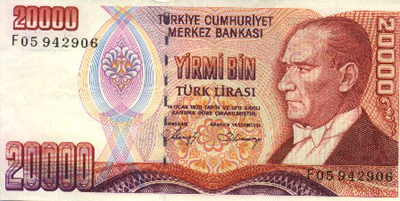
 ISTANBUL: The Turkish lira fell on Monday after lower-than-expected inflation figures boosted expectations that the central bank will have more room to ease its policy stance, while bond yields rose slightly as investors eyed debt auction later in the day.
Turkey's consumer price index rose 0.56 percent month-on-month in February, below a Reuters poll forecast of a 0.60 percent rise, for a year-on-year rise of 10.43 percent, the Turkish Statistics Institute said on Monday.
By 0901 GMT, the lira traded at 1.7740 versus the dollar, weaker than 1.7641 in late trade on Friday.
"The data indicated that core inflation is decreasing, which strengthens the central bank' loose policy stance for more easing. This would affect the lira negatively," said Tufan Comert, a strategist at Garanti Securities.
Against its euro-dollar basket the lira stood at 2.0558, compared with 2.0474 in late trade on Friday.
The Turkish Central Bank eased its tight monetary stance to support the economy at its monthly policy meeting earlier in February by unexpectedly cutting the overnight lending rate by 100 basis points to 11.5 percent. It also increased the liquidity provided through one-month repo auctions by 1 billion lira to 6 billion lira.
The mid-point of the central bank's year-end inflation forecast currently stands at 6.5 percent, seen still very optimistic by many analysts, as Turkey's economy is dependent to imports of energy, which prices remain close highest levels since 2008.
Turkey's two-year benchmark bond yield didn't react to lower inflation data and stood at 9.25 percent, slight up from a previous close of 9.24 percent.
"I wouldn't expect a significant effect of the inflation data on the bond market as the data was not a big surprise," Comert added.
Investors also eyed the treasury's tap of the fixed-coupon bond maturing on Jan. 12, 2022 later in the day.
"Considered the successful borrowing of the treasury in January and February and the positive global risk sentiment, we think the treasury could borrow without any problem this month too," wrote Fatih Keresteci, a strategist at HSBC.
Turkey's Treasury borrowed more than expected from domestic markets in January and February, mainly due to easier liquidity conditions boosting the demand at auctions.
The Turkish Treasury plans to borrow 10 billion lira from domestic markets in March. On Tuesday it will issue the new benchmark bond maturing on March 5, 2014 and it will tap a CPI-indexed bond maturing on Feb. 23, 2022.
The main stock index stood at 1.15 percent down at 60,189 points, underperforming a 1.06 percent fall in the MSCI emerging markets index

























Comments
Comments are closed for this article.