


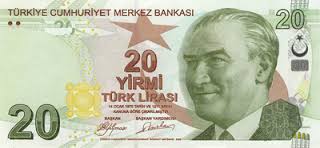
 ISTANBUL: Turkey's lira weakened on Friday after Prime Minister Tayyip Erdogan said the central bank should cut interest rates, a day after the bank's governor had said fighting inflation remained a priority and rates at existing levels would do the job.
Investors have long feared the government exerting pressure on the central bank to keep rates artificially low as it moves into an election cycle, and have warned how detrimental this would be to Turkey's struggle against inflation and external imbalances.
Speaking five days after nationwide local elections in Turkey gave his party a clear victory, Erdogan told reporters:
"As soon as the local election results were announced, markets started to react positively. The stock exchange climbed above 70,000. Yields are falling."
"In line with this, the central bank will probably convene an extraordinary Monetary Policy Committee meeting, and this time it should lower interest rates."
The bank was forced to make a massive rate hike in an emergency meeting in January, to stabilise the lira after it had plunged to record lows. Many analysts said this move came too late as a result of government pressure - denting the bank's reputation.
By 0720 the lira traded at 2.1433 to the dollar, slipping from 2.1350 beforehand. Analyst Tim Ash at Standard Bank said of Erdogan's remarks, "suffice to say very negative and disruptive comments - politicians should steer clear of making such specific comments over monetary policy in countries which are supposed to operate with independent central banks".
Turkey's central bank said on Thursday its tight monetary policy was sufficient to tackle inflation, even though consumer prices rose more than expected in March, and inflation would start to ease from June to approach its 5 percent target by mid-2015.
Istanbul's stock exchange traded flat on Friday at 71,613 points, outperforming the MSCI index of emerging markets which eased 0.24 percent.
The yield on the two-year benchmark bond rose to 10.69 percent from a previous close of 10.65 percent, while the yield on the benchmark 10-year bond rose to 10.45 percent from a previous close of 10.36 percent.
Earlier on Friday ratings agency Fitch cut its growth forecasts for Turkey, citing slower domestic lending growth and signs that consumer and investor confidence are moderating.
It now sees the economy expanding by 2.5 percent in 2014, compared with a previous estimate of 3.2 percent, and by 3.2 percent rather than 3.8 percent next year.
Turkey targets medium-term economic growth of 5 percent, which the central bank has said it expects to achieve by mid-2015 after shortfalls in 2012 and 2013.
Fitch said it expected political noise to remain an enduring feature ahead of presidential elections in August and parliamentary elections in June 2015, periodically clouding the economic outlook.

























Comments
Comments are closed for this article.