


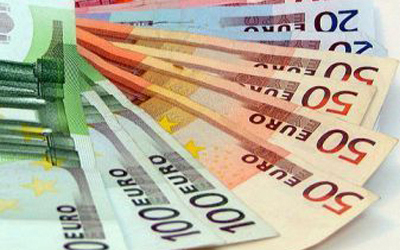
 TOKYO: The euro was buoyed near an 11-month high against the dollar on Monday on mounting signs of recovering economic confidence in Europe, while the yen slipped to a 2-1/2-year low versus the dollar on expectations of more monetary easing in Japan.
Data on Friday showed European banks are repaying more than expected of the emergency loans they borrowed from the European Central Bank (ECB) during the debt crisis, in a sign of their growing confidence.
German business morale also improved for a third consecutive month in January to its highest in more than half a year, more evidence that Europe's largest economy is gathering speed again after contracting late last year.
The euro fetched $1.3459, flat from late US levels last week but not far below an 11-month high of $1.3480 hit on Friday.
The single currency looks set to face a series of major resistance levels near $1.35, including its 2012 high of $1.34869, the 50 percent retracement from the high in May 2011 to the low in July 2012 at $1.3492, and the psychologically-important $1.3500 figure.
The euro was also helped by the perception that the ECB's monetary policy is less loose than that of the US Federal Reserve.
"While the Fed is still taking an accommodative policy stance, the ECB isn't. The fact that banks are returning loans to the ECB also means a smaller balance sheet at the ECB," said a trader at a Japanese bank.
"This difference in monetary policy stance is likely to help the euro in the very near term," he said.
As investors shifted their money back to the euro from various safe havens, the common currency vaulted to a 21-month high against the yen, a 13-month high against the British pound and stayed near an eight-month high against the Australian dollar.
Against the yen it rose as high as 122.90 yen, with its 2011 high of 123.33 seen as the next possible target. Against sterling, the euro climbed to 85.48 pence.
The yen's extended is two-month slide, hitting a 2-1/2-year low against the dollar, on expectations of further monetary easing down the road.
The yen's steep drop has raised eyebrows abroad and sparked talk it is triggering a currency war, with German Chancellor Angela Merkel saying she has some concerns about Japan's policy.
But at weekend Japan's economy minister rejected criticism that his country's extraordinary fiscal and monetary stimulus programme was aimed at weakening the yen.
The dollar climbed as far as 91.26 yen, its highest level since June 2010 and last stood at 91.05 yen, up 0.2 percent from late US levels.
The yen's weakness stemmed also from a rise in US bond yields, with which the currency has a close inverse correlation, as well as Japan's trade balance, which turned into the red after the nuclear disaster in 2011.
The 10-year US bond yield shot up on Friday, helped by optimism on the global economy. Wall Street shares also gained, with the S&P 500 index hitting a five-year high.
"There's no reason to buy the yen now. I think we could see three-digit figures (in the dollar/yen rate) this year," said a trader at a US bank.
The British pound was also soft, after data on Friday showed the UK GDP posted a larger-than-expected 0.3 percent contraction in the final quarter of last year.
The pound fell 0.2 percent to $1.5760, near Friday's five-month low of $1.5745.
Traders also say the pound has been hurt by Prime Minister David Cameron's pledge to hold a referendum on Britain's membership of the European Union, which is raising concerns it could deter foreign investment into Britain.


























Comments
Comments are closed for this article.