


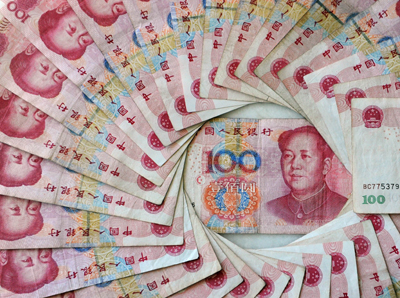
 SHANGHAI: China's yuan closed stronger against the dollar on Monday as the central bank appeared to wind down intervention to stem its rise, traders said.
The yuan closed at 6.2350 per dollar in early afternoon, 0.1 percent firmer than Friday's close of 6.2415.
The central bank set its midpoint at 6.2892 per dollar, slightly firmer than Friday's fix after the dollar index fell in overnight trade.
Trading volume was moderate at over $9.7 billion, just below the market average, but sharply down from the unusually high $17 billion yuan traded on Friday, according to data from the People's Bank of China.
Volumes recovered last week as major Chinese banks, suspected of acting at the behest of the central bank, sold yuan for dollars to restore liquidity to the market and weaken the yuan.
"Last week, the central bank intervened frequently, but if the market can recover on its own, regulators will stop managing the situation," said a trader at a major Chinese bank in Shanghai.
The spot market stalled for much of November and December and liquidity slumped when corporates refused to buy dollars within the range set by the central bank, as they reckoned their yuan was worth more.
The People's Bank of China (PBOC) allows the exchange rate to rise or fall by 1 percent away from the official daily midpoint.
While Chinese regulators have repeatedly said they believed the yuan has found a market-driven equilibrium, the central bank has used weak midpoint settings to signal its discomfort with the pace of appreciation. The currency hit record highs in late November.
According to data from the Bank for International Settlements released Saturday, the yuan's real effective exchange rate (REER) hit a record high in inflation-adjusted trade-weighted terms in November, rising to 109.6 from October's 107.9.
Traders said they expected the yuan to hold steady within its current range next year, pointing to statements by state media, after a key government policy conference on Sunday, that reiterated commitments to economic policy stability.
"We can throw out expectations of much appreciation or depreciation at this point," said a trader at a joint-stock bank in Shanghai.
The yuan looks set to end up around 1 percent against the dollar by the end of 2012.
**


























Comments
Comments are closed for this article.