


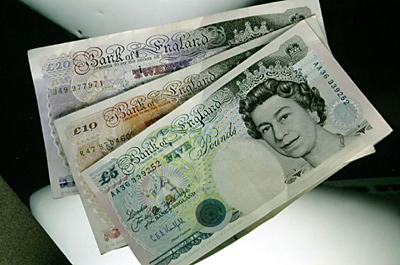
 LONDON: Sterling tracked a rise in the euro to recover from a two-month low against the dollar on Thursday, but looked vulnerable after weak UK economic data highlighted the risk of more stimulus.
The pound was last trading up 0.2 percent on the day at $1.5862. It regained ground after earlier tumbling to $1.5828, its lowest level since Sept. 5, on a surprise fall in UK retail sales data.
Strategists said sterling was following the euro higher against the dollar as appetite for perceived riskier currencies found some support following marginally better-than-expected French and German economic data.
But the outlook remained gloomy, with weak data compounded by a Bank of England inflation report on Wednesday which flagged unease about the impact of a high exchange rate on the economy and weighed on sterling.
Policymakers also said they could still opt for another round of monetary easing to boost the economy if needed.
"News out of the UK has been particularly bad with retail sales and a disappointing inflation report, and from a currency point of view there is nothing positive to take from it," said Gavin Friend, FX strategist at National Australia Bank.
Official data showed October UK retail sales slid 0.8 percent, compared with forecast for no change.
That wiped out a 0.6 percent rise in September and dented hopes of a consumer spending-driven economic recovery. It also hinted at a much weaker UK gross domestic product this quarter after a surprisingly strong reading in the previous one.
The outlook for the pound looked bleak as the faltering British economy is forecast to barely grow in the current quarter and expand slightly more than 1 percent in the next year according to a Reuters poll on Thursday.
Against the euro, sterling hit a two-week low. The euro was up 0.2 percent on the day at 80.55 pence, having risen to 80.65 pence, its highest since Oct. 31.
Stop-loss buy orders were triggered on its move above 80.60 with some investors positioned for the euro to rise to 80.75 pence - the Oct. 31 high - in the coming days.
STERLING VULNERABLE
Sterling losses earlier in the session pushed the BoE's trade-weighted index down to a three-week low of 83.4.
But for the year, trade-weighted sterling has gained 3.2 percent, despite the UK economy being in recession for much of that time. The index has risen nearly 8 percent from a 16-month low of 77.70 struck in early July 2011.
That has made UK exports less competitive at a time when the BoE is attempting to rebalance the economy towards exports. The euro lost 3.5 percent against sterling during the same period.
While sterling is expected to cede ground against the dollar, its weakness against the euro could be temporary, leaving the trade-weighted index at elevated levels.
The euro may come under further pressure if the sovereign debt crisis continues and the euro zone faces a sharper slowdown than the UK.
"The problem for Governor King and the role of a weaker pound in rebalancing the UK economy is that the UK's major trading partner, the euro zone, has a greater need of a weaker currency," said Chris Turner, head of currency strategy at ING.
"A weaker euro is going to have to play a key role and we see a risk that the European Central Bank shifts to negative deposit rates over the next six months. That is why we are retaining our view that euro/sterling trades down to 76 pence in the first half of next year."























Comments
Comments are closed for this article.