


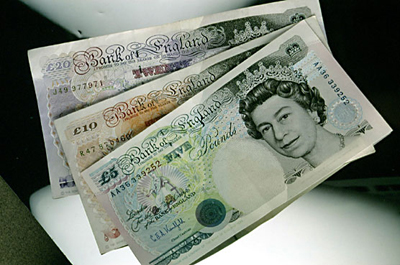
 LONDON: The pound fell more than half a percent against a broadly stronger dollar on Thursday, with a poor batch of data on business lending denting the case for a rise in official interest rates within a year.
Bank of England Governor Mark Carney reiterated on Wednesday that Britain's economic recovery had further to run before monetary policy was tightened and the bank's data showed a 1.9 billion pound fall in lending to businesses in December.
Mortgage approvals, by contrast, rose to the highest in almost six years, adding to the picture of a recovery that is built on consumer credit and rising house prices in a handful of cities and still failing to reach many ordinary Britons.
UK government debt yields have come down a touch this week, reflecting some wobbling of those rate expectations and flows of money from a number of major emerging markets back to developed economies.
There are also concerns the market rout in Turkey and elsewhere will harm growth more broadly.
The US Federal Reserve's decision on Wednesday to proceed with reining in the flood of money it is still pumping into the global economy drove the dollar broadly higher and underlined the challenge for many emerging economies this year.
"Yields in the UK have fallen slightly which I think is mainly a reflection of the emerging sell-off. There is obviously some concern that that could undermine growth and delay a rise in interest rates," said Lee Hardman, currency analyst with Bank of Tokyo Mitsubishi-UFJ in London.
"So far there are fairly limited signs of a recovery in business lending.
The recovery still seems based mainly on the housing sector, although we think that we should soon see an easing in credit conditions."
The pound is supported by expectations the BoE will be the first major central bank to raise interest rates and Hardman expects it to push below 80 pence per euro this year and hold strong against the dollar at just above current levels.
It deepened losses against the dollar after the lending data on Thursday, however, falling 0.65 percent on the day to $1.6451. It was 0.1 percent lower against the euro at 82.59 pence.
YIELDS DOWN
Gilt futures rose as far as 110.23 in early trade - the highest since early November - on emerging market concerns.
They were last up 36 ticks on the day at 110.15, little changed from levels held before the data.
Ten-year British bond yields were down 3.7 basis points at 2.73 percent, having hit their lowest in 10 weeks at 2.72 percent earlier. "Core sovereign bonds including gilts are taking their cue from risk assets," Nick Stamenkovic, bond strategist at RIA Capital Markets, said. "The focus is ongoing emerging market jitters.
As long as it persists gilts should remain pretty well underpinned in the near term."
Like others in the market, he took the view that gilts from a fundamental point of view were "poor value" because he expected the UK economy to strongly improve this year and the BoE to be "heading towards the exit" of ultra-loose monetary policy. "We are seeing cable come down, but that is more of a function of the dollar moving higher ahead of the (US) GDP numbers," said Peter Kinsella, strategist at Commerzbank.
"Sterling remains a buy on dips especially against the euro.
In the next few months we have a very nice environment for the pound, a low inflation environment, a higher growth environment. That should see the pound appreciate."

























Comments
Comments are closed for this article.