

World population will reach 7 billion this year: study

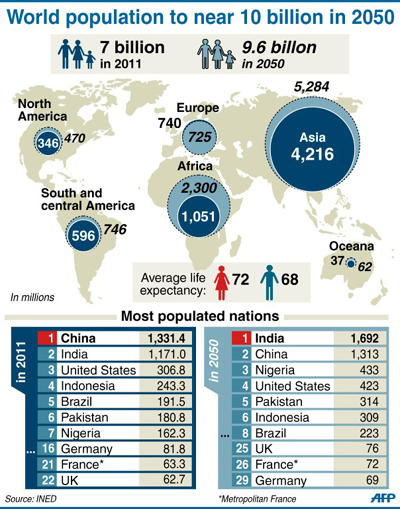 PARIS: The world population will reach seven billion later this year, with increases in the number of people in Africa off-setting birth rate drops elsewhere, according to a new French study published Thursday.
Looking much further ahead, the National Institute for Demographic Studies (INED) predicts a continuing rise in the overall population figures until the total stabilises somewhere between 9-10 billion worldwide by the end of the century.
From six billion people, the figure estimated in 1999, the gap between the global birth and death rates has swiftly brought the total figure towards the next billion in just 12 years.
INED expects it to take a further 14 years to reach eight billion people before the figures start stabilising, according to the study which pulls together research carried out by the United Nations, the World Bank and several major national institutes.
In historical terms the growth in the global population has been soaring since the 19th century.
"It has increased seven-fold over the last two hundred years, topping seven billion in 2011, and is expected to reach nine or 10 billion by the end of the 21st century," the report said.
Just seven countries now account for half the world's population, and therefore their demographic shifts have a major effect. China tops the list with over 1.33 billion people, with another 1.17 billion in India.
The other five countries, in order, are the United States, Indonesia, Brazil, Pakistan and Nigeria.
INED estimates that between now and 2050 India will become the most populous nation, with Beijing's one-child policy moderating the Chinese numbers.
While the overall numbers continue to grow, the rate of increase is already dropping, according to INED, standing at 1.1 percent this year from two percent 50 years ago.
This is due to the total fertility rate per women dropping to 2.5 children, half of the figure recorded in 1950.
However regional differences are great, with an average of 4.7 children per woman in Africa compared with just 1.6 in Europe.
Copyright AFP (Agence France-Presse), 2011






















Comments
Comments are closed for this article.