


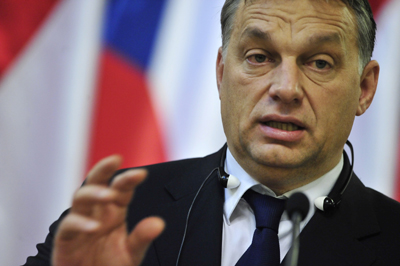
 BUDAPEST: Hungary must go its own way in policy and resist pressure from Brussels to implement steps that would harm its economy, Prime Minister Viktor Orban said on Thursday, in comments that signal a bumpy road ahead in loan talks with the EU and IMF.
Orban, whose government asked for financial help from the European Union and IMF in November but has yet to even begin talks with its lenders, has pursued unorthodox policies in the past two years including crisis taxes and the nationalisation of private pension funds.
Investors who finance most of Hungary's public debt, the biggest in central Europe as a proportion of GDP, are hoping an IMF programme would bring predictability to the country's economic policy, but such an agreement still seems a long way off.
"There is no doubt that EU member states ... will remain a determining partner for us, but when we say this we should know that it is worthwhile for Hungary to reject the crisis management proposed by the EU," Orban told a conference.
"If we wanted to carry out the steps which the bureaucrats in Brussels recommend to us, then I think we would do harm to our country. So in a very complex exercise ... we should chart our own path and resist pressures which want to introduce steps in Hungary that would be disadvantageous to us."
Orban said that Hungary had recently received proposals to introduce a real estate tax or scrap a cap on energy prices, but added that this would be against Hungary's interests.
His strong comments came just after the European Central Bank said his government's planned amendments to a disputed central bank law failed to address all of its concerns over the bank's independence, pointing to yet more delays to aid talks.
The dispute with Brussels and Frankfurt has repeatedly set back the start of talks on a loan from the EU and International Monetary Fund, which Hungary needs to lower its borrowing costs amid the euro zone's mounting debt crisis.
"It's clear that it will be a very slow process to advance towards a deal, or that very negative market sentiment is needed for a quick agreement," Janos Samu at Concorde Securities said.
ECB SLAMS CENTRAL BANK LAW AGAIN
The ECB said in a fresh legal opinion on Thursday that it welcomed the fact that Hungary's government had taken into account some of its earlier observations regarding the law.
"However, the amended draft law still fails to address a number of previously highlighted concerns as regards the MNB's (National Bank of Hungary) independence," the ECB said.
The ECB highlighted concerns over potential changes to the size of the Monetary Council and the appointment of a third deputy governor as issues of particular concern. It said such steps could be taken without consulting the bank and could be used to influence its decision-making.
It also criticised the expanded executive powers of the Monetary Council and a cut in central bankers' salaries.
The ECB said the remaining open issues over the central bank's independence should be addressed as part of the current parliamentary procedure on the legal amendments so as to avoid further changes to the law later.
Hungary's parliament is due to vote on the amendments next week, and some market players had hoped that this would lead to a quick start of aid negotiations after months of delay.
But state secretary Mihaly Varga, who will lead Hungary's negotiations with the IMF and EU, told public radio on Thursday that it was hard to predict when the talks could start.
"It is likely that we will start the talks sometime during the summer, but it is very difficult to say now when this would be," he said.
Eszter Gyargyan, an analyst at Citigroup, said parliament still had time to change the law before the summer recess which starts in mid-July.
"This, however, may only happen following increased market pressure on the government to take action," she said.

















Comments
Comments are closed for this article.