


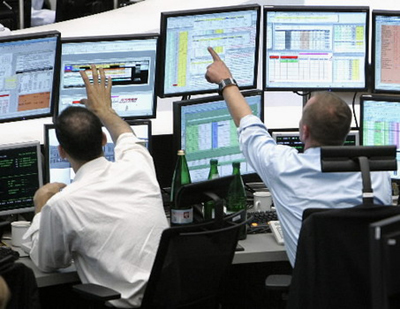
 LONDON: Europe's main stock markets fell on Tuesday, with London hit by profit-taking and poor economic data, while traders kept a keen eye on developments in Japan and Libya. The British capital's benchmark FTSE 100 index of leading shares finished down 0.41 percent at 5,762.71 points. Meanwhile in Paris, the CAC 40 fell by 0.3 percent to 3,892.71 points while in Frankfurt the DAX closed down 0.52 percent to close at 6,780.97 points. European equities had risen on Monday, supported by UN-backed military action in Libya, easing nuclear fears in Japan plus merger and acquisition (M&A) activity in the telecoms sector. However international, and sometimes national, squabbles over the extent and ultimate aim of the 'no-fly zone' action has sown uncertainty into the minds of many investors, already struggling to factor in the effects of Japan's massive earthquake and tsunami and the associated nuclear plant crisis there.
"The market is beginning to show concerns as the international community is not managing to speak with one voice on Libya, said Frederic Aubel, a French trader at Global Equities, in comments which could equally apply throughout world bourses. In London, downbeat data set a disappointing tone on the eve of the British government's annual budget. British state borrowing rocketed last month to a record level, official data showed on Tuesday, reaching £11.8 billion (13.6 billion euros, $19.3 billion) in February, the highest-ever level for the month. At the same time, British annual inflation jumped to 4.4 percent in February, the highest level for more than two years, according to separate data.
"February's public finances and consumer prices numbers presented a distinctly unfavourable backdrop to tomorrow's budget," noted Capital Economics analyst Jonathan Loynes. On top of that the cost of Britain's role in Libya, even if it is less than the wars in Iraq and Afghanistan, is a fresh headache for the cash-strapped government as it tries to tackle a record deficit. A four to six-week air war over Libya would cost Britain around £100 million ($162 million, 114 million euros), up to three million pounds a day, said Malcolm Chalmers, from defence think tank the Royal United Services Institute. The smaller European bourses had a more mixed day, though nowhere was seeing massive gains. The Rome market was up 0.14 percent from Monday while Geneva and Madrid were quasi-stable, adding 0.05 percent and 0.02 percent respectively. Falling with London, Paris and Frankfurt into negative territory were Lisbon, down 1.53 percent, Brussels down 0.66 percent and Amsterdam which slipped 0.09 percent. Asian shares were mostly higher on Tuesday, with Tokyo soaring more than four percent, amid cautious optimism that Japan's nuclear crisis could soon be under control. Japanese traders returned after Monday's public holiday to send the Nikkei shooting 4.36 percent higher, with the mood helped after the Bank of Japan pumped two trillion yen ($24.67 billion) into the money market. The latest move means the central bank has injected 39 trillion yen to ease concerns about the ability of financial institutions to meet demand for funds. Wall Street was also slightly down in early trading Tuesday after rallying for three days amid news of tentative progress in regaining control of Japan's Fukushima nuclear plant.
"With the economic calendar fairly light today, the Street will likely take its cues from the handful of earnings reports on tap, and should continue to monitor the nuclear situation in Japan and the escalating geopolitical tension in the Middle East," said Andrea Kramer of Schaeffer's Investment Research. At 1400 GMT the Dow Jones Industrial Average of blue chip stocks was lower by 0.08 percent at 12,026.65. The broader S&P 500 fell 0.16 percent to 1,296.33, while the tech-focused Nasdaq Composite lost 0.18 percent to 2,687.18.






















Comments
Comments are closed for this article.