


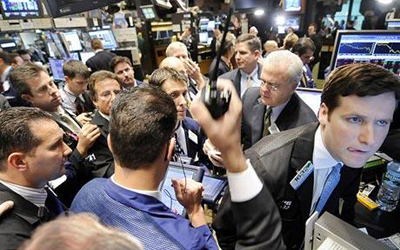
 NEW YORK: Japan's nuclear disaster and violence in Saudi neighbor Bahrain sparked a new plunge in US and European stocks Wednesday, with the key French, German and US indices all giving up more than two percent.
The deteriorating situation at the Fukushima No. 1 nuclear power plant added panic to markets already spooked by Friday's combination earthquake and tsunami, which wiped out part of the country's northeast coastline and killed thousands.
Others were spooked by new violence in Bahrain which left five people dead and observers wondering whether the Shiite-dominated uprising could spill over into oil giant Saudi Arabia, which has sent troops to help its fellow Sunni monarchy.
"Market participants continue to grapple with threats of nuclear fallout in Japan and further instability surrounding the social and political turmoil in the Middle East and North Africa," said analysts at Briefing.com.
"Uncertainty regarding portfolio positioning amid those themes has made many become defensive, or even skittish."
A day of progressively dire warnings about radiation releases from Fukushima pushed stocks lower after more buoyant performances early Wednesday in Asia.
In Europe, the Dax index lost 2.0 percent and France's CAC 40 gave up 2.2 percent. London's FTSE came off slightly better, ceding only 1.7 percent.
The US markets followed suit. The Dow Jones Industrial Average sunk 242.12 points (2.0 percent) to finish at 11,613.30 -- for a nearly 500 point loss over three trading days.
The tech-rich Nasdaq Composite plummeted 1.9 percent to 2,616.82, while the broad-market S&P 500 index shed 2.0 percent at 1,256.88.
That left the Nasdaq and S&P below their starting levels for the year, and the Dow just a few ticks higher.
Analysts said the markets took their cues from officials' remarks on the Japanese crisis: a European energy official spoke of imminent "catastrophic events," while the top US nuclear regulator revealed that "extremely high" levels of radiation after a cooling pool for spent fuel at one reactor had emptied.
"We believe that radiation levels are extremely high, which could possibly impact the ability to take corrective measures," said Nuclear Regualtory Commission chairman Gregory Jaczko.
All that news came after Asian markets delivered marked recoveries Tuesday.
Japan had opened the day with a determined climb-back from a 10.6 percent rout on the Nikkei 225.
It added 5.7 percent for the day, after the Bank of Japan pumped another 3.5 trillion yen ($43.3 billion) into the financial system to soothe shaken markets.
The yen also powered up to a post-war high at 77.86 to the dollar, likely due to repatriation of funds and market speculators.
Other Asian markets also moved up, Seoul adding 1.8 percent, Shanghai 1.2 percent but Hong Kong a bare 0.1 percent.
The US markets were also clouded by a discouraging bunch of economic indicators: the producer price index, a harbinger of inflation, rose 1.6 percent in February from January; and new home construction figures plunged 22.5 percent in February, painting a dismal picture for the crucial building industry.
Latin America's key markets, seemingly immune in previous days, took a hit too. Brazil's Bovespa pared 1.5 percent, while Mexico's IPC lost 1.0 percent.






















Comments
Comments are closed for this article.