


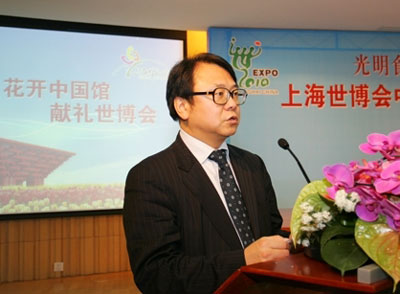
 SHANGHAI: Shanghai's Bright Food Group is betting the allure of China's vast market, not just a huge amount of easy cash, is the key to winning a high-stakes battle to buy half of French yoghurt maker Yoplait. With a population of more than 1.3billion, China promises to be the main source of growth for Yoplait, Bright chairman Wang Zongnan told AFP in an interview this week at the firm's villa-style headquarters in Shanghai.
"On one hand, the population is so huge. On the other hand, the average consumption per capita is so low. There is huge potential in the market," said the 55-year-old Wang.
"After we tie up with Yoplait, the bulk of growth will come from the Chinese market. The European market is already saturated and the growth is limited there." Bright's bid for Yoplait, confirmed last week, is part of its long-term strategy to quickly become a major food industry player over the next five years by partnering with established foreign brands. It is vying with Swiss and US food giants Nestle and General Mills for a 50 percent stake in the French company, owned by private equity firm PAI Partners. French groups Bel and Lactalis are also in the mix. Wang says his group is facing "fierce" competition from global industry leaders, but declined to say how much it offered. Cash-rich Bright, which is controlled by the Shanghai municipal government, reportedly submitted the highest first-round bid, valuing the French firm at 1.7 billion euros ($2.4 billion). The group has easy access to financing from China's state-run banks but Wang said the price may not be the main factor in winning the bid, as long as it is "in a reasonable range acceptable to PAI".
"Funding is not a problem for the development of our group, including mergers and acquisitions. Banks are more than willing to lend money to us," he said.
"There are many factors and the top one is: who can bring Yoplait a bright future? Who can bring bigger growth to the brand and bigger profits to the milk farmers?" Wang said he would keep Yoplait's management team, respect existing agreements with dairy farmers and aim to make Yoplait-branded yoghurt available in China. Although not part of the traditional Chinese diet, dairy products, yoghurt in particular, have become popular in China as incomes rise and government campaigns promote their nutritional value. Yoghurt consumption in the country more than doubled between 2005 and 2010, with more than 33 billion yuan ($5 billion) worth of products sold last year, according to research firm Euromonitor. Wang said he believed Chinese consumers would welcome the "strict management" for which a European brand like Yoplait is known, after a deadly scandal that rocked the dairy industry in China in 2008. At least six children died and nearly 300,000 suffered kidney and urinary problems after consuming products laced with melamine, an industrial chemical that can make milk appear richer in protein. Bright Dairy, a subsidiary of Bright Food, was one of 22 Chinese companies found to have sold contaminated products.
"The melamine scandal was a big blow to China's dairy industry. It was a profound lesson," Wang said. Nevertheless, China's total dairy market expanded 73.8 percent between 2006 and 2010 to $26.6billion, according to Euromonitor. In France, the sector only saw 5.9 percent growth in the same period to about $22 billion. Wang shrugged off a few unsuccessful efforts by Bright in the past at overseas expansion, saying such efforts involved a complicated mix of factors including price, synergy and management risks. Last year, the group failed in its bid for the sugar and biofuels unit of Australia's CSR. It also cut off talks with US nutritional product retailer GNC and Britain's United Biscuits. Wang said he aimed to build Bright Food into a giant with annual sales of 150billion yuan in the next five years. The company had revenues of 80billion yuan in 2010. He said the group, which had a 5.7percent share of China's dairy market at the end of 2009, according to Euromonitor, was also keenly looking at acquiring wine makers and sugar producers.
"We are trying to take a shortcut by taking advantage of foreign brands and resources to move into the overseas market. It should be faster and more effective than going abroad with our own products," Wang said.























Comments
Comments are closed for this article.