

Petroleum Limited (PSX: PPL) has been a frontline player in the energy sector since the mid-1950s. As a major supplier of natural gas, the company contributed to over 20 percent of the country's total natural gas supplies besides producing crude oil, natural gas liquid and liquefied petroleum gas.
It all began in June 1950, with major shareholding by Burmah Oil Company (BOC) of the United Kingdom for exploration, prospecting, development and production of oil and natural gas resources. In 1997, BOC disinvested from the Exploration and Production (E&P) sector world-wide and sold its equity in PPL to the Government of Pakistan.
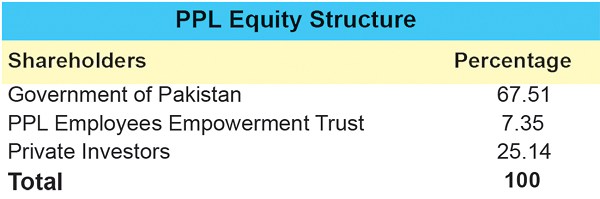
Later, the government reduced its holding through IPO in June 2004, which was further decreased with the initiation of the Benazir Employees Stock Option Scheme in 2009. Furthermore, the government further disinvested its five percent shares in PPL through Secondary Public Offering in 2014. Currently, the PPL's shareholding is divided between the government (68 percent), PPL Employees Empowerment Trust (around 7 percent) and private investors (25 percent).
Business Operations
PPL operates nine producing fields across the country including Sui, Adhi, Kandhkot, Chachar, Mazarani, Adam, Adam West, Shadadpur and Shahdadpur West and holds working interest in 15 partner-operated producing fields. Together with its subsidiaries, PPL has a portfolio of 44 exploration assets of which the company operates 27, including one contract in Iraq, while 17 blocks, comprising three offshore leases in Pakistan and one onshore concession in Yemen, are operated by joint venture partners.
The firm acquired 100 percent shareholding of MND E&P Limited, a company incorporated in England and Wales, and its name PPL Europe E&P Limited. PPL has also established a wholly-owned subsidiary, PPL Asia E&P B.V that will focus on exploration and production of oil and gas in the region.
PPL - Financial performance 9MFY16
The latest announced financial performance of Pakistan Petroleum is that of its nine-month FY16 period. The company has not announced its FY16 and quarterly financial performance for FY17. As per the announcements on the stock exchange, the company has gotten an approval from the SECP for an extension in the period for holding its 75th Annual General Meeting, which the SECP has directed to be held by 28th February 2017.
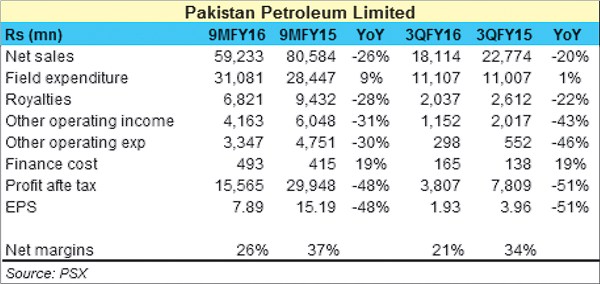
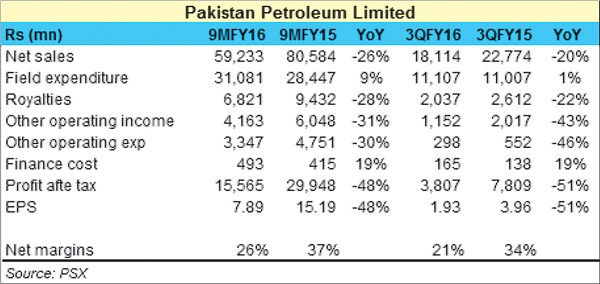
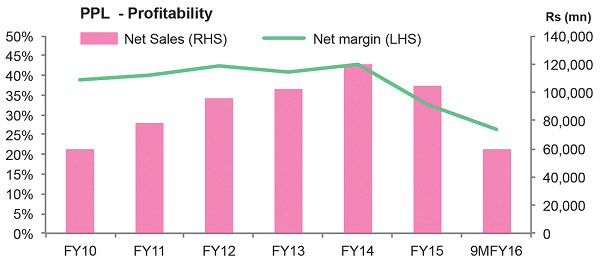
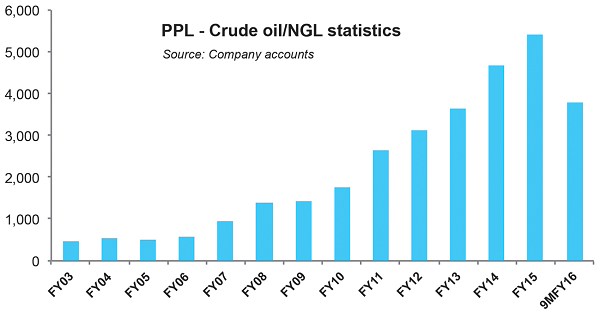
The firm's 9MFY16 financial performance was affected by low crude oil prices - a phenomenon that affected the oil and gas industry in general. In short, the earnings for 9MFY16 were victim of contracting oil prices. Average oil prices fell by around 48-50 percent in 9MFY16. Besides lower crude oil price environment, the firm's crude oil production also slowed as well during the period under review. In 9MFY16, the E&P firm's earnings were down by 48 percent, year-on-year. This notable decline in profits has been due to 26 percent year-on-year decline in top line, nine percent year-on-year increase in field expenditure, and 31 percent decline in other income.
Higher field expenditure for PPL stemmed from higher exploratory component relating to the expensing out of a couple of abandoned wells. Falling of other income remained another reason for the sluggish bottom line, which was possibly due to lower exchange gains.
Outlook
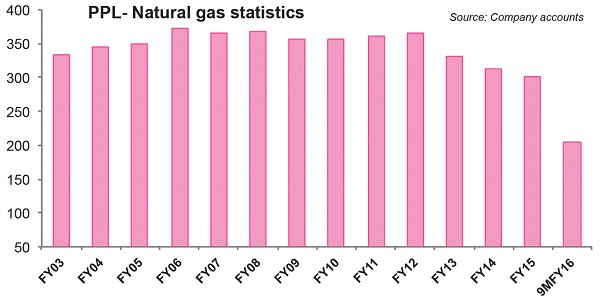
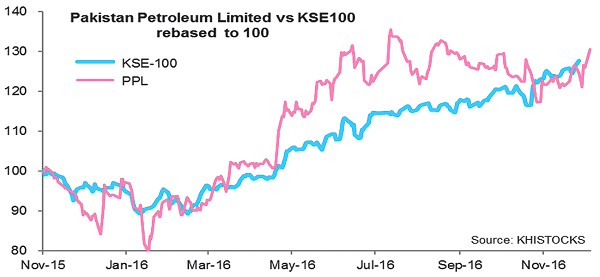
PPL share price has outperformed the benchmark even amid low price environment as the firm has been an aggressive exploration and production firm. Boost to the bottom line will certainly come from a turnaround in crude oil prices. During the same period, gas production has witnessed slight improvement by PPL due to recovery in its two key fields: Sui and Kandhot.
Though the firm's updated financial performance is yet to be announced, the latest press release by the company shows that the firm has achieved a major milestone in November with net PPL production once again crossing the 1 billion feet equivalent per day-mark, resulting in an overall production increase of more than 10 percent during the current year as compared to 2014-2015.
The firm highlights that the increase was brought primarily from the company's structural reorganisation to an asset-based hybrid set-up in mid-2015, enabling renewed focus to optimise reserve replacement and production from mature assets and fields.
The increase in production included notable drilling activity (a record of 23 operated wells) and maximising production efficiencies mainly through revamping of Sui compressors and existing wells in various fields, and commissioning of new production facilities at Adhi and Gambat South. During 2015-2016, the company made six discoveries and drilled 12 exploratory wells in operated blocks and achieved 127 percent reserve replacement ratio according to the company announcement.

















Comments
Comments are closed for this article.