

Merkel to walk fine line on euro at party congress

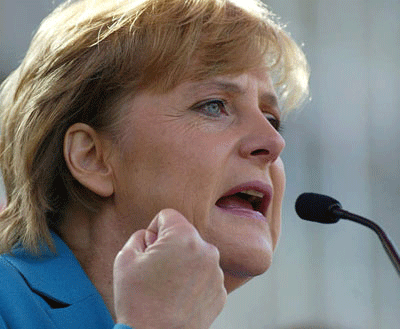 BERLIN: German Chancellor Angela Merkel will attempt to rally her conservatives behind the idea of closer European integration at a party congress starting on Monday, despite escalating doubts in the rank and file about the single currency project.
The two-day meeting in the eastern city of Leipzig was supposed to focus on education policy but is now likely to be dominated by the euro zone's deepening debt crisis, which claimed the scalps of the Italian and Greek premiers last week.
Merkel does not face an election until 2013, but knows she could easily become another victim of euro turmoil unless she plays her cards right.
She will attempt to rally her Christian Democrats (CDU) for the trying months of crisis-fighting to come and what she now openly describes as a drive towards fiscal and political union in Europe is one of her biggest challenges.
That battle starts on Monday in Leipzig.
"These events can be very important for getting the party on side," Gerd Langguth a political scientist at Bonn University and biographer of Merkel. "We've seen a number of governments fall already over this crisis. It's clear that Merkel will have to offer a strong defence of her course to the rank and file."
The CDU is the party of Helmut Kohl, who led Germany into the euro.
But nearly 13 years on, many members are uneasy with taxpayer-funded bailouts of weak euro states, deeply resent fiscal backsliding in countries such as Greece and worry the crisis may compromise the independence of the European Central Bank. Some in the party believe the whole project was a mistake which must now be undone.
The fine line that Merkel will be walking in Leipzig is illustrated by a resolution on euro zone policy prepared for the congress by the CDU leadership.
Entitled "Strong Europe -- A Good Future For Germany", the document contains two main messages that can often seem contradictory: 1) that Germany has benefitted hugely from the euro, must gird for more burdens to save it and be ready to give up sovereignty to Brussels, and 2) that member states that violate European fiscal rules must be dealt with harshly, and may even leave the bloc.
In the resolution, the party rejects the idea of joint euro zone bonds outright and describes the ECB's controversial bond-buying programme as a "last resort" policy that should end as soon as possible.
ALTERNATIVES WORSE
Much criticised abroad, Merkel's policy of bailing out struggling euro states one-by-one but resisting pressure for bolder steps like euro bonds is painted by the party as a wise middle-course.
"The alternatives to this policy would have been a risky collectivisation of government debt or the disorderly insolvency of states with unforseeable consequences for the entire euro zone and world economy," the resolution reads.
It is not only her euro policy which has sparked dissension in CDU ranks. After the Fukushima disaster in Japan earlier this year, Merkel abruptly abandoned the party's long-standing support for nuclear power, enraging the CDU's business wing.
Last month she made another surprising about-face, backing the introduction of a nationwide minimum wage, a policy she had publicly opposed for years.
Both reversals are part of a deliberate strategy by Merkel to co-opt the positions of rival parties, as she did on evironmental and family policy in her first term, and increase her coalition options for 2013, when partnerships with the Social Democrats (SPD) or Greens may be her only hope of retaining power.
Since becoming chancellor six years ago, she has overseen a dramatic transformation of the CDU that has made it nearly unrecognisable from the free-market, business-friendly party that gathered in the same city of Leipzig back in 2003.
Back then Merkel was often likened to Britain's hard-charging reformist Prime Minister Margaret Thatcher, a comparison no one makes anymore after her sharp turn left.
But if the euro zone crisis blows up before the next German vote, forcing one or more countries out of the bloc and hammering the region's economy, then even the most canny political maneouvres and reinventions probably will not save her.
Copyright Reuters, 2011






















Comments
Comments are closed for this article.