

Industrialization coop CPEC's important component: Ahsan Iqbal

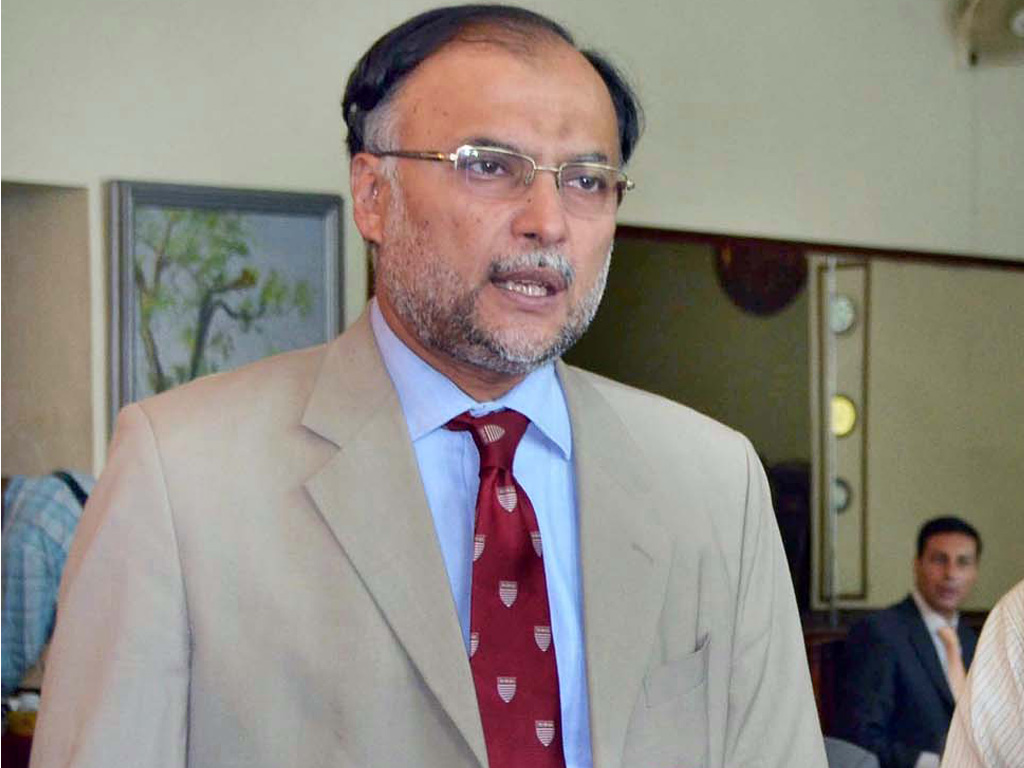 ISLAMABAD: Federal Minister for Planning, Development and Reform, Prof. Ahsan Iqbal Thursday said industrialization cooperation between China and Pakistan was an important component of China Pakistan Economic Corridor (CPEC) framework which would start after completion of Gwadar, energy projects and transportation infrastructure development.
Addressing a conference on 'CPEC and Regional Integration' he said, "We must improve our low value economy to a high value economy after the completion of CPEC framework to make Pakistan a stable economic country,"
The minister informed that the Chinese leadership was committed to help Pakistan to achieve rapid development through CPEC.
Ahsan Iqbal said the living standard of the people in the all the areas along CPEC route was improving.
He mentioned Gilgit-Baltistan (GB) would have an improved connectivity with the fiber optic laying and said new engineering, medical colleges had been established.
He said industrial zones would also be set up along CPEC route for the benefit of the people of the GB.
About Gwadar, the minister said the government was investing heavily in the remote areas to bring them at par with the developed zones.
He said technical institutes were established to impart technical education to local youth while Gwadar university would equipped the youth to hold managerial positions.
The minister said after 70 years, Gwadar had been connected with Quetta after completion of 600-km N-85, adding, now people from Quetta would be able to reach Gwadar within eight hours travelling.
About the development of transportation infrastructure, he said mega transport systems were introduced in big cities to provide a rapid connectivity and clean environment to the citizens.
"The citizens have now fast moving transport facility within the cities as these cities are future growth centres," he added.
Regarding railways, he said Rs 100 billion were injected for the development of railways, adding, railways had again started its cargo service lessening the burden on roads and reducing the cost.
He said during the last three years, 11,000 MW electricity was added to the national grid while during the last 66 years, the country was able to produce around 17,000 MW.
The biggest investment in energy sector would unleash new era of development in the country, he added.
He said the small and medium enterprises depended on public sector energy supply and the sufficient power supply would help revive this important segment of economy.
Terming CPEC number one opportunity, he said this initiative was not only a game changer but a fate changer for Pakistan and the regions beyond.
He informed that several countries had showed intention to join CPEC project which was mutually beneficial for three billion people living in China, South Asia and Central Asia.
About Chahbahar port, he said, "We do not consider it as the competitor but it is complementary."
He asked the researchers and policy makers to come up with concrete suggestions which were beneficial for the country.
The prestigious Quaid-i-Azam Lecture was delivered by Prof Athar Hussain, Director Asia Research Center, London School of Economics, UK.
The theme of his lecture was "Regional and Domestic Political Economy".
The Quaid-i-Azam lecture focused on what is the most striking feature of the geographical distribution of economic activities or entities.
He stated that most of us are either unaware of how uneven many of the geographical distributions are or regard the fact as of no particular significance, needing no explanation.
Based on the New Economic Geography (NEG) framework, Prof Hussain said uneven distributions arise from a variety of causes, some of which are obvious while others are complex and made up of a number of separate but interacting factors.
He argued that with some exceptions economic activities are mobile in principal and can be relocated at a number of alternative locations.
The exceptions are those that are tied to some natural resource in which case they are determined by the availability of that particular resource.
Professor Hussain believed that the main determinant of selecting a location is the trade-off between the economies of scale, transport cost, and market size.
He concluded his talk by giving implications of NEG for regional policy.
He said NEG points to strong trends towards concentration and agglomeration - a trend that seems contrary to reducing regional inequalities.
The focus of regional policy, therefore, should be increasing the attraction of backward regions through investment in local infrastructure and improving local human capital.
The first panel discussion of the day was on "Socio-Economic Impact of CPEC", which was chaired by Dr. Arshad Zaman, former Chief Economist Dr. Nadeem Javed, Chief Economist, Government of Pakistan, said CPEC is primarily an energy-driven connectivity project the aim of which is to reduce energy constraints and improve fuel mix. Post-July 2017 the gap between demand and supply of energy will end and by July 2018 generation of power is expected to be in surplus due to CPEC.
Chief economist said according to projections, CPEC would reduce the number of unemployed labor force by 2.32 million in 2017-18.
Expressing his views on the topic, Prof Tariq Amin Khan, Ryerson University, Canada, said problems in existing social relations require alteration in structure of rural society. If the goal is to create less oppressive social relations then the government needs to intervene.
He said it took many decades for the situation to change in central Punjab but we cannot wait that long to bring social change in Southern Punjab.
The situation demands land distribution, learning lessons from history and imposition of agriculture tax and using the revenues for rural development.
The last panelist of the session, Qazi Issa, Executive Director PPAF, said to uplift the neglected community, the need is to create dedicated community connectivity fund.
For human development we require to build social capital and empower the communities, he commented.
Continuing the discussion, Dr. Safdar A. Sohail, Executive Director, CPEC Center of Excellence, PIDE-Planning Commission, said the socioeconomic impact of CPEC is the most widely and wildly discussed issue in recent days on all the platforms.
He said CPEC in its current manifestation would go up till 2030 but it would continue after that as a part of the long term plan.
Nasir Afghan, Director MBA Program IBA, who was the final speaker of the session, said spatial framework of China involves national to city and district level planning and we also need to look into it.
He said existing industrial parks in Pakistan are not performing well.
He said all national sector plans are needed to be aligned to CPEC.
The second panel discussion was on the theme of "Challenges in the Agriculture Sector and Role of CPEC".
The session was chaired by Muhammad Abid Javed, Secretary Ministry of National Food Security and Research.
Commenting on the theme, Shujaat Ali, Additional Secretary Finance, said the interest in agriculture in policy and research has declined rapidly.
The second speaker on the occasion was Professor Steve Davies of IFPRI.
He said fertilizers yield has gotten worse for cotton and wheat since 1980s and the fertilizer industry is highly subsidized.
He said the best agriculture policy would be to remove subsidies and increase R&D expenditures. It will increase government revenues and increase production.
He said Bhasha Dam initiative is a positive step and the combination of Bhasha Dam and water course line will positively affect water supply in future.
Expressing his views on the topic, Dr. Paul Dorosh said that only large farmers, who sell wheat to the government, benefit from current wheat policy.
He said the government faces financial loss of Rs 4.5 billion every year due to subsidy and wheat procurement.
Dr. Dorosh said per-unit subsidy could be reduced by raising the release price and reducing subsidy to flour mills.
The amount saved could be used for irrigation and other purposes.
At the end, of the session, the book titled "Agriculture and Rural Economy in Pakistan: Issues, Outlooks, and Policy Priorities", edited by David J. Spielman, Sohail J. Malik, Paul Dorosh, and Nuzhat Ahmad, was launched. The book is published for IFPRI, Washington, D.C. USA.
Earlier, some interesting papers were presented in technical sessions. In a paper on CPEC and Regional Integration, the author said the analysis of Trans-Asian Pipeline Network shows the importance of CPEC. Afghanistan can be an effective connecting point but it does not have infrastructure and there is also a problem of security.
Analyzing the use of renewable energy in China and its possible spillover effects for Pakistan, another paper showed that in China there has been a shift from hydro energy to wind and solar energy.
Since the FDI has spillover effects, investment in CPEC related projects in Pakistan will help it to adopt renewable energy. Therefore, policies should facilitate the transfer of tacit knowhow of renewable energy generation.
Using transitional analysis, a paper showed that regional integration will increase 13 percent per year due to CPEC and related projects.
As per statistics given in another paper on infrastructure development and regional integration, nearly 20 percent of GDP will be invested through the FDI by China.
CPEC will also improve the integral physical infrastructure for the development of the whole region, the paper argued.
The three-day long Conference was attended by a large number of social scientists, researchers, faculty members from universities across Pakistan, students, policymakers and government functionaries.
The conference was organized by the Pakistan Institute of Development Economics (PIDE), with the support of Ministry of Planning, Development and Reform and other sponsors of the AGM/Conference included UNDP, FES, the World Bank, PPAF, OXFAM, IGC, ILO, IUCN, AKRSP, IFPRI, ADB, and ECO-SF.


















Comments
Comments are closed for this article.