


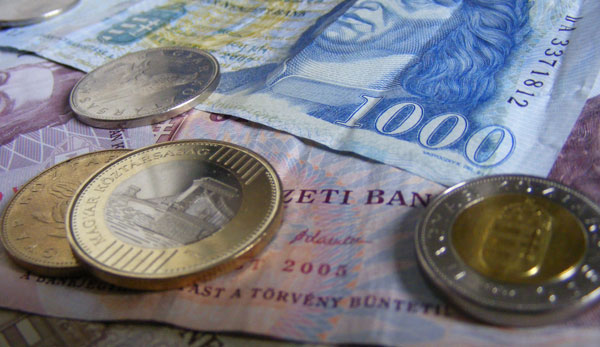
 BUDAPEST/BUCHAREST: The forint retreated and Hungarian government yields steadied at record lows on Tuesday as the country's central bank cut its short-term lending rates, while assets in Central Europe's fast-growing emerging economies were mixed.
The forint dropped to this month's weakest level at 308.85 against the euro.
It reversed an early gain to 307.70. The zloty strengthened by 0.1 percent and the leu gained 0.3 percent.
The Hungarian central bank kept its base rate on hold but cut its overnight lending rate by 10 basis points to 1.05 percent. It also lowered commercial banks' required reserve ratio as of December and said further monetary easing was possible. It cut the interest rate on the one-week central bank loan by 5 basis points to 1 percent as well.
In the past two weeks, the central bank has also provided banks with 400 billion forints at its new swap tenders.
The measures, which boost liquidity in interbank markets, should help local banks bridge a liquidity shortage and meet their monthly reserve requirements.
Banks are short of forints because of tax payments this week and because they placed billions of euros worth of forints in three-month central bank deposits in recent months, before a limit on the facility takes effect at a tender on Wednesday .
The central bank plans to reduce the deposits to 900 billion forints ($3.17 billion) by the end of 2016, compared with 2 trillion forints a month ago.
The latest measures tackle an imminent forint squeeze. Liquidity should rise further in coming weeks, encouraging banks to put more money into lending and government debt purchases.
"The squeeze is temporary, the structural change will be the limits on the three-month deposits," one Budapest-based money market trader said.
Hungarian short- and medium-term government bond yields dropped 2 to 3 basis points from Monday's fixing to record lows. They were unchanged after the central bank decisions, with three-year debt trading at 1.13 percent and five-year bonds at 2.65 percent.
Hungary's three-year bond yields are still almost 2 percentage points above German Bunds, which yield -0.65 percent.
Central European safe-haven Czech Republic's corresponding yield traded below German levels, at -0.842 percent.
That debt still attracts buyers, amid speculation that the crown will surge after the Czech central bank removes its cap on the currency's value, 27 against the euro. The central bank says the cap will last until mid-2017.
The leu jumped to a 12-day high against the euro after Romania's government turned to the Constitutional Court to challenge a bill on the conversion of Swiss franc mortgages, which would raise costs for some commercial banks.


























Comments
Comments are closed for this article.