


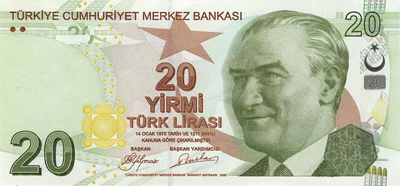
 LONDON: The Turkish lira extended losses on Tuesday, bucking the generally firmer trend across emerging markets as fighting raged across its border with Syria, while Ukraine's dollar bonds fell sharply as worries about the government's future grew.
Broader emerging assets were mainly firmer as a 3 percent rebound in mainland Chinese shares and gains of over 1 percent in Hong Kong led MSCI's benchmark emerging equity index up 0.5 percent to the highest in almost a week.
But political tensions weighed on several markets, with South Korea's won slumping to 5-1/2 year lows against the dollar earlier in the day after the president pledged "strong measures" against North Korea.
The currency was also put under pressure by the central bank, which signalled that policy easing could lie ahead as the economic recovery has faltered.
In emerging Europe, the Turkish lira fell 0.4 percent to a one-week low versus the dollar although stocks rose 0.8 percent after falling sharply on Monday as Ankara accused Moscow of war crimes after a Russian missile killed 50 people just inside the Syrian border.
It warned late on Monday of "bigger and more serious consequences" if Russia did not end the attacks.
Turkish five-year credit default swaps (CDS) rose 3 basis points (bps) from Monday's close to 311 bps, approaching October 2015 highs hit last month, according to Markit. Dollar bond premiums widened 10 basis points over Treasuries though they stayed off 4-1/2-month highs hit on Monday.
"Any ground operation or intensification of air strikes increases the risk of direct confrontations and any such scenario is little priced into markets so far," analysts at Mitsubishi UFG said in a note to clients.
Ukraine's dollar bonds fell sharply across the curve, with the 2027 issue slumping 2.7 cents, as fears mounted that a potential government collapse could derail Kiev's lifeline from the International Monetary Fund.
Ukraine's hryvnia also hit a new one-year low against the dollar.
"It's just a matter of time before the government falls or we have a major reshuffling," said Per Hammarlund, chief EM strategist at SEB. "The anti-corruption measures have been much more controversial than we would have liked, and now with the IMF putting pressure on them ... something will have to give."
Oil-related assets took some support from firmer crude prices after four oil producers agreed to freeze output at January levels in an attempt to stabilise the market. However, this fell short of the production cuts some traders had positioned for.
Some Gulf bourses, such as Dubai rose over 2 percent whilst Saudi Arabia was up around one percent.
Russian stocks increased 0.7 percent but the rouble slipped 0.5 percent against the dollar.
In eastern Europe, the Czech crown was slightly weaker against the euro after a surprise drop in fourth quarter economic growth.
"It was much weaker than anticipated and that could mean the central bank introduces negative interest rates," Hammarlund said.




















Comments
Comments are closed for this article.