


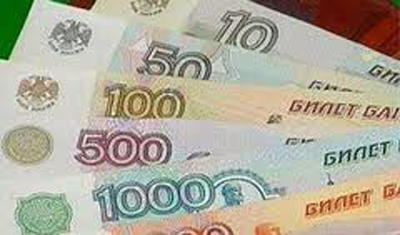
 LONDON: The Russian rouble fell 0.7 percent to another record low against the dollar on Tuesday despite central bank interventions, remaining the main outlier in the generally steady emerging markets asset class.
Most emerging assets were rangebound ahead of a meeting of the U.S. Federal Reserve which is widely expected to end its six-year money-printing programme on Wednesday. But the overall bias was firmer, helped by Chinese markets and a conviction that the Fed is in no hurry to raise its rock-bottom interest rates.
Emerging stocks rose 0.7 percent, thanks to a 2 percent rise in Shanghai, while Hong Kong rebounded 1 percent on hopes of reforms to state-run firms. Most emerging European shares also rose, tracking Western European bourses which were buoyed by a string of robust company results.
Russian shares also gained 0.4 percent but the positive sentiment did not extend to the rouble, which tanked 0.7 percent despite central bank interventions to steady it and expectations that the bank will raise interest rates by 50-100 basis points on Friday.
The Russian currency has lost 22 percent against the dollar so far this year, even though the central bank has spent around $20 billion in October alone to stabilise it.
"Markets see rouble depreciation as a one-way bet and that authorities have only limited willingness to spend reserves," said Manik Narain, a strategist at UBS.
"Markets perceive it as (only) a matter of time before the free float comes and second, there are concerns about December when there is a big external repayment hump of around $30 billion."
Most analysts expect Russia to raise rates by 50 bps but interest rate futures markets are pricing in 100 bps. However options markets suggest there will be no relief, with one-month rouble volatility, a gauge of expected swings in a currency, rising to 15.7 percent, the highest since June 2012.
Risk reversals - a gauge of demand for options betting on a currency's rising or falling - show a growing bias for dollar strength versus the rouble. One-month risk reversals on the rouble show the highest bias in favour of the dollar in more than two years.
On other regional emerging markets, Hungary's forint was near a 10-day low versus the euro before a central bank meeting that is expected to leave interest rates at 2.10 percent. The Nigerian naira slipped 0.3 percent, under pressure from weak oil prices.
Greek stocks fell 3 percent from 10-day highs as several Greek banks are among those named as failing landmark health tests conducted by the European Central Bank.
Earlier in Asia, the Indonesian rupiah fell 0.7 percent as concerns grew about possible delays to government plans to tackle fuel subsidies.
Some analysts view this as a possible spillover from the Brazil election outcome, when voters rejected a pro-reform candidate in favour of leftist incumbent Dilma Rousseff.
Brazilian financial markets had a torrid day on Monday but looked set for a modest rebound, with the London-listed Brazil exchange traded equity fund (ETF) rising 2 percent after a 10 percent fall in the previous session. A Tokyo-listed Brazilian ETF also rose 1.7 percent.

























Comments
Comments are closed for this article.